Get in touch: +1 888 453 5021





The vet school interview is where most competitive applicants miss out on easy points. I've seen thousands of students with near-perfect GPAs and hundreds of clinical hours walk out of an interview wondering what went wrong.
The problem is almost never a lack of qualifications. It's a lack of preparation for how interviewers actually evaluate you.
After speaking with our top veterinary admissions counselors, the one thing that's clear is this: Admissions committees score you against specific competency domains, not on whether you give the "right" answer. Candidates who understand that simple distinction walk in with structured responses tied to real experiences. Candidates who don't end up rambling through answers that sound impressive on the surface but miss every criterion the evaluator uses to measure good answers.
The questions and sample answers below are built around what interviewers actually score so you can prepare for your vet school interview with precision instead of guesswork.
Panelists in vet school interviews ask questions designed to prompt you to think critically about the process of becoming a veterinarian. By familiarizing yourself with these interview questions early in your application timeline, you can walk into your interview feeling confident and ready to shine.
Lead with the specific moment or experience that shifted your interest in becoming a veterinarian from casual to serious. Interviewers hear vague passion statements all day. What they remember are candidates who can point to a concrete turning point and explain how it shaped their professional direction.
Name the type of veterinarian you want to become. Saying "I want to be a vet" tells the admissions committee nothing. Saying "I want to specialize in shelter medicine because I spent two years volunteering at a high-intake facility" tells them exactly what they want to hear. Specificity signals that your motivation comes from exposure, not fantasy.
Stay honest and confident without overselling. Admissions committees are trained to spot inflated narratives. Ground your answer in real experiences and let the stories do the heavy lifting.
Connect every claim about yourself to a specific experience that proves it. Saying "I'm empathetic" means nothing on its own. Describing a moment where your empathy changed the outcome of an interaction with an animal or client makes it real.
Cover three areas in your answer:
Candidates who lean too heavily on one area leave noticeable gaps in their answers. Balance all three to prove you understand how demanding the profession actually is.
Vet school is a four-year commitment with clinical rotations, emotional strain, and intense academic pressure. The admissions committee needs to see that you have the stamina and self-awareness to sustain your performance throughout.
Treat the question as a two-minute highlight reel, not a biography. Pick three or four experiences that, together, paint a picture of who you are, what drives you, and where you're headed. Everything you mention should connect back to your readiness for veterinary school, even if the experience itself happened outside a clinical setting.
Open strong. The first sentence sets the tone for the rest of the interview. A specific moment or experience pulls the interviewer in faster than a generic "I've always loved animals" opener.
Include something beyond academics and clinical work. A hobby, a leadership role, and community involvement can add dimension to your profile and give the interviewer something memorable to associate with your application. Keep the connection to veterinary medicine clear but not forced.
Prioritize breadth and variety over total hours logged. A candidate with 200 hours split across a small-animal clinic, a dairy farm, and a wildlife rehabilitation center tells a stronger story than someone with 1,000 hours in a single setting.
Focus on professional and structured experiences, such as:
Pet sitting and personal pet ownership count as supporting detail, not the foundation of your answer.
For each experience, name one specific thing you learned or observed that shaped your understanding of veterinary medicine. Interviewers want to hear that you paid attention during your clinical hours, not just that you showed up. Describe what you saw, what surprised you, and how it influenced the kind of veterinarian you want to become.
Acknowledge the real challenges up front. Compassion fatigue, euthanasia conversations, long hours, and emotionally distressed clients are daily realities in veterinary practice. Interviewers need evidence that you have thought about these pressures before encountering them in a clinical rotation.
Use a specific example from your own life where you faced adversity and worked through it. The example doesn't need to come from a veterinary setting. What matters is the structure of your response:
Highlight your support systems. Referencing mentors, peers, professional resources, or self-care strategies shows the kind of sustainable coping approach admissions committees actively look for.
Go beyond stating that you have strong ethics. Every candidate says that. What interviewers want to hear is how you apply ethical reasoning when the right answer isn't obvious.
Pull from a real situation where you had to weigh competing interests. Maybe you observed a clinical decision that made you uncomfortable. Maybe you had to choose between what was easy and what was right during a volunteer shift. Concrete examples carry 10 times the weight of abstract statements.
Address how you plan to stay ethically grounded as a practicing veterinarian. Mention continuing education, peer consultation, or structured ethical reflection as tools you intend to use. Framing ethics as an evolving practice rather than a fixed personality trait shows intellectual maturity and self-awareness.
Choose an example with genuine tension. The best answers involve a real disagreement, an emotionally charged interaction, or a situation where you had to hold a boundary under pressure. Mild inconveniences don't demonstrate the conflict-resolution skills interviewers are evaluating.
Structure your answer using a clear sequence:
Vague or disorganized answers lose the interviewer before you reach the resolution.
Focus on how you handled the human side of the situation. Staying calm, listening actively, educating without condescending, and offering alternatives are the behaviors interviewers want to see. The outcome matters less than the process you used to get there. A situation that ended imperfectly but was handled with professionalism and empathy can still score well.
Animal welfare focuses on ensuring humane treatment and minimizing suffering within systems that use animals. Animal rights advocates argue that animals have inherent rights and should not be used by humans at all.
Go beyond the definitions. Interviewers expect you to offer your own interpretation of how these two frameworks intersect and diverge, especially in the context of veterinary practice. Think about how each philosophy applies to topics such as euthanasia, food-animal production, research protocols, and exotic-pet ownership.
Take a clear position without being rigid. Admissions committees penalize vague neutrality just as much as inflexible absolutism. Show that you can deal with moral complexity and articulate a thoughtful perspective that acknowledges competing values.
Interviewers ask about finances because new veterinary graduates averaged $174,484 dollars of debt in 2025. Candidates without a financial strategy face a higher risk of stress, burnout, and attrition.
Name the specific funding sources you've pursued or plan to pursue:
Vague references to "exploring options" show you haven't done the research.
If you've earned merit-based scholarships or awards, mention them. Academic funding demonstrates both financial planning and the achievement that earned it. Treat the question as an opportunity to show the committee that you approach veterinary school as a serious investment with a plan behind it, not just a dream you'll figure out financially once you arrive.
Interviewers use this question to evaluate how you balance compassion for the animal with respect for the client's financial reality. There is no single correct answer. What matters is your ability to think through a difficult clinical scenario without defaulting to judgment or oversimplification.
Frame your answer around a spectrum-of-care approach. Strong candidates present multiple treatment tiers rather than a single gold-standard recommendation and then explain how they would guide the client through each option with clarity and empathy.
If you've observed a veterinarian navigate an affordability conversation in practice, describe what you saw and what you learned from it. Real clinical observations carry far more weight than hypothetical reasoning.
If you lack direct experience, walk through your thought process step by step and show the interviewer how you'd approach the conversation, what options you would present,
If you want to prepare for even more common veterinary school questions, take a look at the video below:
Most vet school interview questions link back to one or more AAVMC competency domains. Recognizing which domain a question targets helps you structure answers that hit exactly what the interviewer is scoring.
Below are 25 common questions organized by category so you can prepare strategically rather than memorizing responses at random.
These questions assess whether you understand what you're signing up for. Interviewers aren't looking for passion alone. They want evidence that your motivation is grounded in realistic exposure to the profession and honest self-assessment.
Vague answers about "loving animals since childhood" will not differentiate you from thousands of other candidates who feel the same way. Anchor every response in a specific experience.
Ethics questions are those in which interviewers ask about uncomfortable situations. Admissions committees need to see how you reason through morally complex situations, not whether you land on the "right" answer.
Strong candidates acknowledge competing values, explain their reasoning framework, and avoid absolutist positions. Weak candidates either dodge the tension entirely or default to a rehearsed stance without engaging with the complexity.
These questions test whether you understand veterinary medicine beyond the exam room. Interviewers want to hear you connect your clinical experience to broader themes such as the human-animal bond, public health, and emerging challenges in the profession.
You don't need encyclopedic knowledge. You need to show that you pay attention to where the profession is heading and can think critically about its direction.
Communication competency is one of the four AAVMC domains that interviewers weigh most heavily. These questions evaluate whether you can adapt your language to different audiences, deliver bad news with empathy, and navigate emotionally charged clinical moments.
Rely on real experiences whenever possible. If you haven't yet had a direct conversation with a grieving pet owner, be transparent about that and describe how you would approach it based on what you've observed.
Veterinary practice runs on collaboration. Solo-practitioner romanticism won't serve you in an interview. Interviewers want specific examples of how you've contributed to a team's success and how you've stepped into leadership when the situation called for it.
The strongest answers demonstrate leadership in one context and support in another. Demonstrating that you know when to step forward and when to step back is more impressive than a single heroic leadership story.
These questions tie directly to Domain 7 of the AAVMC framework: Professionalism and Professional Identity. Interviewers ask about stress because veterinary students face some of the highest rates of burnout and mental health challenges in any health profession.
Answers that boil down to "I just push through" are red flags. Committees want to hear that you have concrete, sustainable strategies for managing pressure and that you recognize when you need support.
Most applicants overlook this category entirely, which makes it an easy place to stand out. The AAVMC dedicates an entire domain to business acumen for a reason.
Veterinarians make financial decisions daily that affect patient outcomes, client relationships, and practice viability. Showing awareness of the economic realities facing both pet owners and practices shows a level of professional maturity that admissions committees value highly.
Our vet school admissions support provides you with the best veterinary school interview guidance to ensure you stand out in your interview. Work with an expert at Inspira Advantage with over 15 years of experience helping applicants prepare for their veterinary school interviews.
Vet schools evaluate you against a defined competency framework. The Association of American Veterinary Medical Colleges (AAVMC) created the Competency-Based Veterinary Education (CBVE) framework around nine domains of competence containing 32 individual competencies. Most accredited programs in the U.S. align their admissions criteria to these nine domains.
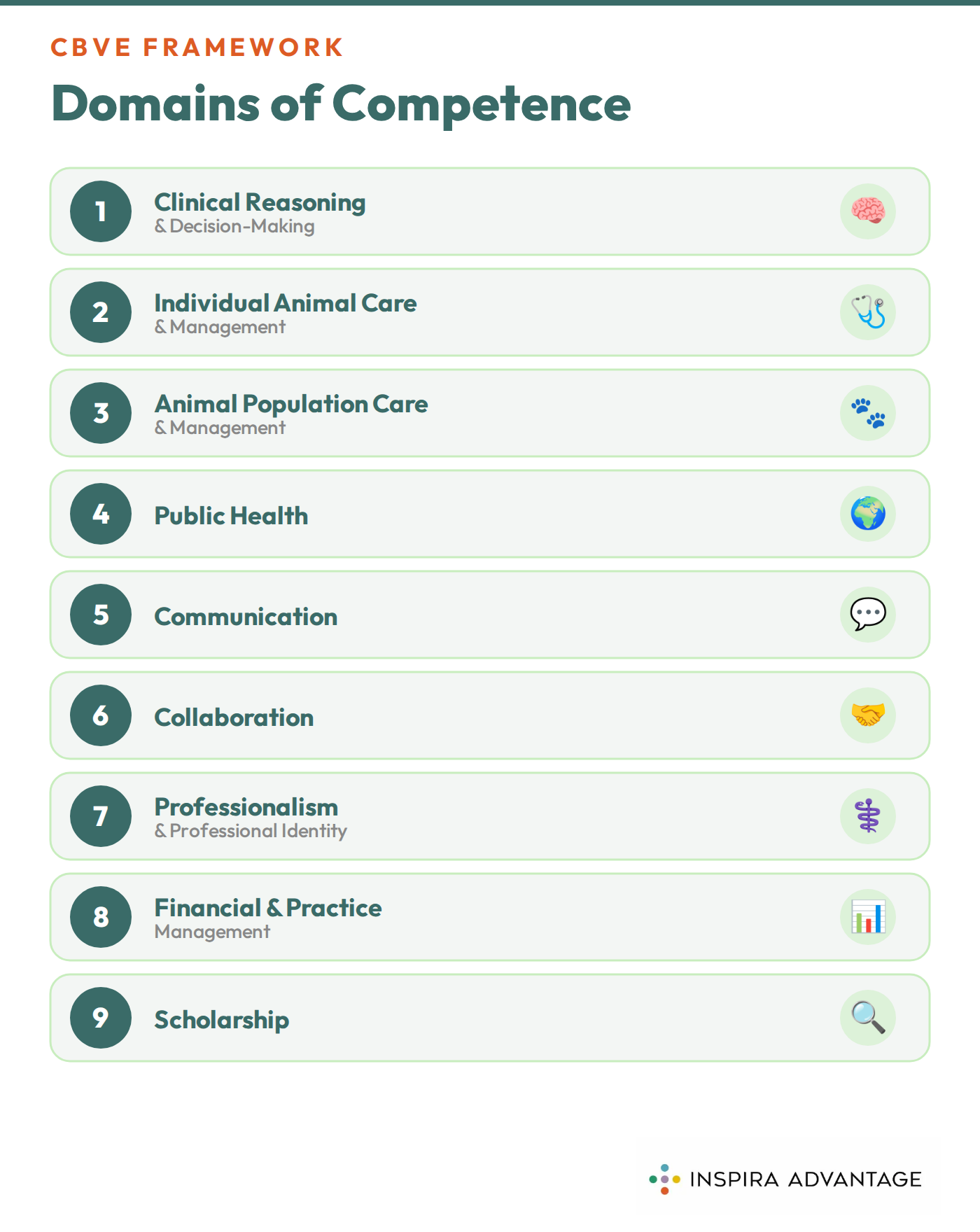
I've spoken with several former vet school admissions officers on our team who interviewed candidates, and one pattern is evidently clear. Average applicants answer questions by listing what they've done. Strong applicants answer questions by explaining how what they've done shaped the way they think.
Think of it this way: Two candidates can describe the exact same shelter volunteering experience, but the one who explains how it changed their approach to client communication scores twice as high as the one who simply regurgitates the tasks they performed.
The competency framework below explains exactly what evaluators measure at each stage of the interview so you can stop guessing what they want to hear and start showing them how you think.
Not all nine AAVMC domains are equally represented in interviews. Four domains generate the majority of interview questions across vet programs:
Broad clinical exposure gives you a significant advantage because it supplies real stories that connect directly to AAVMC competency domains. A candidate with only small-animal clinic hours will struggle to answer questions about population health, biosecurity, or public health. Someone who has also worked on a dairy farm, assisted with wildlife rehabilitation, or shadowed an equine vet can demonstrate adaptability across multiple domains with specific examples.
In our webinar on preparing for vet school interviews, Catherine Aaronson, an expert counselor at Inspira Advantage who earned her veterinary degree from Iowa State University's College of Veterinary Medicine, shares her insights on clinical experience.
"I spent my whole life thinking that I was going to do small animal ... and then I just tried working with horses and I loved it," she says. "Who's to say that I'm going to get into vet school and fall in love with production animal medicine? I see myself doing this right now but I'm open to other experiences, which is ultimately what admissions officers want to hear."
Aaronson points out that interviewers can see being too rigid (e.g., "I will only ever be a feline vet") as negative. Evaluators prefer candidates who acknowledge that vet school is a transformative process and are excited to explore the breadth of multiple clinical experiences.
Interviewers notice when every example comes from the same setting. Pursue varied placements before your interview cycle begins. Even 40 to 50 hours in an unfamiliar environment gives you enough material to answer unexpected questions with confidence and specificity. Diversity of experience signals readiness in ways a single long-term placement never can.
Getting into vet school is very competitive. The best way to stand out is by having unique differentiators that set you apart from others.
In our webinar on preparing for vet school interviews, Dr. Caitlin Passoro, a graduate of North Carolina State University's veterinary program and expert advisor at Inspira Advantage, explains what leaves the best impression on your interviewers:
"It's important to explain why you're unique because that's what's going to leave the lasting impact," she says. "If you have different cultural experiences, if you are bilingual or trilingual, if you did a really cool unique job ... find a way to incorporate that into whatever questions that they ask you so that you can stick out in their mind and that you're not going to just blend in with the other thousand applicants."
Passaro explains that since most applicants have similar "standard" veterinary hours and prerequisites, you should always find a way to include your personal quirks and diverse professional background into your responses to remain memorable.
Ask questions that show how you think, not just that you prepared. Every question you pose signals what you value as a future veterinarian. Generic questions like "What do you like most about your program?" waste your final opportunity to demonstrate the competencies admissions committees just spent an hour evaluating.
Strong candidates use their questions to show genuine engagement with the school's curriculum, clinical philosophy, and professional development approach. Weak candidates ask questions that can be easily answered through a simple web search and read them off like a script.
Anchor your questions to the Clinical Reasoning and Decision-Making domain by asking about how the program teaches diagnostic thinking and handles clinical uncertainty:
Avoid asking about specific courses or class schedules. You can find that information on the website. Ask about the thinking behind the curriculum instead.
The Collaboration domain covers teamwork, leadership, and inclusivity. Use your questions to demonstrate that you already think about veterinary medicine as a team-based profession rather than a solo practice:
Veterinary programs take student well-being seriously because the profession's mental health statistics demand it. Asking about wellness resources is not a red flag. Avoiding the topic entirely is.
Some questions actively hurt your candidacy. Avoid anything you could answer with a five-minute website visit, like class size, tuition, or application deadlines. Asking about ranking or prestige compared to other programs puts the interviewer in an awkward position:
Never ask about how easy or hard it is to pass. Questions about surviving the program instead of thriving in it leave the wrong impression and signal a lack of confidence. Skip salary and the earning potential questions entirely. Save those conversations for career services after you've been admitted.
Freezing during an interview doesn't end your chances of getting into vet school. Every admissions committee member has watched strong candidates lose their train of thought mid-answer. What separates the candidates who recover from the ones who spiral is the ability to pause, reset, and re-engage without apologizing their way through the next two minutes.
Your brain freezes when it tries to retrieve a rehearsed answer and can't find it. The fix is to stop searching for the "perfect" response and start talking through your actual thought process instead. Interviewers score how you think, not whether you deliver a flawless response.
Pause and take a breath. Silence feels longer to you than it does to the interviewer. Two or three seconds of quiet while you collect your thoughts reads as composure, not failure.
Use a bridging phrase to fill the gap while your brain catches up. Say something like "Let me take a moment to think about that" or "I want to make sure I give you a thoughtful answer." Both phrases buy you real time while signaling that you care about the quality of your response. Rushed, panicked filler does the opposite.
Avoid apologizing repeatedly. Saying "Sorry, I'm so nervous" once is human. Saying it three times shifts the interviewer's focus from your answer to your anxiety. Acknowledge the pause once if needed; then move forward.
Think about the most concrete detail you can access. A specific animal, a specific clinic, a specific moment from your experience. Concrete details pull the rest of your answer forward naturally because your brain recalls stories more easily than abstract talking points.
In our vet school interviews webinar, Dr. Clara Marie Young, a graduate of Iowa State University College of Veterinary Medicine and an experienced counselor at Inspira Advantage, provides her expertise on what to do if your mind goes blank:
"I start with honesty," she says. "So, if I was asked a question in an interview about a topic that I was not familiar with, I would say 'To be honest, I'm not the most familiar with what your question poses, but here is my response to what I did take away from your question.' It's basically a redirection with an acknowledgement."
If you prepared anchor stories from your clinical, volunteer, and academic experiences, default to the one closest to the question's topic and reshape it to fit the question. You don't need to match the question perfectly. Starting somewhere real is always better than staring in silence, waiting for the ideal answer to materialize.
You can also restate the question in your own words before answering. Saying "So you're asking about how I've handled conflict in a team setting" gives your brain a few extra seconds to organize a response while showing the interviewer that you understood the prompt. From there, pick one experience and walk through it step by step.
Sometimes, the freeze happens because you legitimately have no answer. Maybe the interviewer asks about a topic you haven't encountered or a clinical scenario outside your experience. Trying to bluff through a knowledge gap is one of the fastest ways to lose credibility.
Say so directly: "I haven't encountered that situation yet, but here's how I would approach it." Then walk the interviewer through your reasoning. Explain what information you'd gather, who you'd consult, and how you'd work toward a decision with incomplete knowledge.
Admissions committees evaluate whether candidates can recognize the limits of their own knowledge and seek help when needed. Acknowledging what you don't know and describing how you would close that gap is a stronger answer than a fabricated one. Interviewers can tell when you're guessing. They respect when you're honest and show a clear process for finding the right answer.
If you need professional advice on how to ace your vet school interviews, take a look at the video below:
Strong vet school interview performance comes from structured, repeated practice over time, not a last-minute cram session.
Your preparation should cover three areas:
Neglecting any one of these creates a visible gap interviewers will notice.
Read beyond the admissions page. Pull up the program's curriculum structure, clinical rotation options, research focus areas, and any recent news about faculty hires or facility expansions. Look for details that connect to your own interests so you can reference them naturally during the interview rather than reciting facts from the website.
Check whether the school uses a traditional panel interview, a Multiple Mini Interview (MMI) format, or a combination. Panel interviews reward longer narrative answers. MMIs require quick, structured responses at timed stations covering ethics, communication, problem-solving, and teamwork. Knowing the format in advance lets you practice the right way.
Review the school's mission statement and values. Programs with a strong rural or community focus will ask different questions than programs emphasizing biomedical research. Align your talking points to the school's priorities without fabricating interests you don't actually have. Interviewers can spot a generic answer tailored five minutes before the interview.
Prepare five to seven detailed stories from your clinical, academic, volunteer, and personal experiences. Each story should include a specific setting, a challenge or decision point, the action you took, and the outcome or lesson. These become your anchor stories, a mental library you can pull from regardless of how a question is phrased.
Choose stories that cover a range of competencies. You need at least one story each for:
Gaps in your story library become gaps in your interview performance.
Practice reshaping the same story to answer different questions. A single experience volunteering at a shelter could answer "Tell me about a time you worked on a team," "Describe a difficult client interaction," or "How do you handle stress?"
The ability to adapt one story to multiple prompts prevents you from going blank when a question doesn't match your rehearsed list exactly.
Rehearse verbally, not in your head. Silent review builds familiarity with content but does nothing for the verbal fluency you need under real interview pressure. Say your answers out loud at full volume. The physical act of speaking engages a different part of your memory than reading ever will.
Record yourself on camera and review the footage. Watch for filler words, pacing issues, eye contact habits, and moments where your answer loses focus. The discomfort of watching yourself stumble in practice is what prevents you from stumbling during the real interview.
Run at least two full mock interviews with someone who will push back, interrupt, or ask unexpected follow-up questions. A friend reading questions from a list in a relaxed setting creates a false sense of readiness.
You need practice recovering from curveballs and thinking on your feet. Ask a pre-vet advisor, a mentor, or a veterinarian you've shadowed to conduct the mock interview if possible. Their follow-up questions will be far more realistic than a peer's.
Send a thank-you letter within 24 hours of your interview. A well-written follow-up reinforces your professionalism and keeps your name fresh in the interviewer's memory during a cycle in which they evaluate dozens of candidates back to back. Skipping the thank-you letter won't disqualify you, but sending a thoughtful one gives you an edge that costs only 15 minutes of effort.
Email is the standard format. Send your email the same evening or the following morning, while the conversation is still fresh for both you and the interviewer.
Open with a direct thank you for the interviewer's time and for the opportunity to learn more about the program. Keep the opening to one or two sentences. Don't over-explain how grateful you are.
Reference one specific moment from your interview. Maybe the interviewer described a clinical rotation that aligns with your interests or a conversation about the school's approach to spectrum-of-care medicine stood out to you. Naming a specific detail shows you were engaged and listening, rather than sending a copy-and-paste template to every school on your list.
Connect that detail to your own goals or experience in one to two sentences. If the interviewer mentioned the school's shelter medicine partnership, explain briefly why that excites you based on your own shelter volunteering background. The connection should feel natural and concise, not forced into a second personal statement.
Close by reaffirming your interest in the program and your enthusiasm for the possibility of joining the incoming class. End cleanly. Do not ask about your application status, timeline, or chances of admission.
Your thank-you letter to your vet school should be between 100 and 150 words. Admissions committees and interviewers read these quickly between sessions. A short, specific message lands better than a long, generic one.
The ideal structure is three paragraphs. This includes a thank-you opening, a personalized middle paragraph referencing your interview, and a brief closing that reaffirms your interest.
Anything beyond that starts working against you. The thank-you letter is a professional courtesy, not a second application essay.
Subject: Thank You for the Interview Opportunity
Dr. Morrison,
Thank you for taking the time to speak with me today about the Cornell DVM program. I appreciated the opportunity to learn more about the program's approach to veterinary education and to share my own background with you.
Our conversation about the integrated clinical rotation model starting in the second year stood out to me. My experience working across small-animal and equine settings during my gap year has made me especially eager to train in a program that prioritizes early clinical exposure across species.
I'm excited about the possibility of joining the Cornell community and contributing to the program. Thank you again for your time and consideration.
Sincerely,
Jordan Ramirez
jordan.ramirez@email.com
(555) 814-2390
A vet school interview typically lasts between 15 and 45 minutes, depending on the format. Traditional panel interviews tend to run 20 to 30 minutes with a single group of interviewers asking questions in sequence. MMIs spread the evaluation across six to 10 stations, each lasting five to eight minutes, so your total interview time can reach 60 to 90 minutes, including transitions. Check your interview invitation for the specific format and time commitment so you can plan your energy and preparation accordingly.
Bring a valid photo ID, a printed copy of your application, and a professional folder or portfolio to hold your documents to your vet school interview. Some programs require additional paperwork, such as proof of prerequisite completion or vaccination records, so review your interview invitation carefully for any school-specific requirements. Pack a water bottle and a small snack in case of delays between sessions. Leave your phone on silent and stored out of sight before the interview begins so it never becomes a distraction.
Structure every answer using a clear beginning, middle, and end in your vet school interview. Open with a direct, one-sentence response to the question; then support it with a specific example from your clinical, academic, or personal experience. Walk the interviewer through what happened, what you did, and what you learned. Close with a brief takeaway that connects the experience back to your readiness for veterinary school. Keeping each answer under two minutes prevents rambling and gives the interviewer space to ask follow-up questions.
You can and should discuss weaknesses when asked about them directly in your vet school interview. Choose a real weakness you've actively worked to improve rather than disguising a strength as a flaw. Describe the specific steps you took to address the weakness and the measurable progress you made. Interviewers ask about weaknesses to evaluate self-awareness and growth mindset, not to disqualify you. A candidate who names a genuine challenge and explains how they overcame it demonstrates more maturity than someone who claims to have no weaknesses at all.
Research the vet school's curriculum structure, clinical rotation options, faculty research areas, and any unique program features before your interview. Review whether the school uses a traditional panel interview, an MMI format, or a combination so you can tailor your practice sessions to the right structure. Read the program's mission statement and recent news to identify values and priorities you can reference naturally during conversation. Preparing school-specific talking points proves to the interviewer that you chose their program deliberately rather than applying broadly and hoping for the best.
Dr. Jonathan Preminger was the original author of this article. Snippets of his work may remain.


.svg)


