Get in touch: +1 888 453 5021


Regardless of format, every dental school interview evaluates the same core question: Can you handle the human side of clinical care?
Both traditional panels and Multiple Mini Interview (MMI) stations test:
Dr. Helina Tessema, an expert advisor at Inspira Advantage and a graduate of Tufts University School of Dental Medicine, who reviewed applications and conducted interviews for the program, frames the evaluation this way in our dental application process webinar:
"Being a dentist is being in someone's chair and being taken care of,” she says. “A lot of people do have dental anxiety, a lot of people do have fear of going to the dentist. So how do you get them to be comfortable in your chair and have them build trust with you? That's the kind of stuff that you're not going to get from biochemistry."
Dr. Tessema's point describes the entire purpose of dental school interviews. They’re meant to get a better understanding of you. Your academic credentials looked impressive on paper. Now it’s time to truly stand out in your interview.
Start your interview preparation by understanding exactly what you're preparing for. Dental schools use different interview formats, and practicing for a 30-minute traditional panel when your school uses eight MMI stations wastes critical prep time.
Check your interview invitation email first. Most schools outline the format, schedule, and logistics directly. If it doesn’t, search the school's admissions page for descriptions of the interview day.
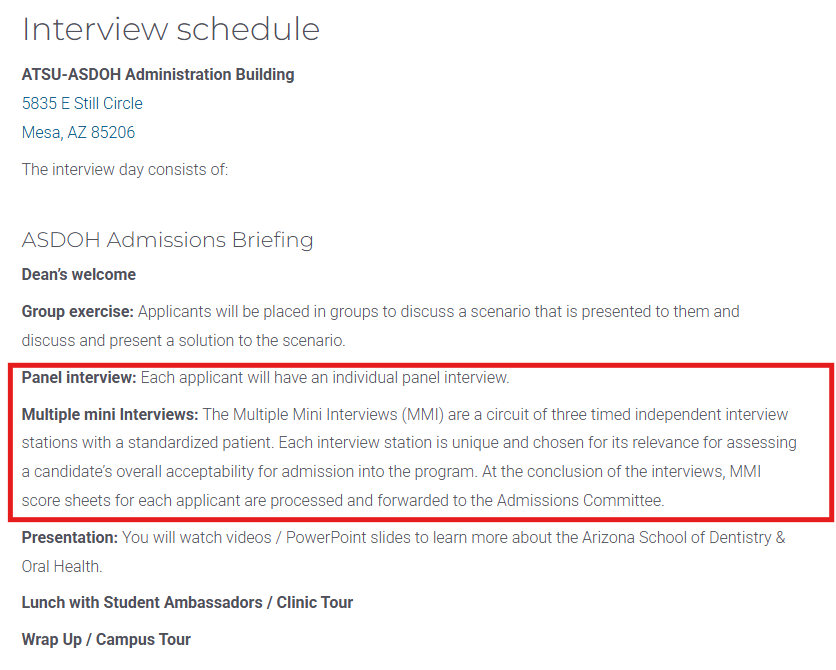
When researching, find answers to these specific questions:
Structure your entire interview preparation plan around these answers. A student interviewing at a school with 10 MMI stations needs to practice rapid-fire, timed responses to unfamiliar prompts. A student facing a 30-minute traditional panel needs to develop three to four core stories that they can adapt to different behavioral questions.
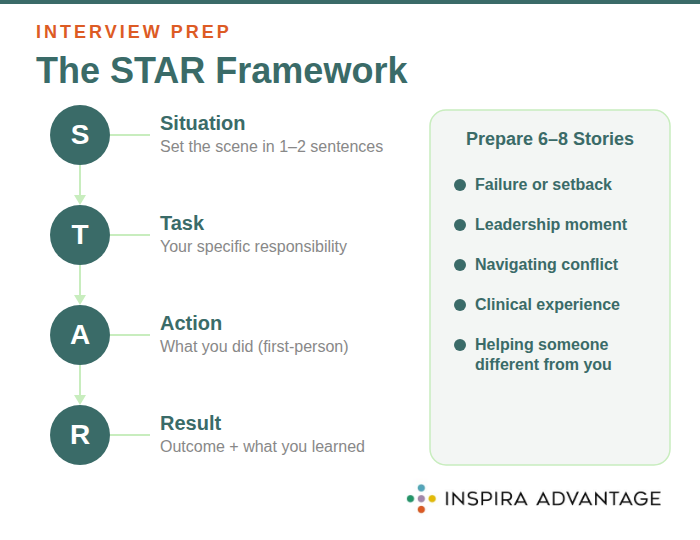
The biggest gap between applicants who ramble and applicants who impress admissions interviewers is having a proper structure. You don't need better stories. You need a repeatable framework that organizes any story into a clear, compelling response under pressure.
The STAR method gives you that structure:
Prepare six to eight STAR-formatted stories before your interview. Your set of stories should cover these categories:
You might not use every story in every interview. But being fully prepared reduces your chances of being caught off guard.
MMI ethical stations work differently from traditional interview questions. Before entering each station, you get 1 to 2 minutes outside the door to read a printed scenario — a hypothetical dilemma with no objectively correct answer. Once inside, the interviewer asks you to walk through your reasoning, then often pushes back with follow-up questions or plays a role in the scenario.
To answer these questions effectively, use a four-step ethical reasoning framework:
Practice this framework on scenarios you've never seen before. Have a friend read you a prompt, give yourself two minutes to organize your thoughts, and then respond for six minutes. The discomfort of thinking on your feet with an unfamiliar problem is exactly the skill you need to refine to perform well in your interview.
Reading sample questions and mentally rehearsing answers feels productive, but doesn't simulate the actual stress of speaking to an evaluator. Your preparation needs to include out-loud, timed, in-front-of-another-person practice to be effective.
Schedule at least three full mock interviews before your real one. Use different mock interviewers each time, such as:
Each person should catch a different weakness. Your advisor might notice that you break eye contact when you're uncertain. Your friend might point out that you start every answer with "So basically ..."
Record at least one mock session on video. Watching yourself speak shows habits you can't understand in the moment, like:
Review the recording using a specific checklist rather than passively watching.
Inspira Advantage’s dental school admissions advisors provide structured mock interview sessions. Our experts, many of whom are former dental school admissions officers, can help you prepare the best answers to stand out.
For MMI preparation, simulate the station rotation. Set a timer for two minutes of reading and thinking, then six minutes of speaking. Then move to the next prompt. Practice five to eight stations in sequence without long breaks between them. The only way to practice properly is through repetition.
Generic answers about "wanting to help people" don't distinguish you from the thousands of other applicants. Admissions committees evaluate whether you fit their program, not just whether you'd make a good dentist somewhere.
In our dental school interview webinar, Herchel Patel, who studied at the University of Michigan School of Dentistry and has years of admissions counseling experience at Inspira Advantage, describes what admissions committees look for in competitive applicants:
"They want to pick someone who actually knows their stuff about their school,” he says. “If you're going to be attending a school, you definitely want to know how it works, what their curriculum is like, what the class culture is like, what the clinic looks like, and what the interactions are that take place daily between professors and students."
Herchel's advice means that if you can find the answer on the school's website in under 30 seconds, don't ask it in the interview. Demonstrate that you already know it and ask your questions from there. Before each interview, research these specifics:
Ask questions that prove your research. For example, asking "Can you tell me more about how the community oral health outreach program selects student participants?" signals genuine interest. Asking "What's your student-to-faculty ratio?" signals you didn't look at the website.
Every interview includes at least one question designed to catch you off guard. Maybe it targets:
How you respond to these difficult questions tests your integrity more than your response.
In our dental school interviews webinar, Patel explains the admissions committee's perspective when it comes to difficult questions:
"They have a very honest nature, and they really don't want to see anyone lying,” he says. “Even if it's a bad quality they're asking about, just say it to them. Because at the end of the day, they would much rather you just come up to them and say, 'Yeah, I did have this mistake, but this is how I learned.'"
Patel reinforces that you should prepare honest, growth-oriented answers for every vulnerable spot in your application before interview day.
For example, if your GPA decreased in your sophomore year, know the reason why and what you changed to remedy it. If you switched career paths, talk about the specific moment that redirected you toward dentistry. Rehearse these answers out loud so the delivery feels natural rather than defensive.
Acknowledge what happened, explain what you did about it, and connect the growth to how you'll show up as a dental student. Interviewers don't expect perfect applicants. They expect future dentists who can own up to mistakes and adapt, because that's exactly what patient care demands.
Preparation quality decreases when logistics create last-minute stress. Eliminate every variable you can control well before interview day.
Confirm your travel and accommodation at least two weeks in advance. If the interview requires a flight, arrive the evening before, not the morning of. Lay out your outfit the night before and choose professional attire you've already worn and feel comfortable in. New clothes that fit awkwardly will distract you.
Bring printed copies of your application, a list of your prepared questions for the school, and a pen. Eat a real breakfast. Arrive 20-30 minutes early. Use the extra time to:
Plan your post-interview follow-up in advance. Draft a thank-you email template before interview day so you can personalize and send it within 24 hours while specific details are still fresh. Reference a particular conversation or moment from the interview to show the admissions committee that you were fully engaged the entire time.
For even more expert tips, watch the video below about the entire dental school interview process. Our admissions counselors offer valuable tips to help you prepare for interview day.
Use this checklist to track your progress through each phase of dental school interview preparation:
Each response below follows a structured reasoning approach, and the analysis breaks down the reasons why each response is effective.
This question opens most traditional interviews, and applicants consistently overthink it. The interviewer doesn't want your life story. They want a 90-second narrative arc that connects who you are, why dentistry, and why you're sitting in that chair today.
"I grew up in a small town in eastern Tennessee where the nearest dentist was a 40-minute drive. For most families in my community, dental care was something you dealt with only when the pain got bad enough. I watched my grandmother lose most of her teeth by age 60 — not because she didn't care, but because access and cost made prevention almost impossible.
That experience pulled me toward public health early. I majored in biology at UT Knoxville, but I also volunteered with Remote Area Medical clinics starting my sophomore year. During one weekend dental blitz, I assisted a dentist who extracted 11 teeth from a single patient. She looked at me afterward and said, 'Every one of these was preventable.' That moment shifted my focus from general healthcare to oral health specifically.
Since then, I've logged over 200 shadowing hours across general dentistry, pediatrics, and oral surgery. I've also spent two years as a peer health educator, which taught me how to explain complex topics to people who are scared and skeptical. I'm applying to your program because your community clinic rotation aligns directly with the kind of dentistry I want to practice — reaching patients who've fallen through the gaps in the system."
Every applicant expects this question. Few answer it in a way that actually stands out. The mistake most candidates make is describing what dentistry is rather than explaining the specific experience that made dentistry feel inevitable for them.
"My path to dentistry started in an orthodontist's chair when I was 14. I had a severe crossbite that affected my speech and made me dread eating in front of other people. Over 18 months of treatment, I watched my orthodontist solve what felt like an unsolvable problem — and I experienced firsthand how oral health shapes someone's confidence and daily life.
That personal experience motivated me, but shadowing confirmed that dentistry was the right fit. I spent a summer working with a general dentist at a community health center, where most patients hadn't seen a provider in years. What struck me wasn't the clinical complexity — it was the relationships. Dr. Navarro knew every patient's name, their kids' names, and their fears. One patient told me she only came back because 'he's the first dentist who never made me feel stupid for waiting so long.' I want to build that kind of practice.
I also explored other health professions to make sure. I shadowed a physician and a physical therapist, and while I respected both fields, neither offered the combination that draws me to dentistry — the immediate, tangible impact of restoring function, the long-term patient relationships, and the autonomy to run a practice that reflects my values."
Interviewers ask this question to test your commitment to dentistry. They want to see whether you can articulate what makes dentistry specifically the right pathway for you.
"Social work is meaningful work, and I respect the profession deeply. But my drive isn't just to help people in general. It's to help people through a specific skill set that combines clinical problem-solving with hands-on care and long-term patient relationships.
For me, what dentistry offers that social work doesn't is the ability to diagnose a problem, physically treat it with my own hands, and see the result in real time. During my shadowing with Dr. Pham, I watched him place a same-day crown on a patient who had been hiding her smile for 3 years because of a fractured front tooth. She looked in the mirror and started crying. That moment captured exactly why I chose this profession: the intersection of technical precision and immediate human impact.
I also want the autonomy to shape how care is delivered. My long-term goal is to open a practice in an underserved area where I can set the culture—sliding-scale fees, Spanish-speaking staff, and a space that feels welcoming rather than clinical. Dentistry gives me the clinical training and the business framework to build that from the ground up."
Admissions committees ask this question to evaluate whether you've thought seriously about your career trajectory or whether you're focused on getting accepted without any vision beyond that. A strong answer demonstrates ambition, specificity, and alignment with the school's strengths.
"In 10 years, I see myself as a practicing pediatric dentist running a clinic that specializes in treating children with special healthcare needs. My younger brother has autism, and I've watched my family struggle to find dental providers willing to adapt their approach for patients with sensory sensitivities. That care gap is personal to me, and I want to fill it.
Clinically, I plan to pursue a pediatric dentistry residency after dental school, with a focus on behavioral management techniques for neurodiverse patients. I also want to contribute to research on how sensory-adapted dental environments affect treatment compliance in children with autism spectrum disorder. Your school's partnership with the children's hospital gives me direct exposure to that patient population during training, which is one of the main reasons I applied here.
Beyond the clinic, I want to train other providers. Most general dentists receive minimal education on treating patients with developmental disabilities, and I'd like to develop continuing education workshops that help bridge that gap across the profession."
Interviewers use this question to gauge self-awareness and resilience. Candidates who say "nothing, I'm ready for everything" sound naive. Candidates who spiral into anxiety about how hard dental school will be sound unprepared. Identify a real challenge and show you've already thought about how to overcome it.
"The transition from preclinical coursework to treating live patients will be the biggest challenge for me. I've spoken with several D3 and D4 students who described that shift as the steepest learning curve in their training. Knowing the theory behind a procedure and actually performing it on a person who's anxious and in pain are fundamentally different experiences.
I know this will be challenging for me, especially since I'm a perfectionist in controlled environments. I performed well in lab settings during my post-bacc program because I could repeat a technique until I got it right. In the clinic, the variables multiply, and perfection isn't the standard. Competent, compassionate care is.
I've already started building habits to prepare for that change. During my shadowing, I asked every dentist I worked with to describe their worst day in the clinic and how they recovered from it. The consistent theme was that resilience in clinical practice comes from preparation, mentorship, and honest self-assessment after every patient encounter. I plan to lean heavily on faculty mentorship and peer debriefs during my clinical years to stay grounded through that transition."
Interviewers aren't asking for a list of hours. They want to know what you observed, what you learned, and how those experiences shaped your understanding of what dentistry actually looks like day to day. The strongest answers focus on one or two meaningful moments rather than restating a resume.
"I've completed about 220 hours of shadowing across three settings: a private general practice, a pediatric dental office, and an oral surgery center. Each one taught me something different about the profession, but the experience that shaped my perspective the most happened at a community health fair in my junior year.
I was volunteering at a free dental screening event where we saw over 80 patients in a single day. One woman brought her two kids, ages 6 and 9, both with visible decay across multiple teeth. She told me she worked two jobs and hadn't been able to afford dental care for either job in three years. She wasn't neglectful. She was overwhelmed. I helped coordinate follow-up referrals for the family through a local sliding-scale clinic and checked in with them twice over the following month.
That experience taught me two things. First, clinical skill means very little if patients can't access care in the first place. Second, effective dentistry involves navigating insurance barriers, community resources, and the emotional weight patients carry about their oral health. Those 220 hours confirmed that I want to practice dentistry, but that one family clarified how I want to practice it."
Most candidates answer this question by listing accomplishments the interviewer already read in their application. The committee doesn't need you to repeat your resume. They need you to articulate the perspective or combination of experiences that no other applicant brings to the table.
"My differentiator isn't a single achievement. It's the combination of my background in design and my clinical preparation. Before I committed to dentistry, I spent two years studying industrial design. I learned how to think in three dimensions, prototype solutions to functional problems, and consider the end user's experience in everything I created.
When I transitioned to pre-dental coursework, I expected those skills to feel irrelevant. The opposite happened. During my shadowing with a prosthodontist, I realized that designing a crown or a denture involves the same spatial reasoning and user-centered thinking I practiced in the design studio. My mentor told me I had a more intuitive grasp of occlusal and esthetic principles than most students she'd worked with, and she attributed it directly to my design training.
I also bring a perspective shaped by being a first-generation college student. Nobody in my family had navigated professional school admissions before, so I built every step of this process from scratch — researching programs, finding mentors, and funding my own DAT prep. That resourcefulness isn't on my transcript, but it's the quality that will carry me through the moments in dental school when the path forward isn't obvious."
These questions signal that you studied the school's specific curriculum, clinical model, and culture before walking through the door.
Here are some questions you should never ask in a dental school interview.
Save logistical and financial questions for admissions office staff, financial aid counselors, or student ambassadors during the informal portions of interview day. Reserve time with interviewers to ask questions that demonstrate your intellectual curiosity and program-specific investment.
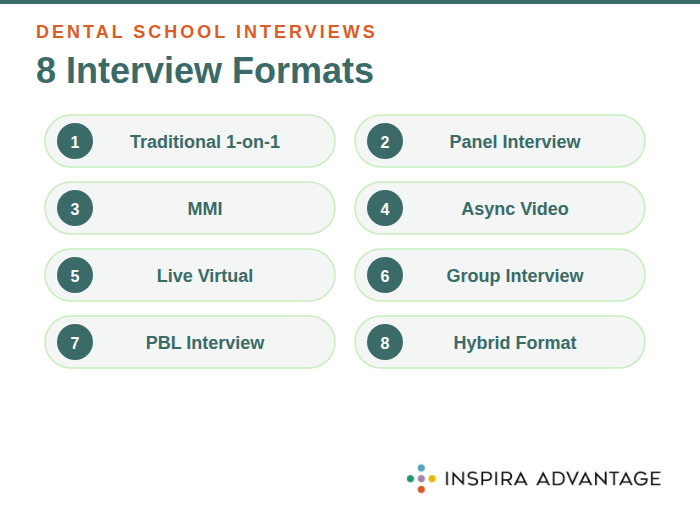
Dental schools use eight interview formats, and each one tests you differently.
A traditional interview might feel like a casual conversation, but the interviewer scores you against a rubric the entire time.
Most traditional formats fall into one of two setups.
Both versions typically run 20-30 minutes and draw from a mix of:
Your goal in a traditional interview is to own your narrative. Every answer should:
Admissions officers remember candidates who tell cohesive stories far more than candidates who just list their accomplishments.
One advantage of the traditional format is that it gives you time to build rapport with your interviewer. Pick up the interviewer's energy, reference something they mentioned earlier in the conversation, and let your personality shine.
A relaxed candidate who speaks with specificity reads as confident. A rigid candidate who recites rehearsed answers reads as unprepared for the improvisation that clinical work demands.
In an MMI, you walk up to a station, read a prompt on the door, get about two minutes to collect your thoughts, and then enter the room to respond for six to eight minutes. Then you move to the next door and start all over again.
MMI prompts vary significantly. One station might present an ethical scenario, such as a classmate you witnessed cheating on an exam. The next might ask you to role-play a conversation with an actor portraying an anxious patient. A third could test your ability to collaborate by asking you to work through a problem with the evaluator in real time.
Each station targets a different competency, and a different evaluator scores you independently. The MMI format rewards consistency across stations more than any single standout answer. However, a bad performance at one station won't necessarily harm your entire interview.
The biggest adjustment you need to make for MMIs is the mental reset period. You have roughly 60 seconds between stations to process whatever just happened (good or bad) and walk into the next room with a clear mind. Practicing timed responses to unfamiliar prompts builds that skill faster than memorizing sample answers ever will.
In an asynchronous video interview, you record responses to preset prompts with no live interviewer on the other end. Kira Talent is the most common platform dental schools use for this format. NYU College of Dentistry uses it as a screening step before the live interview day.
The platform shows you a question, gives you a short preparation window (typically 30 to 60 seconds), then records your response for a set time limit. You cannot re-record. An admissions committee member reviews your responses later, on their own schedule.
The biggest adjustment here is performing without feedback. In a live interview, you can read the room. In a Kira interview, you're speaking into a camera with no signal that you're answering questions correctly.
Practice recording yourself answering cold prompts without stopping to start over. Comfort with that format is entirely a rehearsal problem that disappears with enough practice.
A live virtual interview mirrors whatever format the school uses (e.,g., traditional one-on-one, panel, or MMI) just over Zoom or a similar platform. The questions, structure, and evaluation criteria are identical. What changes is the logistics.
Test your setup before the interview day. Ensure you have:
Looking slightly off-camera or having the audio drop mid-answer creates more questions than answers.
One practical advantage of virtual interviews is that you can keep discreet notes just outside the camera frame. However, use them sparingly, if at all. Repeatedly glancing down signals that you're reading, not thinking.
In a group interview, several applicants respond to the same questions or work through the same scenario together. Interviewers observe rather than participate, watching how you engage with peers under pressure.
The instinct most applicants fight here is over-competing. The group interview does not reward the loudest voice in the room. Interviewers look for candidates who:
Those are exactly the behaviors that signal clinical readiness.
Prepare by practicing structured group discussions, not solo answers. Know when to lead and when to follow. Both matter equally in this format.
A PBL interview presents a small group of applicants with a real dental scenario and asks them to analyze and solve it together. USC's Herman Ostrow School of Dentistry is the most prominent example of a school that uses this format, which mirrors its actual PBL curriculum.
If you're interviewing at a school with a PBL curriculum, treat this format as a preview of how you'll spend the next four years. The interviewers are not just evaluating your clinical knowledge. They want to see how you break down an unfamiliar problem, contribute to a group process, and stay intellectually engaged when there's no single right answer.
Research the school's curriculum model before the interview. Walking in knowing what PBL actually looks like in the classroom signals the kind of preparation that earns admission.
Not every dental program fully commits to a single format. Some schools run a traditional interview in the morning and MMI stations in the afternoon. Others use a group activity or a writing exercise alongside individual evaluations.
Hybrid formats test your versatility. A candidate who thrives in a 25-minute conversation but freezes when handed a two-minute ethical prompt shows a gap in adaptability. Admissions committees at hybrid dental schools are looking for applicants who can maintain their composure and quality across multiple evaluation styles on the same day.
Research each school's exact format before interview day. Admissions offices typically outline their process in the interview invitation or on their website. Knowing whether you'll face three MMI stations or eight, whether a writing sample is included, or whether student interviewers participate alongside faculty lets you refine your preparation instead of walking in blind.
Most dental schools use a committee-based review process. Your interviewer submits a scored evaluation that gets combined with your entire application file. The admissions board then reviews everything and places you into one of three categories:
Many dental programs operate on a rolling admissions timeline. That means decisions go out in batches throughout the interview season. Others conduct all interviews first and release decisions on a set date.
Schools that use rolling admissions reward early interviewers. Seats fill as offers go out, so interviewing in October gives you a big advantage over interviewing in February. If you receive multiple interview invitations, prioritize your top-choice schools earliest in the cycle whenever scheduling allows.
A waitlist placement means the admissions committee sees potential in your candidacy but isn't ready to offer you a seat. Your response to a waitlist determines whether you stay in contention or fade from their consideration.
Depending on how many dental schools you applied to, send a letter of intent to your top choice within one to two weeks of receiving the waitlist notification. State clearly that the program remains your top choice (only if it actually is). Include any meaningful updates since your interview, such as:
Keep the letter to one page and don’t repeat content that’s already in your application.
Continue interviewing at other schools and secure at least one acceptance elsewhere. A waitlist is not a promise, and structuring your entire application strategy around a single program's decision puts you in a vulnerable position.
Yes. You don't need to be an expert, but you should be able to speak knowledgeably about two or three recent developments shaping the dental profession. Topics such as teledentistry, AI-assisted diagnostics, the oral-systemic health connection, and access-to-care disparities frequently arise in both traditional and MMI formats.
Read a few recent articles from the ADA News or Journal of Dental Education before your interview so you can reference specific trends rather than speaking in generalities.
If you can’t attend your interview for any reason, contact the admissions office immediately. Most schools will reschedule your interview if you provide at least two weeks' notice. Last-minute cancellations without communication can result in your application being withdrawn entirely. If a genuine emergency arises the day before or day of, call (don't just email) the admissions coordinator, explain the situation, and ask about rescheduling options.
No. Most dental students don't commit to a specialty until their D3 or D4 year. Interviewers ask about your interests to gauge curiosity and self-awareness, not to lock you into a career path. Saying "I'm exploring pediatric dentistry and prosthodontics based on my shadowing experiences, but I'm excited to discover new areas during rotations" sounds far stronger than either a premature commitment or a directionless "I haven't thought about it yet."
The decision timeline depends on whether the school uses rolling admissions or batched decisions. Rolling programs may respond within two to six weeks after your interview. Batched programs hold all decisions until a set release date, which can be months after your interview. Check each school's admissions website for its specific timeline, and don’t contact the admissions office for status updates unless the stated decision window has passed.
The dental school interview is extremely important in the admissions process. Your GPA and DAT scores get you the interview, but the interview itself is often the deciding factor between equally qualified candidates. A strong interview can offset a slightly lower DAT score, and a weak interview can eliminate an applicant with a 4.0 GPA. Treat it as the most consequential 30 minutes of your entire application cycle.
Most competitive applicants receive two to five interview invitations. The number depends on your application strength, how many schools you applied to, and how early you submitted. Applicants who submitted their AADSAS application in June and completed secondaries promptly tend to receive more invitations than those who applied later in the cycle.
Yes, you can perform poorly enough to eliminate yourself from consideration regardless of your academic credentials. Common interview failures include giving dishonest or evasive answers, showing zero knowledge of the school's program, displaying poor interpersonal skills, or being dismissive to staff and student ambassadors during the interview day. The interview exists to evaluate qualities your transcript cannot measure.


.svg)


