Follow these expert tips and insights to help you get into the University of California, San Francisco School of Medicine (UCSF SOM).
If you’re just here for the requirements, click here.
Privacy guaranteed. No spam, ever.
University of California, San Francisco School of Medicine Acceptance Rate: 1.71%
The acceptance rate at UCSF School of Medicine is 1.71%. In the 2025-2026 application cycle, UCSF School of Medicine received 10,372 applications and 177 students matriculated. For every student who earned a spot in the entering class, 58 did not.
Take a look at the graphic below for more insight into UCSF SOM’s acceptance rates.
0%
Acceptance Rate
0
Total Applicants
0
Matriculants
<2 in 100
Your Odds
Out of every 100 applicants…
Matriculant
Did not matriculate
UCSF SOM's acceptance rate has dropped from 2.00% in 2022–2023 to 1.71% today. Applications have risen by over 1,200 while class size has stayed consistent.
Acceptance rate by cycle
Below is a table highlighting UCSF School of Medicine’s acceptance rate over the past five admissions cycles, based on archived data from the Association of American Medical Colleges (AAMC).
Admissions Cycle
Number of Applications
Number of Matriculants
Acceptance Rate
2025-2026
10,372
177
1.71%
2024-2025
9,555
174
1.82%
2023-2024
8,847
173
1.95%
2022-2023
9,156
183
2.00%
2021-2022
9,880
177
1.79%
The average acceptance rate at UCSF School of Medicine across the past five years is 1.85%. An average of 9,562 applicants competed for each available seat at UCSF School of Medicine throughout all five admissions cycles.
How Hard Is It to Get Into UCSF SOM?
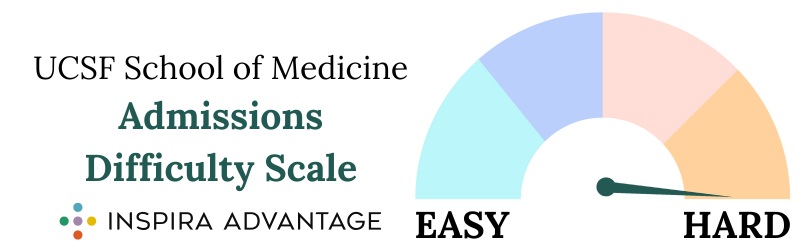
It’s extremely challenging to gain admission to the UCSF School of Medicine. In the 2025-2026 admissions cycle, the UCSF School of Medicine admitted fewer than two students for every 100 applicants. UCSF School of Medicine receives enough qualified applications to fill its incoming class roughly 58 times over. That means you need to have an extremely compelling application to stand out from the crowd.
What Is UCSF SOM’s Acceptance Rate for In-State Applicants?
The acceptance rate for in-state applicants at UCSF SOM is 2.65%. In the 2025-2026 admissions cycle, UCSF School of Medicine received 4,761 verified in-state applications, and 126 of them matriculated.
California residents have an acceptance rate of 2.65%. UCSF SOM draws nearly half its applicant pool from California alone, which means you're competing against a concentrated group of strong candidates who often have ties to UCSF-affiliated clinical and research programs. Residency status alone won't carry your application to acceptance.
What Is UCSF SOM’s Acceptance Rate for Out-of-State Applicants
The acceptance rate for out-of-state applicants at UCSF School of Medicine is 0.89%. UCSF SOM received 5,482 verified out-of-state applications, and 49 of them matriculated. That means your odds of matriculating to UCSF SOM as an out-of-state applicant are fewer than 1 in 100.
UCSF SOM is one of the most difficult schools in the country to get into as an out-of-state applicant. Despite those odds, out-of-state candidates still account for over half of the total applicant volume. If you're applying from out of state, your application needs to answer a specific question: Why UCSF SOM over every other top program you could attend closer to home
What Is UCSF SOM’s Acceptance Rate for International Students?
The approximate acceptance rate for international applicants at UCSF School of Medicine is 1.55%. UCSF SOM received 129 verified international applications, and 2 of them matriculated.
UCSF SOM only considers applications from U.S. citizens, U.S. permanent residents, and DACA recipients. However, "international" in the AAMC data likely refers to applicants with foreign undergraduate institutions or dual citizenship who still hold U.S. residency status, not applicants without U.S. legal status.
Applicants with foreign undergraduate institutions or dual citizenship should have strong research publications, meaningful U.S. clinical exposure, or a scientific background that aligns directly with UCSF SOM's institutional priorities will separate viable international applicants from the rest of the pool.
How Many People Apply to the UCSF SOM Every Year?
Over the last five admissions cycles, an average of 9,562 students applied to the UCSF School of Medicine. The average acceptance rate is 1.85%.
Privacy guaranteed. No spam, ever.
Admissions Statistics
UCSF SOM Median MCAT Score: 517
The median MCAT score of accepted applicants at the UCSF SOM is 517. UCSF SOM does not have a minimum MCAT score requirement.
Here’s an interactive infographic comparing MCAT scores of accepted applicants in the 2025-2026 admissions cycle. Use this tool to estimate your competitiveness at UCSF SOM.
517
Median MCAT Score of Accepted Applicants
UCSF School of Medicine
510
10th Percentile
513
25th Percentile
517
Median Score
521
75th Percentile
524
90th Percentile
Enter your MCAT score
517
472490500510520528
UCSF SOM does not have a minimum MCAT requirement for admission. Scores are one factor in a holistic review.
The table below shows the range of MCAT score percentiles for UCSF School of Medicine matriculants and accepted applicants.
MCAT Score Percentiles
MCAT Score of Accepted Applicants at UCSF SOM
MCAT Score of Matriculants at UCSF SOM
10th Percentile
510
510
25th Percentile
513
512
50th Percentile (median)
517
516
75th Percentile
521
520
90th Percentile
524
523
For the table above, we’ve used the most recent MSAR data available.
Accepted applicants and matriculants in the 2025-2026 admissions cycle had section median MCAT scores shown in the table below:
MCAT Section
Median MCAT Score of Accepted Applicants at UCSF SOM
Median MCAT Score of All Matriculants at UCSF SOM
Chemical and Physical Foundations of Biological Systems
130
130
Critical Analysis and Reasoning Skills (CARS)
128
128
Biological and Biochemical Foundations of Living Systems
129
129
Psychological, Social, and Biological Foundations of Behavior
130
130
According to the AAMC, the national average MCAT score of medical school matriculants was 512.1 in the 2025-2026 admissions cycle. This is nearly four points lower than the UCSF SOM’s average MCAT score for accepted applicants, 516.7.
What MCAT Score Makes You Competitive at UCSF SOM?
Aim for a score of 521 or higher to be a competitive candidate. This aligns with the top quarter of accepted applicants in the 2025-2026 admissions cycle. An MCAT score of 521 places you in the top 2% of test-takers nationally.
What this means for competitiveness:
⚈ You can still be competitive with a 517 MCAT score (median) if you supplement it with an excellent GPA, letters of recommendation, and a standout personal statement.
⚈ A 524 score places you within the top 10% of accepted applicants, making you very competitive.
⚈ UCSF SOM will not consider an MCAT score of 513 or lower to be competitive. This matches the bottom quarter of accepted applicants, so you’ll need other factors to help you stand out.
UCSF SOM Median Overall GPA: 3.93
The median overall GPA of UCSF SOM accepted applicants in the 2025-2026 admissions cycle was 3.93. UCSF SOM does not have a minimum GPA requirement.
Below is an interactive infographic comparing the GPA of accepted applicants in the 2025-2026 admissions cycle. Use it to see how competitive your overall GPA is.
3.93
Median GPA of Accepted Applicants
UCSF School of Medicine
3.76
10th Percentile
3.85
25th Percentile
3.93
Median Score
3.98
75th Percentile
4.00
90th Percentile
Enter your GPA
3.93
0.001.002.003.004.00
UCSF SOM does not have a minimum GPA requirement for admission. GPA is one factor in a holistic review.
Here is a table with the range of GPA percentiles for UCSF SOM accepted applicants:
Overall GPA Percentiles
Overall GPA of Accepted Applicants at UCSF SOM
Overall GPA of Matriculants at UCSF SOM
10th Percentile
3.76
3.76
25th Percentile
3.85
3.83
50th Percentile (median)
3.93
3.93
75th Percentile
3.98
3.97
90th Percentile
4.00
4.00
Based on the AAMC’s 2025-2026 data, the national average overall GPA for medical school matriculants was 3.91. UCSF SOM’s overall GPA of accepted students (3.93) is only 0.02 points higher than the national average.
What Overall GPA Makes You Competitive at UCSF School of Medicine?
An overall GPA of 3.98 or higher makes you competitive at UCSF SOM. This puts you in the top quarter of accepted applicants in the 2025-2026 admissions cycle.
What this means for competitiveness:
⚈ You can still be competitive with a 3.93 (median) overall GPA, but you must supplement it with a 521 MCAT score and other impressive application components.
⚈ Applying with a 4.00 overall GPA is a great way to stand out. This puts you in the top 10% of accepted applicants in the 2025-2026 admissions cycle.
⚈ UCSF SOM will not consider an overall GPA of 2.85 or lower to be competitive. This will put you in the bottom quarter of accepted applicants in the 2025-2026 admissions cycle.
UCSF SOM Median Science GPA: 3.91
The median science GPA of UCSF School of Medicine accepted applicants in the 2025-2026 admissions cycle was 3.91. There is no minimum science GPA required for admission.
Here is a table with the range of science GPA percentiles of UCSF School of Medicine matriculants and accepted applicants.
Science GPA Percentiles
Science GPA of Accepted Applicants at UCSF SOM
Science GPA of Matriculants at UCSF SOM
10th Percentile
3.67
3.65
25th Percentile
3.81
3.79
50th Percentile (median)
3.91
3.90
75th Percentile
3.98
3.97
90th Percentile
4.00
4.00
Privacy guaranteed. No spam, ever.
University of California, San Francisco School of Medicine Admissions Requirements
Here is a list of admissions requirements to help you get into UCSF SOM:
Eligibility: U.S. citizens, U.S. permanent residents, and DACA recipients only
UCSF SOM Course Requirements
The table below shows the course prerequisites for UCSF School of Medicine.
Required Courses
Required/Recommended
Number of Credit Hours
Biology
Required
2 semesters or 3 quarters of college-level Biology with laboratory
Biochemistry
Required
1 semester or quarter of college-level Biochemistry
Chemistry (including Organic Chemistry)
Required
2 semesters or 3 quarters of college-level Chemistry, including at least 1 semester of Organic Chemistry with laboratory. Biochemistry may be included within the Chemistry requirement.
Physics
Required
1 semester or 2 quarters of college-level Physics
UCSF SOM Interview Format
UCSF School of Medicine uses a closed-file interview format. Applicants selected for an interview will complete two separate virtual interviews via Zoom, each lasting approximately 40 minutes.
Interviewers are faculty members or a combination of one faculty member and one current medical student. A closed file means the interviewers have no access to your application, including your GPA, MCAT score, personal statement, activities, and secondary essays. Every conversation starts from scratch.
The interview focuses on your:
Interpersonal skills
Commitment to medicine
Alignment with UCSF SOM's mission
Ability to think critically in real time
Interview invitations are sent on a rolling basis, typically from late September through early February.
What Is UCSF SOM's Interview Rate?
The interview rate in the 2025-2026 admissions cycle at UCSF SOM was 5.65%. In this admissions cycle, UCSF SOM interviewed 586 of the 10,372 students who applied.
Of the total 586 students interviewed:
⚈ 342 were in-state students
⚈ 242 were out-of-state students
⚈ 2 were international students
The interview rates for each type of applicant are listed below:
⚈ 7.18% interview rate for in-state students
⚈ 4.41% interview rate for out-of-state students
⚈ 1.55% interview rate for international students
Privacy guaranteed. No spam, ever.
Secondary Application
Below are UCSF SOM’s secondary essay prompts for the 2026-2027 application cycle.
Interview Prompt (300 characters)
“Applicants are interviewed by invitation only. Interviews are scheduled from October to mid-February (days vary). For the 2025-2026 interview season, we will conduct interviews via Zoom. If you will be out of the country, provide additional info below (e.g., dates, best way to contact, etc.)”
How to approach it:
⚈ This prompt’s purpose is to flag international travel that could complicate Zoom scheduling across time zones.
⚈ If you'll be studying abroad, completing international research, or traveling outside the country for an extended period between October and mid-February, state the dates and provide a reliable contact method.
⚈ If you’ll be in the country for the entire interview window, leave the field blank.
Update/Expand Upon Activities Prompt (500 Words, Optional)
“If you wish to update or expand upon your activities, you may provide additional information below.”
How to approach it:
⚈ This prompt’s purpose is to update the timeline on activities already listed in AMCAS and introduce new activities that began after you submitted the primary application.
⚈ For updates to existing activities, keep each entry brief. Name the activity, state what changed, and quantify the change if possible.
⚈ The admissions officers can cross-reference your AMCAS activities list, so context-setting should be minimal.
⚈ For new activities, provide slightly more detail. Name the activity, describe your role, and explain why it matters to your candidacy.
⚈ Don't use this space to add low-impact extracurriculars that pad your resume without adding substance. A new research position or a meaningful clinical experience deserves the space. Joining a new club does not.
Updates Since Graduation Prompt (350 Words, Optional)
“If you are a 2024 or earlier college graduate, please use the space below to tell us what you have done since completing your undergraduate degree.”
How to approach it:
⚈ This prompt is optional, but for applicants who graduated in 2024 or earlier, it’s effectively required.
⚈ At 350 words, prioritize depth over breadth. If you've held one primary role since graduation, spend most of the essay on that experience. Describe what you do, what you've learned, and how the role has prepared you for medical school in ways your undergraduate experience alone couldn't have.
⚈ If you've held multiple positions, select two or three that represent the most significant dimensions of your post-graduation development and give each one proportional space based on its relevance.
⚈ Avoid defensive framing about why you took time off. Admissions officers evaluate what you did with the time, not whether you took it.
⚈ If your post-graduation time includes periods of non-medical work (retail, food service, or office jobs taken to pay loans), you can briefly mention them for timeline clarity without apologizing.
⚈ A sentence acknowledging that you worked to support yourself while pursuing clinical volunteering on weekends shows resourcefulness, not weakness.
PRIDE Values Prompt (500 Words)
“UCSF PRIDE values serve as a guiding light for institutional life and activities. Briefly describe how you will contribute to and support our PRIDE values consistent with your goals or life experience.”
How to approach it:
⚈ UCSF's PRIDE values are Professionalism, Respect, Integrity, Diversity, and Excellence.
⚈ Regardless of which value you select, the essay must follow a specific structure: experience first, then connection to the value, then forward-looking contribution to UCSF SOM.
⚈ Don't open by defining the value or quoting UCSF SOM's definition. Open instead with the experience that embodies it.
⚈ If you choose Integrity, describe a moment where you faced pressure to compromise your ethical standards. Maybe you reported a data error in a research project that would have gone unnoticed and improved the results.
⚈ If you choose Respect, describe how you built a relationship across a meaningful difference by prioritizing the other person's dignity and autonomy.
⚈ If you choose Excellence, show how your pursuit of mastery in a specific domain pushed you beyond competence into genuine distinction.
⚈ Avoid writing about a PRIDE value in general terms without grounding it in your own experience. "I believe diversity is important because different perspectives strengthen teams" is a thesis statement, not an essay. The prompt asks how you will "contribute and support" the value, which demands action, not belief.
Ethics / Disclosure Statement (No Word Limit)
“Candidates and current students must meet the ethical and legal standards to be licensed to practice medicine in the State of California. Acknowledge and disclose any felony offense, misdemeanor offense, or institutional action taken against you prior to matriculation, including expunged and diverted offenses not already reported in your AMCAS application.”
How to approach it:
⚈ If you have nothing to disclose, check the box and move on. The prompt requires no narrative if your record is clean.
⚈ If you do have a disclosure, address it with the same directness you'd use for any application red flag.
⚈ State what happened, when it happened, and the outcome. Take appropriate responsibility. Then describe what you learned and how your behavior or circumstances have changed.
⚈ Keep the explanation factual and proportional. A minor in possession charge from freshman year needs two to three sentences: what happened, what the consequence was, and what changed.
⚈ institutional academic integrity violation needs slightly more context: what the allegation was, how it was resolved, and what safeguards you've put in place since.
⚈ Avoid lengthy justifications or attempts to minimize the incident. The admissions officers evaluate how applicants handle accountability, not whether they have a flawless record.
⚈ A concise, honest explanation followed by evidence of growth demonstrates the integrity that UCSF SOM's PRIDE values demand. An evasive or excuse-laden explanation undermines it.
Privacy guaranteed. No spam, ever.
How to Improve Your Chances of Getting Into the University of California, San Francisco School of Medicine
Here are even more expert tips to help you get into the UCSF School of Medicine.
Prioritize Clinical Experience That Serves Underserved Populations
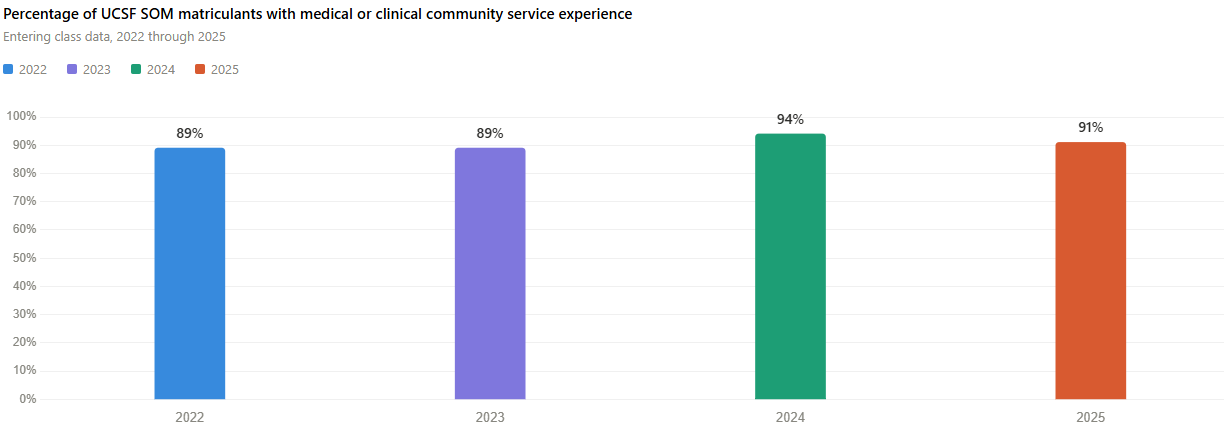
In the 2025-2026 admissions cycle, 91% of UCSF SOM matriculants had clinical experience on their application, so yours should too.
According to Michelle Albert, Associate Dean for Admissions at UCSF School of Medicine, prospective students must have a passion for helping all community members. She shared:
“At UCSF, we strive to recruit a student body with the collective desire to advance the health of ALL members of society. We are seeking curious, compassionate people who are committed to serving others. If you are eager to lead the innovations needed to address the scientific and health needs, YOU belong at UCSF.”
Albert’s statement reveals two key priorities. First, UCSF SOM defines “belonging” not solely through GPA or MCAT scores, but through a demonstrated record of service and compassion. The admissions office is explicitly seeking candidates who will carry forward the institution’s broader mission of social accountability in healthcare.
Second, Albert links curiosity with compassion, suggesting that UCSF SOM values students who can merge scientific innovation with a patient-centered ethos. For applicants, this means your personal statement and experiences must convey not just what you’ve achieved, but why you’ve pursued those achievements in the service of others.
The UCSF School of Medicine prioritizes health equity; consider volunteering or working in clinics, hospitals, or nonprofits that specifically serve marginalized communities. Admissions officers are seeking applicants who already embody their mission to advance health for all, particularly underserved populations.
Prove Your Involvement in Public Health or Basic Science Research
According to MSAR, 98% of UCSF School of Medicine matriculants had research experience on their application in the 2025-2026 admissions cycle. Over the last four years, an average of 97.75% of applicants have had research experience when applying to the UCSF School of Medicine.
That means you should have research experience when applying to UCSF SOM to be considered a competitive applicant.
Almost any form of research experience will strengthen your application to UCSF School of Medicine, but if you want to truly stand out, consider pursuing projects that connect to health disparities, primary care, or translational science. Research in these areas aligns with UCSF SOM’s mission to advance health equity and improve outcomes for underserved populations, making your work especially relevant to what the admissions committee is seeking.
For example, instead of focusing solely on general oncology, you might take part in a project that examines cancer outcomes in low-income communities or investigates racial disparities in cancer screening access. Research framed in this way not only demonstrates scientific rigor but also shows that you are committed to addressing the very inequities UCSF SOM prioritizes.
Demonstrate Competence and Compassion in Your Secondaries and Interviews
UCSF School of Medicine’s admissions officers and interviewers look for maturity, self-awareness, and a growth mindset. They’re evaluating how you think, how you reflect, and how you evolve in the face of difficulty.
In your secondary essays and interviews, use specific, personal experiences that clearly show:
How you handle mistakes
What you’ve learned from failure
Your reason for caring about people, not just science
These stories demonstrate that you possess the kind of emotional intelligence, humility, and purpose that the UCSF School of Medicine actively seeks in future physicians.
Show a History of Leadership That Aligns With UCSF School of Medicine’s Mission
“To nurture, support and equip medical students to carry out their goal of effectively promoting health equity and providing healthcare to urban underserved communities.”
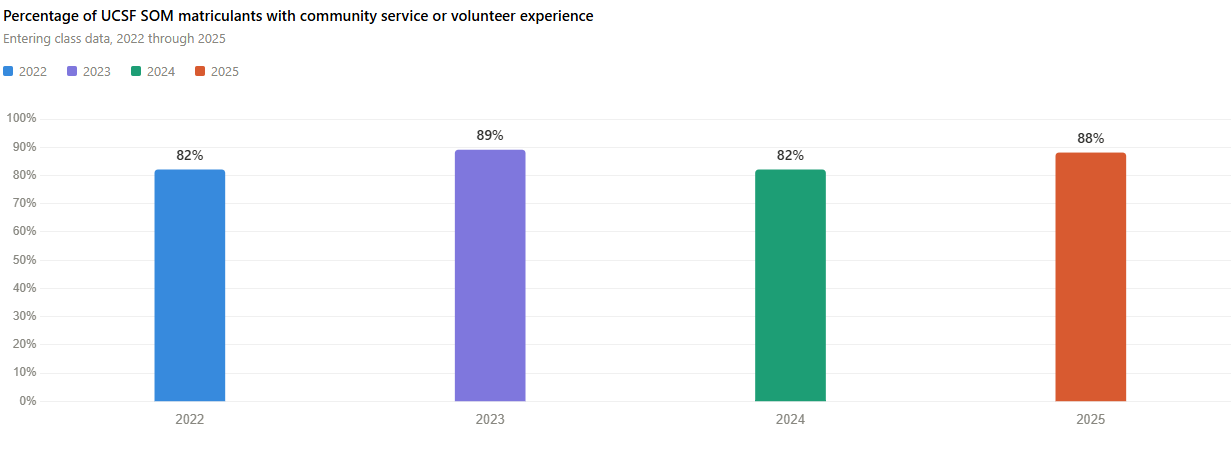
You can demonstrate your leadership in public health through community or volunteer experience. In the 2025-2026 admissions cycle, 88% of applicants had community service or volunteer experience. That means you should aim for a relevant volunteer experience that aligns with UCSF SOM’s mission.
Choose experiences that emphasize public health, as that’s one of UCSF SOM’s main objectives. Then demonstrate in your interviews and secondary essays how these experiences prove your leadership skills.
The best advice to increase your chances of acceptance is to find a reliable admissions counselor. Inspira Advantage features former admissions officers from some of the nation's top medical schools. With over 15 years of experience, they can help you get into the UCSF School of Medicine.
Prepares graduates in core physician competencies; modern curriculum aligned with evolving healthcare needs
MD/Master's in Advanced Studies (MD/MAS)
5 years
Combined MD and MAS degree in clinical research; includes rigorous training in methods and study design
MD with Distinction
5+ years (includes 1-year LoA)
Optional 12-month research-focused LoA with faculty mentorship, grants, and required legacy project (e.g., thesis, manuscript)
Medical Scientist Training Program (MSTP)
~8 years
The combined MD/PhD program prepares students for careers as physician-scientists
UC Berkeley - UCSF Joint Medical Program (MD, MS)
5 years
2.5 years at UC Berkeley, earning an MS in Health and Medical Sciences; final 2.5 years at UCSF for clinical MD training
Program in Medical Education for the Urban Underserved (PRIME-US)
5 years
Specialized MD track focused on serving the urban underserved communities through public service and advocacy
San Joaquin Valley Program in Medical Education (SJV PRIME)
5 years
UCSF track for students committed to addressing healthcare disparities in California’s San Joaquin Valley
Tuition and Scholarships
Tuition at UCSF SOM costs $55,959 for first-year medical students. When you factor in additional costs, the total cost of attendance is $89,634 for residents and $101,879 for non-residents. Based on this data, first-year non-residents pay approximately 13.66% more than California residents at UCSF School of Medicine.
How Much Does UCSF SOM Cost for 4 Years?
The total cost of attendance at UCSF SOM for California residents is $380,138. This breaks down as:
Year 1: $89,634
Year 2: $90,039
Year 3: $102,644
Year 4: $97,821
The total cost of attendance at UCSF SOM for non-residents is $429,118. This breaks down as:
Year 1: $101,879
Year 2: $102,284
Year 3: $114,889
Year 4: $110,066
Scholarships
UCSF School of Medicine offers the Regents Scholarship, one of the highest honors available to UC students. It is awarded to a limited number of candidates based on academic excellence and exceptional promise. Additionally, the Professional School Scholarships and other campus-based awards are available based on financial need.
University of California, San Francisco School of Medicine Application Timeline
Here is the complete 2026-2027 application timeline for the UCSF School of Medicine
Date
What Happens
May 5, 2026
AMCAS 2027 application opens at 9:30 AM EST.
May 28, 2026
AMCAS submission and verification begin.
June 26, 2026
AMCAS begins transmitting verified applications to UCSF SOM.
Mid-July 2026
UCSF SOM secondary application invitations begin going out. Expect 8-12 weeks between AMCAS verification and receipt of secondary applications.
Interview invitations are released on a rolling basis.
October 15, 2026
Hard deadline for submitting the AMCAS primary application to UCSF SOM. No extensions granted.
November 2026
Secondary application window closes. Submit your secondary within two weeks of receiving it
Late September 2026 - Early February 2027
Virtual interview period. Interviews run 9:00 AM-5:00 PM PT with two interviewers (faculty or faculty + student), averaging about 40 minutes each.
February - March 2027
UCSF SOM sends post-interview admissions decisions.
April 30, 2027
Traffic rules deadline. Accepted applicants holding multiple offers must choose one school and withdraw from all others
May 15, 2027
Schools cannot extend acceptances to anyone still holding a seat elsewhere.
Summer/Fall 2027
Matriculation at UCSF SOM.
FAQs: Getting Accepted to UCSF SOM
Does UCSF School of Medicine Prefer California Residents (i.e., In-State Applicants)?
Yes, UCSF SOM prefers California residents. In-state applicants matriculate at a rate of 2.65%, compared to just 0.89% for out-of-state applicants. Roughly 77% of each entering class comes from California, and in-state candidates are nearly three times more likely to earn a seat than their out-of-state counterparts.
Can I Get Into UCSF School of Medicine Without Research Experience?
No, it’s highly unlikely that you’ll get into UCSF School of Medicine without research experience. In the 2025-2026 admissions cycle, only 2% of matriculants applied without research experience, so research experience is strongly recommended.
What Kind of Volunteer Work Impresses UCSF School of Medicine Admissions?
UCSF School of Medicine prioritizes applicants who serve underserved or marginalized communities, primarily through clinical or community health work. Volunteering in safety-net clinics, harm-reduction programs, or public health education efforts that align with the UCSF School of Medicine’s mission will stand out more than generic hospital volunteering.
Does UCSF School of Medicine Accept Postbaccalaureate or Non-Traditional Applicants?
Yes, UCSF School of Medicine accepts postbaccalaureate and non-traditional applicants. Many admitted students come from diverse educational or career paths. However, you’ll still need a strong academic foundation, a competitive MCAT, and precise alignment with UCSF School of Medicine’s values.
How Many Letters of Recommendation Should I Submit?
UCSF School of Medicine requires three to five letters of recommendation, with at least two from instructors. A committee letter or letter packet is preferred if available. Letters that highlight your character, leadership, and real-world contributions to medicine or research are more impactful than generic academic references.
Does UCSF School of Medicine Require a Specific Major to Apply?
No, the UCSF School of Medicine does not require a specific major for application. However, you must complete all prerequisite coursework in biology, chemistry (including organic), biochemistry, and physics. Successful applicants often major in biological sciences, but students from humanities or social science backgrounds are also accepted.
Dr. Jonathan Preminger was the original author of this article. Snippets of his work may remain.
Arush Chandna is the Co-Founder of Inspira Advantage and a nationally recognized expert on graduate school admissions. Arush has used his 12+ years of experience in higher education to help 10,000 applicants get into their dream graduate programs.
Subscribe to Our Newsletter
Schedule A Free Consultation
Plan Smart. Execute Strong. Get Into Your Dream School.







.svg)

