Get in touch: +1 888 453 5021




Know where a program's graduates end up before you interview there. Find the program's match data in the Fellowship and Residency Electronic Interactive Database Access (FREIDA), review their fellowship match rates, and examine where recent graduates practice.
Reference a specific fellowship pathway or a clinical partnership with a particular hospital system. For example, say, "Your graduates match into GI fellowships at a rate that outpaces most community programs in the region, and your partnership with [specific site] gives residents longitudinal continuity clinic exposure starting PGY-1," to sound like someone who already sees themselves in the program.
As Dr. Michael Manansala, a Senior Fellow at Rush University Medical Center and expert counselor at Inspira Advantage, explains in our residency interview webinar:
"It's really important you do your homework before the interview to really highlight some of the unique points about that particular program,” he says. “If you look at their website and at the faculty, you may notice that a certain program is stronger in some clinical areas and that they really take pride in that. If that particular area is of interest to you, it would be to your advantage to upsell that when you talk to the program."
Cross-reference the program's Accreditation Council for Graduate Medical Education (ACGME) case logs and procedure numbers if they're available. For surgical and procedural specialties, especially, these numbers tell you whether residents actually get the operative volume the program advertises during recruitment dinners.
Residency interviewers rely heavily on behavioral questions because they predict how you'll handle the situations you'll face as a resident. "Tell me about a time you dealt with a difficult patient," and "Describe a conflict with a team member" appear in nearly every interview. Vague answers significantly lower your chances of standing out.
In our residency interview webinar, Dr. Manansala recommends having a handful of stories.
"It's important to have two or three patient interactions that stuck out to you throughout your medical school experience where it taught you a lesson ... and having an outline of the story and being able to adapt those stories to these different questions," he says.
Prepare at least two to three clinical stories from your clerkships and sub-internships before interview season starts. Each story should follow the STAR-P structure:
The reflection piece is what separates a medical student's answer from a resident-ready answer. Programs want to see that you process clinical experiences rather than just survive them.
Pick stories that show a range of traits. You should aim for:
Rehearse them out loud until you can deliver each one in under 90 seconds without sounding scripted.
Interviewers have your Electronic Residency Application Service (ERAS) application open in front of them. They will ask about:
If you stumble when explaining your own application, the interviewer might question whether the rest of it is accurate.
In our residency interview webinar, Dr. Andjela Nemcevic, a Dermatology Resident at NYU Langone with over 40 academic publications and an expert counselor at Inspira Advantage, warns that some interviewers will go through your CV point-by-point:
"If you put something on that resume, you should know about it and have a brief summary and talk about it within a minute, a minute and a half," she advises. "Specifically for research, if there is something that you published and you put it on there, expect them to ask a question. They will say, 'Oh, this is really interesting — I actually research the same topic. Can you tell me more about this?'"
Review every line of your personal statement, CV, and Medical Student Performance Evaluation (MSPE) before each interview. For research experiences, know the:
Address your weaknesses proactively and briefly. For example, a failed Step attempt or a leave of absence doesn't automatically disqualify you, but a defensive or evasive answer about it might. Frame setbacks in terms of what you did after them.
Your questions at the end of an interview reveal how seriously you've thought about training at that program. Generic questions like "What do you like about this program?" waste a perfect opportunity.
Dr. Manansala recommends preparing different questions for different audiences:
"For faculty, you can ask 'What is one thing you'd change about this program?' For residents, you can ask where they live, how they get to work, what's the transportation like, what's the cost of living, do residents get along, what do you do for fun," he says.
Ask questions that help you understand what the resident's experience is like. For example, "What does handoff look like between day and night teams, and has the program changed the handoff structure recently?" tells you about patient safety culture and whether leadership responds to resident feedback.
Ask your questions to the person sitting across from you. Ask faculty about mentorship and research support. Ask the program director about board pass rates and how they intervene early when residents fall behind.
Ask current residents about schedule flexibility, moonlighting policies, and whether they'd choose the program again. Each conversation is a data point, and you're building a composite picture that will lead your rank list decisions.
Residency programs use the pre-interview social to see how you interact with current residents. Nobody is holding a scorecard, but residents absolutely report back to the program director about who was pleasant, who was awkward, and who got too comfortable with the open bar.
Show up. Skipping the social shows that you aren’t interested in the program. Arrive on time, introduce yourself to residents you haven't met yet, and ask questions about their day-to-day experience. The residents who volunteered for these events are invested in recruitment and will remember you on rank list day.
The social is a chance to learn things you'll never hear in a formal interview, such as:
Listen more than you talk. The applicants who dominate conversations at the pre-interview dinner rarely make the impression they think they're making.
Every interviewer at every program will ask some version of "Why did you choose this specialty?" The most common answer is a story about a clerkship rotation that felt right. That answer is fine, but it's also forgettable because every other applicant in your specialty gives the same one.
Structure your answer around a pattern of decisions rather than a single moment. Connect your:
A strong answer to "Why surgery?" isn't just "I loved my surgery clerkship." It's "I've consistently sought out problems that require procedural decision-making under time constraints. My research in trauma outcomes, my sub-I in acute care surgery, and the fact that I spent my fourth year elective time in the OR rather than in outpatient clinics all point in the same direction."
The pattern-based answer also protects you against follow-up questions. The applicant with a single-moment story falters when an interviewer pushes with, "But what if you'd done a different rotation first?" The applicant who can show a trail of decisions that all converged on the same specialty sounds like someone who made a deliberate choice.
Content preparation matters, but delivery determines how that content lands. Medical students who rehearse answers silently or only in their heads often freeze or ramble when they sit across from a faculty member for the first time.
"Do mock interviews before you start interviews for real,” Dr. Manansala says in our residency interview webinar. “That helps you put yourself in that interview mindset and get the nerves out. It'll also help if you get a third-person perspective of how you come off, so you come off like the best that you can."
Do at least three mock interviews with someone who will give you honest feedback. Ideally, one should be with a faculty member in your specialty, one with a resident, and one with a peer who interviews you cold (without having seen your application).
Ask them to evaluate specific things:
Most applicants talk past the point where their answer was strong and dilute it with filler.
Record yourself answering two or three common questions on video. Watch it once. You'll immediately notice:
One round of video review does more for interview polish than five rounds of mental rehearsal.
Your memory of an interview day degrades fast. By the time you've flown home, unpacked, and moved on to the next program, the specific details that should drive your rank list decisions start blending together. The program with the impressive simulation lab merges with the one with a strong fellowship pipeline, and you can't remember which program director gave a vague answer about resident wellness support.
Within 24 hours of every interview, sit down and write a structured debrief. Record the names of your interviewers, the questions they asked, the answers you gave that landed well, and the answers that fell flat. Note the moments that surprised you, such as:
Pay attention to what you observed between interviews, too. How did the residents interact with each other in the hallways? Did the coordinators seem stressed or organized? Was the hospital itself well-maintained, or did the facilities look neglected?
These environmental signals tell you more about daily life at a program than any polished recruitment presentation will.
Work with our residency experts to help you prepare for your residency interview. Our consultants provide mock interview sessions to minimize your nerves and maximize your acceptance chances.
For even more tips on residency interviews, check out our webinar below:
Residency interviewers are assessing whether you'd be a safe, reliable, and pleasant colleague. Every question, every small-talk exchange, and every pause between your sentences feeds into that evaluation.
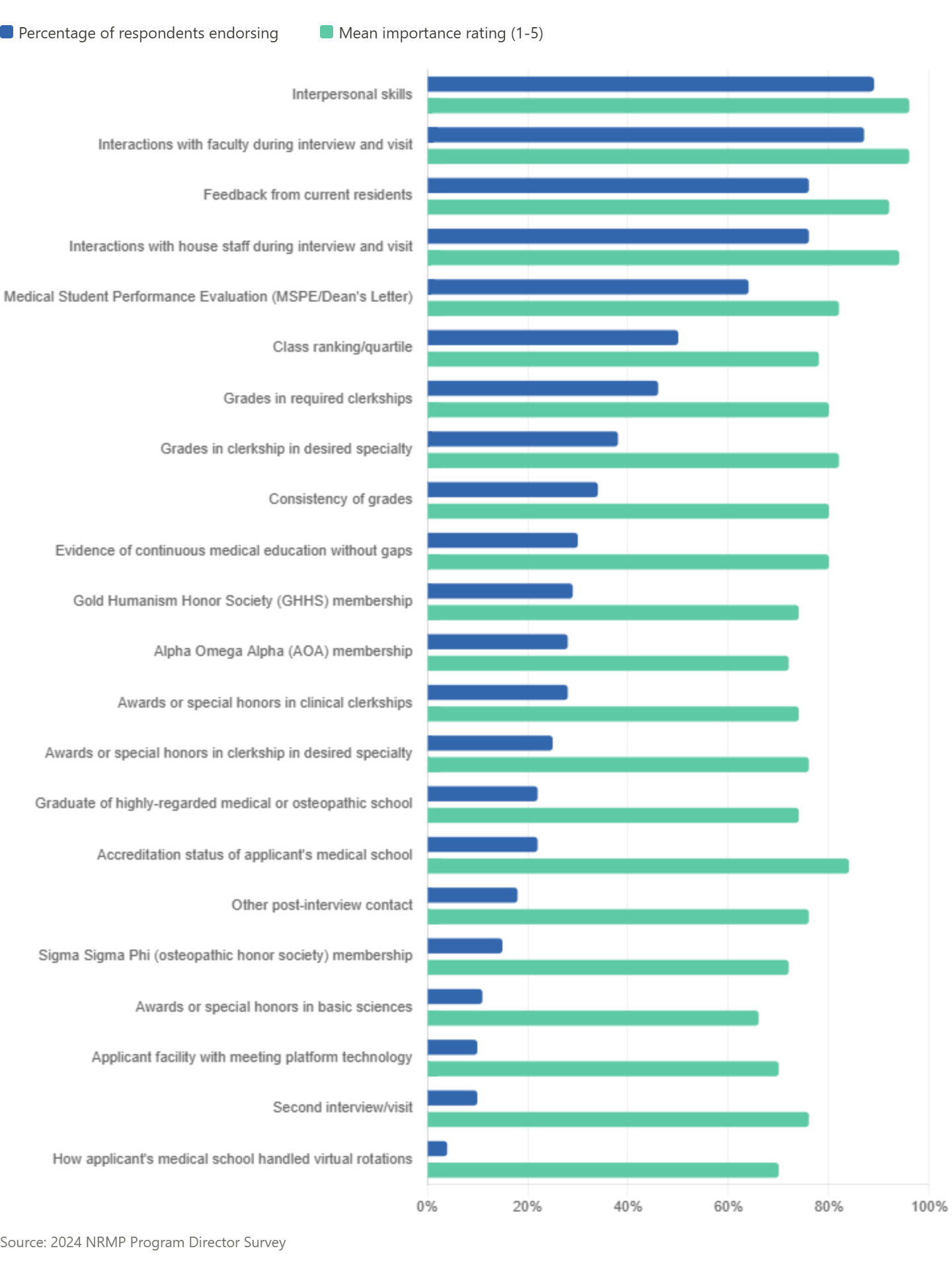
Program directors rank interpersonal skills as the top traits they look for in interview candidates. The 2024 National Residency Match Program (NRMP) Program Director Survey found that 89% of program directors cited interpersonal skills during the interview and visit as a major factor when ranking applicants, second only to interactions with faculty members. Your clinical knowledge won't matter if you can't explain a plan to a patient, present a case to an attending, or de-escalate a tense family meeting.
Interviewers evaluate communication the moment you speak. They notice whether you answer the question that was asked or pivot to a rehearsed script that doesn't quite fit. They notice whether your answers have a clear beginning and end or trail off into filler. They notice whether you listen to their full question before jumping in.
Strong communicators in interviews share three habits:
Rambling past your answer is one of the fastest ways to lose an interviewer's attention.
Professionalism shows up in how you handle the uncomfortable moments. When an interviewer asks about a low Step score or a gap year, they already know the facts. What they're watching is your reaction. Do you get defensive? Do you blame someone else? Do you minimize it with a joke that doesn't land?
The applicants who score highest in professionalism exhibit these traits:
That shows the kind of resident who will acknowledge a mistake on rounds, correct it, and keep functioning rather than shutting down or deflecting.
Professionalism also extends beyond the interview room. How you treat the program coordinator who walks you between sessions, how you interact with other applicants during lunch, and whether you show up to the pre-interview social all factor into the picture programs build of you.
Every program wants residents who actually want to learn there. Interviewers can tell the difference between an applicant who researched the program and one who recycles the same generic answer across 15 interviews.
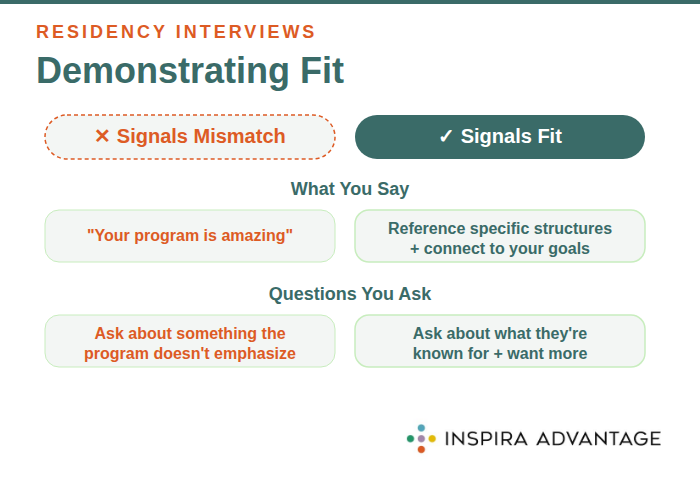
Fit isn't about flattery. Saying "Your program is amazing" tells the interviewer nothing. Referencing the program's longitudinal continuity clinic structure and explaining how it connects to your interest in outpatient chronic disease management shows them you've done real work to understand what the training would look like.
Interviewers also gauge fit through the questions you ask. An applicant who asks about early research mentorship at a program known for its clinical volume signals a mismatch. An applicant who asks about operative case distribution at a program that prides itself on surgical training signals someone who understands what the program offers and wants more of it.
Residency is a three- to seven-year apprenticeship. Programs need residents who can absorb feedback, adapt, and improve year over year. An applicant who presents as a finished product raises a red flag because no medical student is a finished product.
Interviewers assess growth potential through behavioral questions. "Tell me about a time you received difficult feedback" isn't a trap question. It's a direct window into whether you process criticism productively or treat it as an attack. The strongest answers describe:
Self-reflection also surfaces in how you discuss your specialty choice, your clinical experiences, and your weaknesses. Applicants who can articulate what they learned from a difficult rotation or a patient interaction that challenged their assumptions demonstrate the reflective practice that residency training depends on.
Residency is team-based work. You'll rely on nurses, co-residents, attendings, social workers, and consultants every shift. Program directors look for applicants who strengthen a team rather than create friction within one.
Interviewers assess teamwork through your stories:
The language you use indicates whether you see medicine as a collaborative effort or a solo performance.
The pre-interview social and the lunch with residents also serve as informal teamwork assessments. Residents notice which applicants ask questions and listen versus those who dominate the conversation or only talk about themselves. Those observations get relayed to the program director before rank list meetings.
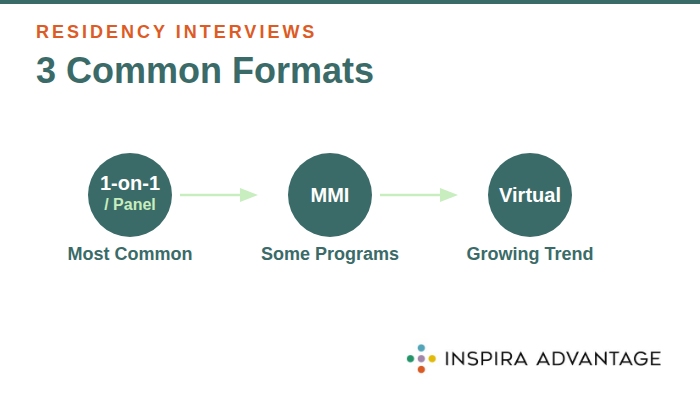
Most residency programs use one-on-one or panel interviews as their primary format. A smaller number incorporate MMI-style stations, and many programs now offer virtual interviews for at least a portion of their interview days.
One-on-one interviews are the most common format in residency applications. You'll sit across from a single interviewer for 15 to 20 minutes and answer a mix of questions about:
The interviewer is typically:
Some programs use panel interviews instead, where two or three interviewers question you simultaneously in a single session.
To prepare for both one-on-one and panel interviews, know your application, have your stories ready, and prepare tailored questions for the person sitting across from you.
In a one-on-one interview, the conversation can feel more natural and relaxed because you're connecting with a single person. In a panel interview, you should distribute eye contact evenly among all interviewers, not just the person who asked the question. Direct your initial answer to the person who posed the question; then shift your gaze to the other panelists as you elaborate.
Panel interviews also go more quickly because multiple interviewers can ask their questions within the same time slot. Keep your answers tighter than you would in a one-on-one setting. If a panelist asks a follow-up question, it's a sign that your initial answer was great and they want you to go deeper.
The best one-on-one interviews feel like conversations between future colleagues, not interrogations. That impression is what sticks when the interviewer sits down to fill out their evaluation form afterward.
If a program uses MMIs, you'll rotate through six to 10 stations lasting roughly seven to 10 minutes each, with a different evaluator and prompt. You'll typically get two minutes to read the scenario outside the room before entering to discuss or role-play your response.
In a traditional interview, you can steer the conversation toward your strongest stories. In an MMI, the prompt dictates the topic, and you have no control over what's coming next. You can't rely on rehearsed answers because each station presents:
Prepare for MMIs by practicing structured thinking under time pressure rather than memorizing specific answers.
Use Inspira's INCE framework (Identify, Name, Consider, and Explain) to answer ethical scenarios:
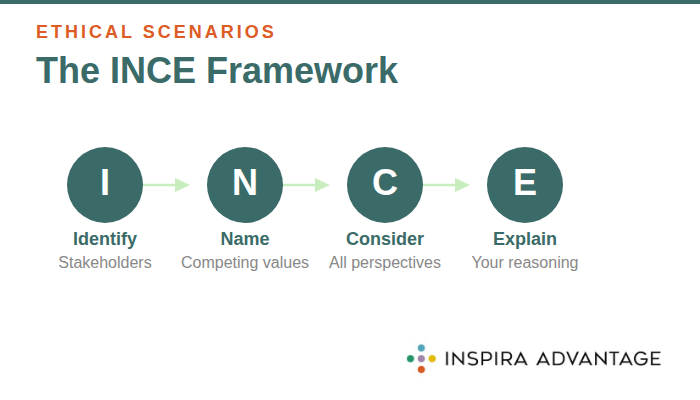
Interviewers at MMI stations care less about your final conclusion and more about how you arrived at it. A thoughtful, well-organized answer that lands on a debatable position will score higher than a rushed answer that happens to align with the "right" take.
In virtual interviews, you’ll be asked the same questions as in-person interviews. The challenge is that building a connection through a screen requires more deliberate effort.
Position your camera at eye level so you're looking straight ahead, not down at a laptop on a desk. Place the video call window as close to your camera lens as possible so that when you look at the interviewer's face, your eyes appear to be making direct contact.
Natural lighting from a window in front of you (not behind you) eliminates shadows and keeps your face clearly visible. Choose a plain, uncluttered background so the focus stays on you.
Test your setup the day before. Run a practice call with a friend to see if these are working properly:
Close every application and browser tab that could trigger a notification during the interview. Have a backup device charged and ready in case your primary setup fails. If a technical issue happens during the interview, stay calm, acknowledge it briefly, and reconnect.
Project slightly more energy than you would in a physical room. Smile when you greet the interviewer. Nod visibly when they're speaking to show you're listening. Sit forward in your chair rather than leaning back. Avoid the temptation to glance at your own video feed or check notes on a second screen.
Once invitations start arriving in October, you won't have time to build a preparation system from scratch. Use the checklist below to track your progress across every major preparation task before, during, and after each interview.
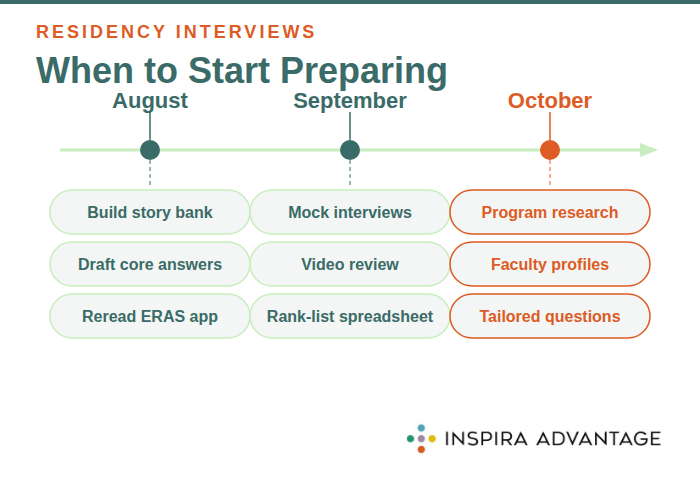
Start preparing for your residency interviews in August, at least six weeks before ERAS opens in late September. Interview invitations can arrive as early as October, and some programs schedule their first interview days within two weeks of sending invitations.
August is when you should start building the foundation for your answers. Write out your story bank of clinical experiences. Draft your "Tell me about yourself" narrative and your "Why this specialty?" answer.
Reread your entire ERAS application line by line so you can speak to every research project, activity, and gap without hesitation. These core assets take time to develop well, and rushing them in October produces answers that sound thin under pressure.
Schedule your mock interviews in September during this window so you have time to rework weak answers before real invitations arrive. Record yourself on video, watch it back, and fix the delivery issues you catch. Build your rank-list evaluation spreadsheet now so you're ready to score programs after your first interview, rather than trying to reconstruct impressions from memory weeks later.
In October, do program-specific research. When an invitation arrives, spend one to two hours:
Doing program-specific research the night before each interview keeps details fresh and prevents the blur that comes from researching 10 programs at once in a single weekend.
Treat your interview day like a clinical rotation. Show up early, stay organized, observe everything, and document your findings before you forget them. The way you manage the hours before, during, and after your interviews determines whether you walk away feeling confident or wishing you'd handled it differently.
For both in-person and virtual interviews, arrive at least 15 minutes early. Here’s everything else to consider, depending on the interview format.
Eat a real breakfast. Interview days run long, and some programs don't provide food until midday lunch with residents. Low blood sugar at 11 a.m. makes you slower, less articulate, and more likely to give short answers.
Review your program-specific research one final time. Skim your notes on:
Reread your interviewers' names and backgrounds so you can greet them with recognition rather than asking "So, what do you do here?" within the first minute. Review your tailored question list so the right questions come up naturally when the interviewer asks, "What questions do you have for me?"
Silence your phone completely. Not vibrate. Silent. A vibrating phone during an interview is a distraction you can't undo, and reaching for your pocket to check it signals that something else has your attention.
During the interview, make eye contact and offer a firm handshake. Use the interviewer's name when you greet them.
Listen to their full question before you start answering. A common mistake under pressure is to hear the first few words, assume you know where the question is going, and launch into a rehearsed answer that doesn't match what was actually asked. Pausing for two seconds after the interviewer finishes shows composure and gives you time to choose the right story.
Keep your answers to most questions between 60 and 90 seconds. Interviewers typically have 15 to 20 minutes with you and a set of questions they need to cover. If the interviewer wants more detail, they'll ask a follow-up.
Some faculty members want a structured, professional exchange. Others prefer a conversational tone and will ask about your hobbies or weekend plans. Read the room and adjust.
Pay attention to what happens outside of your interview sessions, too. The tour, the lunch with residents, and the hallway conversations between interviews all offer valuable insights into the program's culture that you won't find on any website.
Notice whether the residents look exhausted or energized. Notice whether the faculty and staff interact warmly or avoid each other. Notice whether the facilities match the program's recruitment materials. All of these observations will help you build your rank list.
Once you’re done with your interview, write your structured debrief immediately. Record the names of every interviewer, the questions they asked, and which of your answers landed well. Flag any answer that felt weak or any question that caught you off guard so you can rework your response before the next interview.
Score the program on your rank list spreadsheet the same day. Assign a rating to:
If you wait a week, you’ll probably forget your impression of the program — or worse, mix up programs.
Send a short, personalized thank-you email to your interviewers within 24 to 48 hours. Reference something specific from your conversation so the email doesn't read like a template. For example, "Thank you for describing the new simulation curriculum. Learning that PGY-1s get weekly procedural practice before entering the OR confirmed that your program prioritizes hands-on skill development early" reminds the interviewer exactly who you are and reinforces your interest.
Start preparing for your residency interviews in August, at least six weeks before ERAS opens in late September. Interview invitations can arrive as early as October, and some programs schedule their first interview days within two weeks of sending invitations. Use August to build your story bank, draft your core answers, and reread your entire ERAS application line by line. Schedule mock interviews in September, so you have time to rework weak answers before real invitations arrive.
The most important residency interview questions to practice are:
These four questions appear in nearly every interview across every specialty. Your "Tell me about yourself" narrative and specialty answer form the foundation of every conversation, so refine them first. Behavioral questions require pre-built stories using the STAR-P framework (Situation, Task, Action, Result, Perspective). And these take multiple rounds of practice before they sound natural under pressure.
Research residency programs by using match data from FREIDA, checking fellowship match rates, reviewing ACGME case logs, and reading the program's website for curricular details and recent changes. Look up each interviewer's clinical focus, recent publications, and departmental role so you can ask informed questions and reference specific faculty during your conversations. Cross-reference what the program advertises with what residents report on forums and at pre-interview socials. Spend one to two hours on program-specific research when each invitation arrives, rather than batching 10 programs into a single weekend.
You can stand out during a residency interview by connecting specific program details to your professional trajectory instead of giving generic answers that apply to any program. Reference a faculty member's research, a rotation site that offers training you can't get elsewhere, or a curricular structure that aligns with your career goals. Prepare clinical stories that show a range of traits (patient advocacy, teamwork under pressure, learning from mistakes), and deliver each one in under 90 seconds. The applicants who stand out are the ones who sound like future colleagues rather than candidates reciting rehearsed scripts.
You know you're ready for your residency interview when you can answer the core questions (about yourself, your specialty choice, your application gaps, and behavioral scenarios) out loud in under 90 seconds without rambling or sounding scripted. Complete at least three mock interviews with people who will give you honest feedback:
Record yourself on video answering two to three common questions and watch it back to catch verbal tics, filler words, and pacing issues. If you can speak to every line of your CV, personal statement, and MSPE without hesitation, you've built a strong enough foundation to handle whatever question an interviewer asks you.
Ask residency programs questions that help you understand what daily life actually looks like for residents and that demonstrate you've already done research. Tailor your questions to the person sitting across from you by asking about faculty mentorship and research support, asking program directors about board pass rates and how they intervene when residents fall behind, and asking current residents about schedule flexibility and whether they'd choose the program again. Avoid anything that can be easily answered on the program's website. Treat each question as a data point you'll use when building your rank list.
Expect residency interview expenses to include travel costs (flights, gas, rental cars), hotel stays for in-person interviews, professional attire, and meals during travel days. Most programs now conduct interviews virtually, which significantly reduces travel costs, but in-person interviews can cost $200 to $500 or more per visit, depending on location and travel distance. Budget for 10 to 15 interview days if you're applying broadly across a competitive specialty. Planning your interview schedule geographically (grouping nearby programs into a single trip) helps reduce total travel costs.
Residency interview costs for couples matching are significantly higher than for individual applicants. The AAMC estimates couples should budget roughly double the individual cost (approximately $6,000 with a range of $800 to $14,000) because both partners apply more broadly and need overlapping geographic coverage. Both ERAS application fees and NRMP ranking fees multiply when two people are applying, and couples who rank up to 300 program combinations face additional per-program charges beyond the standard 20. Coordinating interview schedules in the same cities can offset some travel costs, but the need to cover more regions typically pushes total spending well above what a solo applicant would spend.




.svg)


