Get in touch: +1 888 453 5021





A post-baccalaureate program is a structured academic program for students who already hold a bachelor's degree and need to complete additional undergraduate-level coursework before applying to graduate or professional school.
For medical school specifically, these programs focus on the core science prerequisites that admissions committees require, including biology, general chemistry, organic chemistry, biochemistry, and physics.
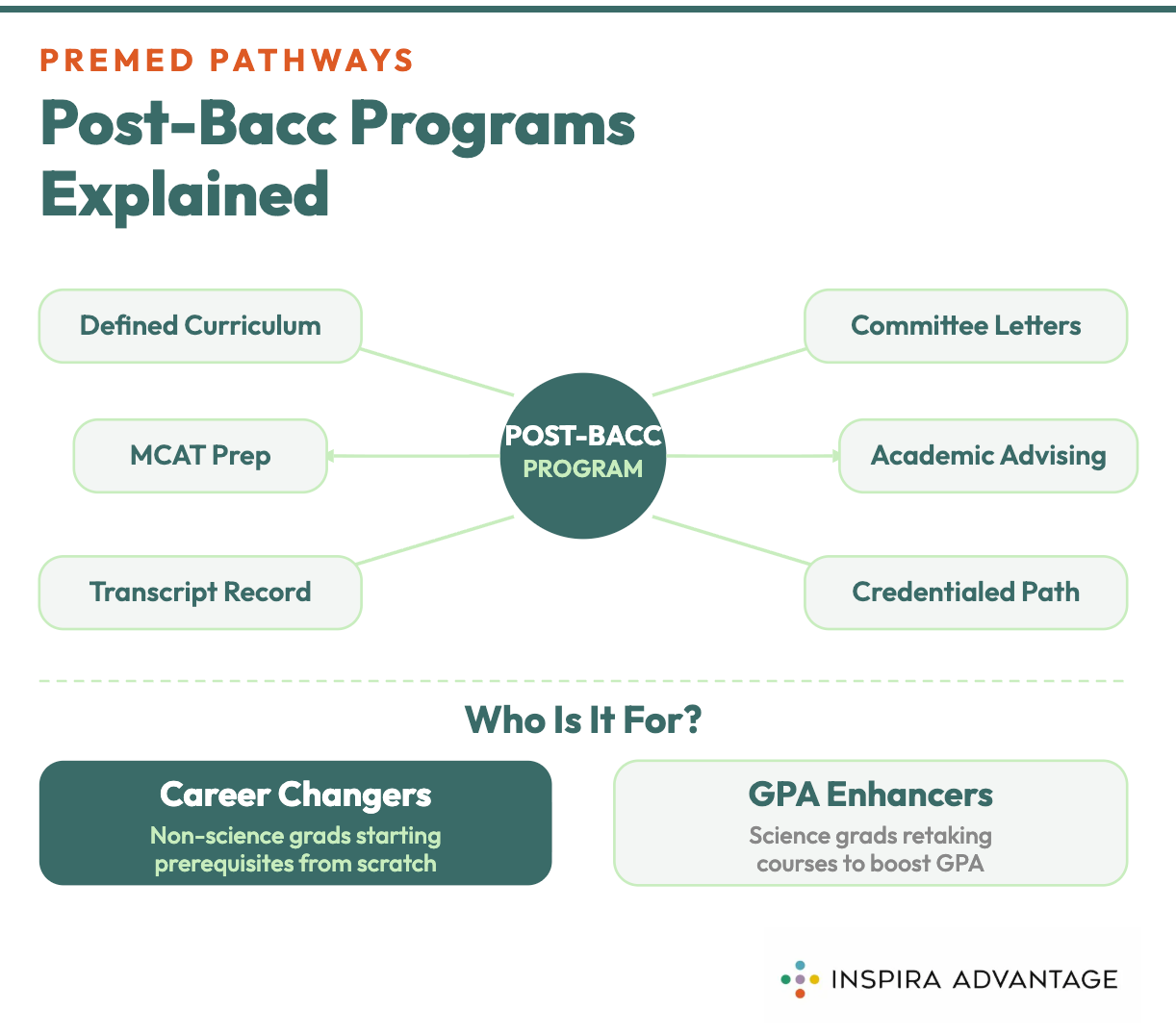
The key distinction between a post-baccalaureate program and simply enrolling in individual courses at a university is structure. A post-bacc program gives you a defined curriculum, academic advising, committee letter support, and often MCAT preparation built into the experience.
You aren’t just taking chemistry again. You’re completing a credentialed academic pathway with institutional support behind it.
Most post-bac programs produce a certificate or transcript record that signals to medical school admissions committees that you pursued your prerequisites through a deliberate, recognized process rather than piecemeal. That distinction matters when evaluators assess the rigor and intentionality behind your academic preparation.
Post-bacc programs are for individuals who already hold a bachelor’s degree but require additional coursework or want to strengthen their GPA to apply to graduate/professional schools, such as medical school.
Career changers typically earned a bachelor's degree in a non-science field and are now pursuing medicine. They have little to no science coursework and need to complete the full prerequisite sequence from the ground up. Most structured, cohort-based post-bac programs are built for this group.
Academic record enhancers usually have a science background, but have a low overall GPA or specific course grades that will weaken their medical school application. These students need to retake or supplement their coursework to demonstrate they can handle the academic rigor of professional school.
Many post-bacc students, especially career changers, fall into the non-traditional applicant category. You can learn more about how to get into med school as a non-traditional student in our expert-led webinar:
Most post-baccalaureate programs are one to two years long, depending on how many prerequisites you need to complete and whether you attend full-time or part-time.
A full career changer starting with no science background typically needs four to six semesters of coursework covering biology, general chemistry, organic chemistry, biochemistry, physics, and their associated labs. In a full-time cohort-based program, it's compressed into one to two academic years, often including a summer session.
An academic record enhancer who only needs to retake a few courses or add upper-division science credits can often complete a post-bac pathway in one year or fewer, especially in a self-designed program that allows flexible course selection.
The format also determines the timeline. Cohort-based programs follow a fixed schedule with defined start and end dates. Self-designed programs let you build your own sequence, which means the timeline depends entirely on your pace and how many credits you take per term.
Post-baccalaureate programs range from roughly $30,000 to over $70,000 in tuition a year, depending on the school, program structure, and how many credits you complete. Here is what a few well-known programs charge for tuition a year:
Tuition is only part of what you will spend. Living expenses, health insurance, MCAT prep if it isn’t included, and application fees all add up on top of that.
There are four main types of post-bacc programs. The type you choose should match both where you are academically and what you need to get into medical school.
SMPs are a unique category of graduate programs designed to prepare students for medical school by enhancing their academic profiles.
These programs offer a range of opportunities, such as boosting a low GPA, providing exposure to biomedical sciences, as well as facilitating research and clinical experiences. SMPs also allow students to explore areas such as public health or global health, which can influence the medical specialty they pursue in the future.
Usually affiliated with a specific medical school, SMPs often offer the chance for students to enroll in first-year courses alongside MD students or in separate classes. This setup allows students to experience the academic rigor of medical school and demonstrates their readiness to handle MD-level coursework.
Beyond academics, SMPs may simulate other aspects of medical school, allowing students to compare their academic performance with current MD students.
Pros
Cons
A Special Master's Program can be a valuable bridge to medical school for applicants whose stats fall short of the typical bar, but it isn't the right move for everyone. With acceptance rates hovering around 36% and a strong emphasis on GPA and MCAT performance, an SMP offers a structured way to prove you can handle a medical school workload, often with built-in MCAT prep, committee letters, and linkage agreements that can fast-track you to affiliated programs.
The trade-off is real, though. SMPs are expensive, intense, and time-consuming, and they don't guarantee admission anywhere. They also pull you away from other paths, such as clinical work, research, or simply applying again after a gap year, and concentrate your focus narrowly on biomedical sciences.
Before committing, weigh whether your application gap is primarily academic (where an SMP shines) or experiential (where it may not help much). If the cost, timeline, and rigor align with your goals and you're confident in your ability to perform at a graduate level, an SMP can meaningfully strengthen your candidacy. If not, alternative paths like a post-bacc, research roles, or a strategic reapplication may offer better return on investment.
A post-bacc program is worth it if your science GPA or overall GPA puts you at risk of being screened out by medical school admissions filters, if you need to demonstrate an upward academic trajectory, or if you are changing careers and lack the required science prerequisites. Skip it if your GPA is already competitive and your coursework is recent and relevant.
Dr. Nakia Sarad, a General Surgery Resident at New York-Presbyterian and admissions expert at Inspira Advantage, puts it directly in our med school webinar: If you have already graduated from college and your science GPA is not competitive, a post-bacc or master's program can give you "that extra edge" so you aren’t screened out by GPA requirements.
That screening happens before a human reviewer ever opens your file. Your clinical hours, MCAT score, and personal statement can’t help you if an automated filter removes you from the pool first because your GPA is too low to meet their minimum academic cutoffs.
Look up the median GPAs for the schools on your list. If your science GPA falls more than a few tenths below those numbers, a post-bacc gives you the most direct path to close that gap with recent, verifiable coursework.
Medical schools weigh grade trends heavily. In our webinar on how to get into med school, Dr. Katherine Munoz, a former admissions committee member at the University of Wisconsin-Madison School of Medicine and current advisor at Inspira Advantage, explains that admissions committees can see your GPA trajectory.
A pattern of improvement tells reviewers you figured it out along the way. And that ability to adapt is exactly what they want to see in a future medical student.
A post-bacc program lets you extend that upward trend beyond your undergraduate transcript. If your grades were already improving by junior or senior year, strong post-bacc coursework reinforces that growth and shows admissions committees the trajectory was not a fluke.
High grades in more recent science courses prove that you can handle the rigor of medical school now, which matters more than what happened during your freshman year.
For reapplicants, the decision is even more clear-cut. If feedback from a previous cycle pointed to grades as a weakness, a post-bacc program is the most direct way to act on that feedback. Reapplying without addressing the specific concern admissions committees flagged rarely produces a different outcome.
If your undergraduate degree was in a non-science field, you likely never completed the biology, chemistry, organic chemistry, physics, and biochemistry prerequisite courses that medical schools require. You can’t skip these. Every accredited medical school expects them, and the MCAT tests them directly.
A post-bacc program designed for career changers bundles all required prerequisites into a structured sequence, typically over one to two years. Taking these courses individually at a community college or university is an option, but a formal post-bacc program offers built-in advising, MCAT preparation support, and a cohort of students on the same path.
Many programs also have linkage agreements or preferred relationships with medical schools, which can give career changers a smoother path to admission.
A post-bacc program is a significant investment of time and money. These are the tradeoffs worth weighing before you commit:
Follow these steps to apply to post-bacc programs:
Source: AAMC
Requirements vary by program, but most formal post-bacc applications ask for the same core materials:
Some programs also require:
Check each program's requirements individually. They differ more than you might expect, and overlooking one small requirement can cost you a full application cycle.
The programs below represent a range of top post-bacc options for aspiring med school applicants:
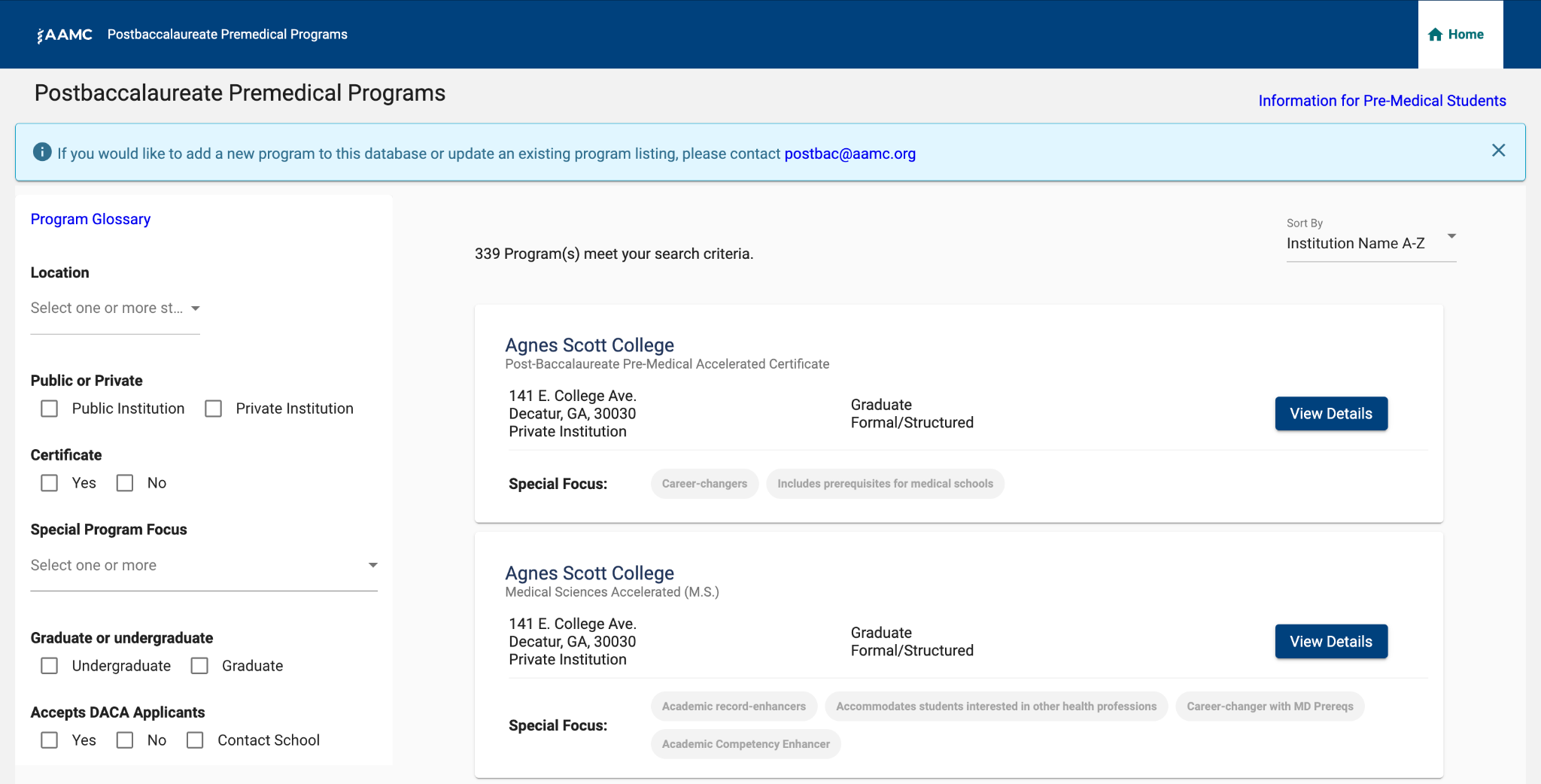
You can use the AAMC Postbaccalaureate Premedical Programs database to find post-bacc programs based on their location, focus, and other criteria. You can filter by program type (career changer, academic enhancer, or underrepresented in medicine), whether the program offers linkage agreements with medical schools, and whether it’s structured or unstructured.
Yes, some programs, like Fordham University, offer part-time, evening, and weekend courses specifically designed for career changers and working professionals, allowing students to move at their own pace. Unstructured post-bacc programs generally offer the most flexibility because you select individual courses each semester rather than following a fixed cohort schedule.
Post-bacc programs can last one to three years, depending on full-time or part-time enrollment, so a part-time path simply means a longer timeline. Check whether your target program allows part-time enrollment, because structured cohort programs often require full-time commitment.
Yes, post-bacc programs increase your med school acceptance chances when they address a specific weakness in your application. A strong post-bacc GPA can make up for a weaker undergraduate GPA because it gives admissions committees recent evidence that you can handle rigorous science coursework.
Programs with linkage agreements offer an even more direct advantage. Linkage is a formal agreement between a post-bacc program and a medical school that enables qualified students to accelerate the application process, and some linkage agreements guarantee an interview at the partner school.
A post-bacc alone does not guarantee admission. But it removes the academic red flags that would otherwise keep your application from being reviewed.
You should apply to post-bacc programs that are affiliated with med schools if you want a built-in pathway to a specific medical school. Linkage agreements may guarantee an interview at a particular school. And many medical schools accept a substantial number of students who perform well in their post-bacc programs.
Affiliated programs also give you access to the medical school's faculty, clinical sites, and advising resources while you complete your coursework. The tradeoff is that affiliated programs tend to be more competitive and more expensive.
If you don’t have a strong preference for a specific medical school, a non-affiliated program that fits your budget and schedule can serve you just as well.
Post-bacc programs offer undergraduate-level coursework and typically award a certificate, not a degree. Master's programs (including Special Master's Programs) offer graduate-level coursework and award a master's degree. The key distinction for your medical school application: Work completed in post-bacc programs can adjust your undergraduate GPA, while SMPs provide an additional GPA that is separate from your undergrad GPA.
Acing your post-bacc classes can increase your GPA by a few tenths of a point, such as from 2.8 to 3.1. The actual impact depends on how many undergraduate credits you already have. When you already have a large number of undergraduate science credits, your GPA will not move very much, even with straight As, because each new course represents a smaller fraction of your total.
Post-bacc programs are moderately difficult to get into. Top post-bacc programs only accept around 30%-40% of applicants. GPA requirements for admission vary by institution, ranging from as low as 2.5 to as high as 3.5. Structured career changer programs at well-known universities are the most competitive and often require interviews.
Unstructured or DIY post-bacc options at four-year universities have lower barriers to entry because you are enrolling as a non-degree student rather than applying to a formal program.
Whether you can work while enrolled in a post-bacc program depends on the program structure. Some programs allow students to work while completing their coursework, particularly unstructured or part-time programs. However, some intensive full-time programs explicitly state that the program's intensity does not allow participants to hold employment.
If you need to work, look for evening programs or part-time options, and be realistic about the course load you can handle while maintaining the high grades that make the investment worthwhile.
No, most post-bacc programs do not require the MCAT for admission. Career changer programs expect you to take the MCAT after completing your prerequisite coursework. Many include MCAT preparation as part of the curriculum.
The major difference between Special Master's Program (SMPs) and post-baccs is that post-bacc programs can adjust your undergraduate GPA, while SMPs provide a separate graduate GPA and confer a master's degree.
An SMP is a graduate-level program, typically one to two years, designed to mirror the first year of medical school. Students in SMPs take advanced biomedical science courses, often alongside first-year medical students, and earn a master's degree upon completion.
SMPs are often more rigorous and more accurately simulate the medical school curriculum, usually involving graduate-level courses sometimes taken alongside medical students.
Choose a post-bacc if you need to complete prerequisites or raise your undergrad GPA by a few tenths. Choose an SMP if you are 0.4 to 0.9 GPA points off your target, because a separate graduate GPA helps reset your academic narrative rather than trying to inch your existing GPA upward.
Yes, international students can apply to post-bacc programs, but only some accept them. Visa requirements and eligibility policies vary significantly by institution. Some programs offer full visa sponsorship and support through their international studies offices, while others don’t provide any visa sponsorship and explicitly exclude applicants who need a student visa or Form I-20. Check each program's international student policy before you apply.


.svg)


