For expert tips on how to get into Morehouse School of Medicine (MSM), read our comprehensive guide.
If you're just here for the requirements, click here.
Privacy guaranteed. No spam, ever.
Morehouse School of Medicine Acceptance Rate: 1.60%
Morehouse School of Medicine’s acceptance rate is 1.60%. According to the Medical School Admission Requirements (MSAR) database, MSM received 6,873 verified applications in the 2025-2026 application cycle, and 110 students matriculated. In other words, fewer than 2 out of every 100 applicants earned a seat in the entering class.
The table and interactive graph below show MSM's acceptance rate based on the most recent cycle's AAMC data:
Year
Number of Applications
Number of Matriculants
Acceptance Rate
2025-2026
6,873
110
1.60%
2024-2025
6,855
105
1.53%
2023-2024
6,992
110
1.57%
2022-2023
7,095
125
1.76%
2021-2022
8,939
110
1.23%
1.60%
Acceptance Rate (2025–2026)
6,873
Applications
110
Matriculants
2 in 100
Applicants Accepted
Out of 100 applicants…
Accepted (~2)
Not accepted (~98)
Acceptance rate by cycle
Note: Acceptance rates reflect the number of matriculants divided by verified applications for each cycle, as reported by the AAMC's MSAR database.
MSM's average acceptance rate from 2021-2022 through 2025-2026 is approximately 1.52%, meaning only about 1 out of every 66 applicants ultimately matriculated.
Class size held steady throughout the period, with MSM enrolling between 105 and 125 matriculants per cycle. Even in the most favorable year (2022-2023, with a 1.76% acceptance rate), fewer than 2 applicants out of every 100 earned a seat.
How Hard Is It to Get Into Morehouse School of Medicine?
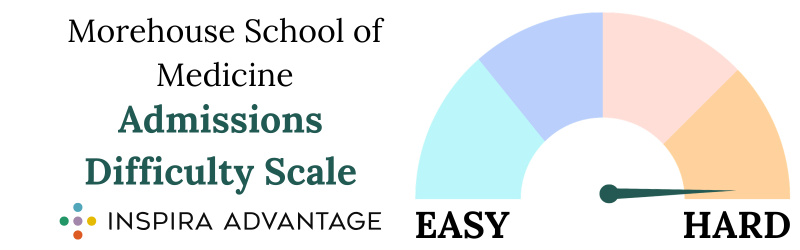
Getting into Morehouse School of Medicine is exceptionally difficult. A 1.60% acceptance rate places MSM among the most selective medical schools in the United States. With only 110 seats and nearly 7,000 applicants, roughly 60 people are competing for every single spot at MSM.
What Is Morehouse School of Medicine's Acceptance Rate for In-State Applicants?
The acceptance rate for in-state residents at Morehouse School of Medicine is 7.54%. MSM received 822 verified in-state applications, extended 196 interview invitations, and matriculated 62 students. Georgia residents make up only 12% of the total applicant pool but fill 56% of the entering class.
What Is Morehouse School of Medicine's Acceptance Rate for Out-of-State Applicants?
The acceptance rate for out-of-state applicants at Morehouse School of Medicine is 0.80%. Of 5,997 out-of-state verified applications, 319 were invited to interview, and just 48 students matriculated. Out-of-state applicants represent 87% of the total pool but occupy only 44% of the entering class.
What Is Morehouse School of Medicine's Acceptance Rate for International Students?
The acceptance rate for international applicants at Morehouse School of Medicine is 0%. In the 2025-2026 admissions cycle, there were 54 international applications submitted, but no international students received interview invitations, and none matriculated.
How Many People Apply to Morehouse School of Medicine Every Year?
Approximately 6,800 to 8,900 applicants apply to Morehouse School of Medicine each year. Despite significant swings in application volume over the past five years, MSM holds its class size steady at around 105 to 125 matriculants.
Privacy guaranteed. No spam, ever.
Admissions Statistics
Morehouse School of Medicine Median MCAT Score: 508
Students admitted to the Morehouse School of Medicine’s recent class had a median MCAT score of 508. The matriculating class had a median MCAT score of 505.
While MSM does not publish a minimum MCAT requirement, MSAR data shows that applicants admitted to the 2025 class scored competitively across every section of the exam:
MCAT Section
Median Score
Chemical and Physical Foundations of Biological Systems
127
Critical Analysis and Reasoning Skills
126
Biological and Biochemical Foundations of Living Systems
127
Psychological, Social, and Biological Foundations of Behavior
128
508
Median MCAT Score of Accepted Applicants
501
10th
504
25th
508
Median
513
75th
516
90th
Your MCAT Score508
472486500514528
At the median of accepted applicants
Note: This school does not publish a minimum MCAT score requirement. MCAT scores are one factor in a holistic review process that also considers GPA, extracurriculars, research, clinical experience, and personal statements.
The table below shows the MCAT score range for MSM admits and matriculants based on percentile data:
Percentile
MCAT Score for Accepted Applicants
MCAT Score for Matriculants
10th Percentile
501
499
25th Percentile
504
502
Median
508
505
75th Percentile
513
509
90th Percentile
516
513
The 508 median MCAT score for MSM admits sits at the 74th percentile of all test-takers. That means the typical enrolled student at MSM scored higher than 74% of everyone who took the test. The median national MCAT score is 500. So MSM's median lands 8 points above where half of all test-takers fall.
The MSAR also reports that MSM’s accepted applicants had an average MCAT score of 508.6. In comparison, the AAMC reports that all 2025 medical school applicants had an overall average MCAT score of 506.3.
That means successful MSM applicants have MCAT scores that are about 2.3 points higher than the overall applicant average.
What MCAT Score Makes You Competitive at Morehouse School of Medicine?
A 513+ MCAT score makes you competitive at MSM because it aligns with the scores of the top 25% of admitted students.
Here’s what each score level means for your competitiveness:
⚈ A 508 MCAT score places you at MSM's median for accepted students and shows you meet the school’s academic benchmarks. You still need strong community involvement, clinical experience, and clear alignment with MSM's mission to serve underserved communities to stand out.
⚈ A 513 MCAT score puts you in the top 25% of accepted students and gives your application a noticeable academic edge.
⚈ A 516 MCAT score places you in the top 10% of admittees and signals exceptional academic readiness well above the typical MSM admit.
Morehouse School of Medicine Median GPA: 3.77
MSM’s accepted applicants had a median GPA of 3.77, and matriculants had a median GPA of 3.73.
While MSM does not publish a minimum GPA requirement, MSAR data reveals the academic profile of its applicants. The table below shows the total GPA percentile range for the 2025-2026 MSM admits and matriculants.
Percentile
Total GPA for Accepted Students
Total GPA for Matriculants
10th Percentile
3.37
3.25
25th Percentile
3.60
3.48
Median
3.77
3.73
75th Percentile
3.92
3.87
90th Percentile
3.97
3.95
508
Median MCAT Score of Accepted Applicants
501
10th
504
25th
508
Median
513
75th
516
90th
Your MCAT Score508
472486500514528
At the median of accepted applicants
Note: Morehouse School of Medicine does not publish a minimum MCAT score requirement. MCAT scores are one factor in a holistic review process that also considers GPA, extracurriculars, research, clinical experience, and personal statements.
The spread from 3.37 at the 10th percentile to 3.97 at the 90th percentile is notably wide. Some students with GPAs in the mid-3.2 range were still admitted alongside near-4.0 applicants. This reinforces that MSM weighs the full application rather than screening on academics alone.
This large range of GPAs means that a lower GPA does not take you out of the running for admission. But every other part of your application, like your personal statement and letters of recommendation, extracurriculars, and secondary essays, needs to make up for it.
The average GPA of successful MSM admits was 3.67. In comparison, the average 2025 med school applicant had a 3.67 GPA, according to the AAMC. MSM applicants have GPAs that are about 0.05 points higher on average, indicating a slightly stronger academic profile than the broader medical school applicant pool.
What GPA Makes You Competitive at Morehouse School of Medicine?
A 3.92+ GPA makes you highly competitive at MSM because it aligns with the school’s 75th percentile GPA for accepted students.
Here’s what each GPA level means for your competitiveness:
⚈ A 3.77 GPA places you at MSM’s median for accepted students and keeps you academically on target but not above the typical admit. This GPA alone won’t make you stand out, so the rest of your application will need to carry more weight.
⚈ A 3.92 GPA places you in the top 25% of accepted students and gives your application a clear academic advantage.
⚈ A 3.97+ GPA places you in the top 10% of accepted students and signals elite academic readiness as a top performer in the admitted pool.
Morehouse School of Medicine Median Science GPA: 3.69
The median science GPA among students accepted to MSM is 3.69, while the median science GPA for matriculants is 3.64.
Percentile
Total Science GPA for Accepted Students
Total Science GPA for Matriculants
10th Percentile
3.28
3.14
25th Percentile
3.48
3.38
Median
3.69
3.64
75th Percentile
3.90
3.83
90th Percentile
3.96
3.92
The science GPA distribution sits slightly lower than the total GPA across all percentiles. That’s typical. The 10th percentile GPA of 3.14 and the 25th percentile GPA of 3.38 reflect MSM's willingness to look past imperfect science coursework when a candidate demonstrates the drive and character the admissions committee looks for.
What Science GPA Makes You Competitive at Morehouse School of Medicine?
A science GPA of 3.83 or higher is competitive at Morehouse School of Medicine, as it matches the top 25% of the 2025 admits. If your science GPA falls in the 3.38 to 3.64 range, focus on demonstrating consistent performance trends and strong MCAT section scores in the sciences to reinforce your readiness.
A declining science GPA will always be a red flag to admissions committees. So always aim for an upward trend, even if your overall GPA is lower.
Privacy guaranteed. No spam, ever.
Morehouse School of Medicine Admissions Requirements
The table below lists all of Morehouse School of Medicine’s prerequisites:
Required Course
Requirement
Biology with lab
One full year
General chemistry with lab
One full year
Organic chemistry with lab
One full year
Physics with lab
One full year
College-level mathematics
One full year
English including composition
One full year
You need to complete all prerequisite coursework before matriculation. An accepted student who fails to complete all required courses or maintain their academic standing leading up to enrollment will be denied admission.
Morehouse School of Medicine Interview Format
MSM conducts two in-person, on-campus, one-on-one interviews with faculty members that follow a traditional, conversational format. Each interview lasts 30 to 60 minutes. They don’t offer virtual interviews. And they’ll consider accommodations for special circumstances on a case-by-case basis.
The interview day includes a light breakfast and lunch, a campus and hospital tour, an overview of the program, a discussion with the Associate Dean of Admissions, and the two interviews.
What Is Morehouse School of Medicine's Interview Rate?
Morehouse School of Medicine's overall interview rate in the 2025-2026 admissions cycle was 7.49%. Of 6,873 verified applications, 515 applicants received interview invitations.
The interview rate varies sharply by residency status:
In-state residents: 196 interviews from 822 applications, resulting in a 23.84% interview rate
Out-of-state applicants: 319 interviews from 5,997 applications, resulting in a 5.32% interview rate
International applicants: zero interview invitations
Georgia residents received interviews at more than four times the rate of out-of-state applicants.
Privacy guaranteed. No spam, ever.
Secondary Application Essays
MSM participates in AMCAS and emails a secondary application to selected applicants by invitation after the initial file screening.
Your secondary essays should reinforce your personal narrative, demonstrate maturity and reflection, and clearly align with MSM's values, including health equity, service to underserved communities, and a commitment to addressing healthcare disparities.
Morehouse School of Medicine's 2025-2026 secondary essay prompts are:
Question 1: Give an example of when you have shown resilience and how you would overcome academic adversity if encountered in medical school. (200 words)
How to Approach This Prompt
Start with a specific example of real adversity, not a vague challenge. Focus on what actually went wrong, what you did in response, and what changed as a result. Then connect that experience directly to medical school by outlining how you would handle future academic difficulty.
Make sure you:
⚈ Highlight growth and self-awareness
⚈ End with a clear, practical plan (study strategies, support systems, accountability)
Avoid generic answers like “I work hard” or “I stay positive.” MSM wants specific evidence of your resilience.
Question 2: In what ways do you plan to contribute to the Morehouse School of Medicine community, both during your time as a student and beyond? (200 words)
How to Approach This Prompt
Be specific about what you will do at MSM, not just what you value. Tie your past experiences to future contributions at MSM and extend that impact beyond medical school.
Make sure you:
⚈ Connect your background to MSM’s focus on health equity and underserved populations
⚈ Name specific ways you will contribute (mentorship, outreach, specific student orgs, Georgia-based community work)
⚈ Talk about long-term commitment, not just short-term involvement
Strong answers feel grounded and forward-looking. Weak answers stay broad and generic.
Question 3: Imagine you are a healthcare provider working at a community clinic with limited resources. You are responsible for distributing a small number of free glucose monitors to patients with diabetes. You have two patients who qualify: one is highly engaged, follows care instructions, and has shown consistent improvement. The other struggles with managing their condition due to low literacy, language barriers, and unstable housing, and often misses appointments. You only have one monitor left. Who do you give it to, and why? How would you navigate the situation in a way that reflects a commitment to health equity? (200 words)
How to Approach this Prompt
There is no “perfect” answer to this prompt. Your reasoning matters more than your choice. You may decide to prioritize the patient with greater structural barriers because that reflects an equity-based approach, or you may choose the more engaged patient if you argue the monitor will have the most immediate impact on them.
Either answer can work if it is thoughtful, ethical, and grounded in health equity.
Make sure you:
⚈ Define your decision clearly and early
⚈ Ground your reasoning in health equity, not convenience or compliance
⚈ Offer a plan to support both patients, even with limited resources
Avoid framing this as a simple “deserving vs. undeserving” choice. MSM is looking for nuanced thinking that reflects real-world care.
Privacy guaranteed. No spam, ever.
How to Improve Your Chances of Getting Into Morehouse School of Medicine
The most effective tips to get into Morehouse School of Medicine are proving your commitment to underserved communities with documented experience, logging substantive physician shadowing hours early in your premed path, and completing the AAMC PREview exam, even though it’s technically optional.
Here’s a closer look at each of these tips:
Prove Your Commitment to Underserved Communities, Especially if You’re an Out-of-State Applicant
In-state (Georgia) residents hold a massive advantage at MSM, with a 7.54% acceptance rate compared to 0.80% for out-of-state applicants. If you’re applying from outside Georgia, you can’t afford to submit a generic application about "wanting to help people."
MSM's mission centers on improving the health and well-being of people of color and underserved urban and rural populations in Georgia, the nation, and the world. Your application needs to reflect that same focus with specific, documented experience.
Here is a framework for building a competitive community engagement profile:
Direct service: Volunteer consistently at free clinics, federally qualified health centers, or mobile health units serving low-income or uninsured patients. Sustained commitment over six to 12 months carries far more weight than one-off events.
Health education and outreach: Lead or participate in health literacy workshops, chronic disease prevention programs, or nutrition education in underserved neighborhoods.
Research with a health equity focus: Conduct or assist with research on health disparities, social determinants of health, or access gaps in minority communities.
Georgia-specific connections: If you can, volunteer, work, or conduct research in rural or underserved parts of Georgia (even if it’s virtually). A non-resident with direct Georgia experience sends a much stronger signal at a school that explicitly prioritizes Georgia residents and applicants willing to serve the state's communities.
Complete Substantive Physician Shadowing Early Into Your Pre-Med Path
MSM explicitly requires physician shadowing, which is notable because many medical schools only recommend it. In our Pre-Med 101 webinar, Dr. Bima Hasjim, a general surgery resident, former admissions officer at UC Irvine, and admissions expert at Inspira Advantage, recommends at least 500 clinical hours to be considered safe.
More important than the raw number of hours you accumulate is the length of your shadowing commitment. A single 40-hour week does not compare to 12 months of consistent weekly exposure. Understanding what Morehouse School of Medicine is looking for helps you structure your shadowing strategically rather than just accumulating hours.
Here’s how to structure your shadowing for maximum impact:
Primary care settings: Shadow family medicine physicians or pediatricians. MSM trains primary care providers, so experience here shows direct alignment.
Community health centers: Shadowing in underserved settings carries extra weight. Seek out federally qualified health centers, rural clinics, or hospitals known to serve underserved populations.
Variety of specialties: While primary care should anchor your experience, exposure to two or three additional specialties shows a broader understanding of medicine.
Document and reflect: Track hours, settings, and specific interactions. Be ready to discuss how shadowing changed your thinking, not just where you showed up.
Start early in your undergraduate career. Waiting until the summer before you apply leaves no time to build sustained, meaningful experience.
Take the AAMC PREview Exam
MSM strongly recommends applicants take the AAMC PREview exam for the 2026-2027 admissions cycle. "Strongly recommended" at a school with a 1.60% acceptance rate effectively means it’s expected. The PREview exam assesses preprofessional competencies like ethical reasoning, cultural humility, and teamwork. These are all qualities that sit at the core of MSM's mission.
A strong PREview score reinforces that you have the interpersonal and ethical foundation MSM is selecting for, beyond just academics. When an application component is optional, some candidates will skip it. If two applicants have similar stats and extracurricular depth, the one who completed the PREview and scored well has a clear edge.
Every optional element you complete is another opportunity to prove your candidacy and separate yourself from other applicants, making it one of the simplest strategies to boost your MSM admissions odds.
Inspira Advantage can help you strengthen every part of your application and maximize your chances of admission. Learn how we help students get into top med schools like MSM every year.
Privacy guaranteed. No spam, ever.
MD Programs Offered
Morehouse School of Medicine offers a core MD program and several dual-degree tracks for students who want to expand their training across medicine, research, public health, business, and clinical science.
MD Program
Length
Key Information
MD Program
4 years
Traditional MD focused on primary care and health equity, with clinical training at affiliated Atlanta hospitals and a third-year site in Columbus, GA.
MD/PhD (Biomedical Sciences)
7-9 years
Students enter after two years of preclinical training, complete PhD coursework and a dissertation, and then return for clinical rotations.
MD/MBA (Georgia Tech Scheller College of Business)
5 years
Students complete the first three years at MSM; then spend their fourth year taking 39 MBA credit hours at Georgia Tech's Scheller College of Business. Designed for future leaders in healthcare administration, innovation, and entrepreneurship.
MD/MSCR (Master of Science in Clinical Research)
5 years
Designed for medical students interested in clinical and translational research. The MSCR portion adds one year to the MD program.
Tuition and Scholarships
First-year MD students at MSM pay $54,702 in tuition and $12,612 in fees for the 2025-2026 academic year. When you add in room, board, books, transportation, and personal expenses, the total first-year cost of attendance reaches $115,918.
How Much Does Morehouse School of Medicine Cost for 4 Years?
The total estimated cost for four years of the MSM MD program is around $464,344, based on official school tuition data.
Scholarships and Financial Aid at Morehouse School of Medicine
MSM offers several scholarships to help students manage costs:
Merit Scholarships: Awarded to entering MD students recommended by the Admissions Committee
Georgia Board of Healthcare Workforce Loan Repayment: Covers tuition, fees, and educational expenses for students who commit to practicing full-time in an underserved rural Georgia county with a population of 50,000 or less. Applicants must be Georgia residents enrolled in an accredited U.S. medical school.
National Health Service Corps (NHSC) Scholarship: Pays tuition, required fees, and a monthly stipend for 12 months. Recipients owe one year of full-time primary care service in a health professional shortage area for each year of support, with a two-year minimum commitment. Preference goes to applicants from disadvantaged backgrounds.
Armed Forces Health Professions Scholarship Program: Covers full tuition, fees, books, supplies, and a monthly stipend. Recipients serve one year of active duty for each year of the award. Applicants must be U.S. citizens and meet physical and moral qualifications.
Ty Cobb Scholarship: Available to Georgia residents attending medical school who demonstrate financial need.
George and Pearl Strickland Scholarship: Available to low-income Georgia residents enrolled or accepted at MSM. Selection considers academic records, community activities, work history, and character references.
Apply for federal aid through FAFSA as early as possible. And contact MSM's financial aid office directly to understand which institutional scholarships apply to your program and enrollment year.
Morehouse School of Medicine Application Timeline
Below is Morehouse School of Medicine's full application timeline based on the 2025-2026 cycle:
Date
Deadline
May 1, 2025
AMCAS application opens
May 28, 2025
Applicants may begin submitting AMCAS applications
June - September 2025
AAMC PREview exam available
August 2025
Interview season begins
September 2025
Last MCAT and PREview exam date accepted
December 1, 2025
AMCAS application deadline
January 2, 2026
Secondary application, green card form, and foreign credential evaluation deadline
March 2026
Interview season ends
November 2025 - June 2026
Admission decisions communicated to applicants
February 19 - April 30, 2026
Accepted applicants may select "Plan to Enroll" in AMCAS
April 30, 2026
Deadline to select "Plan to Enroll" and last day for refundable $100 pre-enrollment deposit
June 2, 2026
Deadline to submit completed matriculation packet
June 9, 2026
Deadline to select "Commit to Enroll" in AMCAS
FAQs
Does Morehouse School of Medicine Require Casper?
No, Morehouse School of Medicine does not require the Casper exam.However, MSM strongly recommends that applicants in the 2026 admissions cycle take the AAMC PREview exam, which also assesses pre-professional characteristics needed to succeed in medical school.
Does MSM Give Preference to Georgia Residents?
Yes, MSM does give preference to Georgia residents. They explicitly state that “qualified residents of Georgia are given high priority” on their admissions page.The admissions data also confirms this statement: Georgia residents have a 7.54% acceptance rate, while out-of-state applicants have a 0.80% acceptance rate.
Does Morehouse School of Medicine Accept Online Prerequisite Courses?
No, Morehouse School of Medicine doesn’t accept online prerequisite courses, unless they’re online math courses and AP courses that appear on your official undergraduate transcript. MSM won’t consider any online science prerequisites.
Arush Chandna is the Co-Founder of Inspira Advantage and a nationally recognized expert on graduate school admissions. Arush has used his 12+ years of experience in higher education to help 10,000+ applicants get into their dream graduate programs.






.svg)


