Get in touch: +1 888 453 5021





Most vet school applicants prepare for the MMI the same way they prepared for every other interview in their lives: They memorize answers to common questions and hope the right one comes up.
But that approach falls apart by station three.
I've spoken with our top vet school consultants about how to properly prepare for the MMI, and the difference between applicants who score well and those who don't often comes down to how they structure their thoughts and answers. Candidates who walk in with a reliable framework for organizing their thoughts significantly outperform candidates with stronger academics but weaker reasoning skills in every cycle.
The example questions and answers, and tips below will help you properly prepare for your vet school interview.
The MMI for vet school is a timed circuit of short, independent stations that ask you different questions. Each station presents a different scenario or question and uses a separate evaluator, so your performance is measured across multiple data points rather than filtered through one person's impression. The MMI is one requirement of your application.
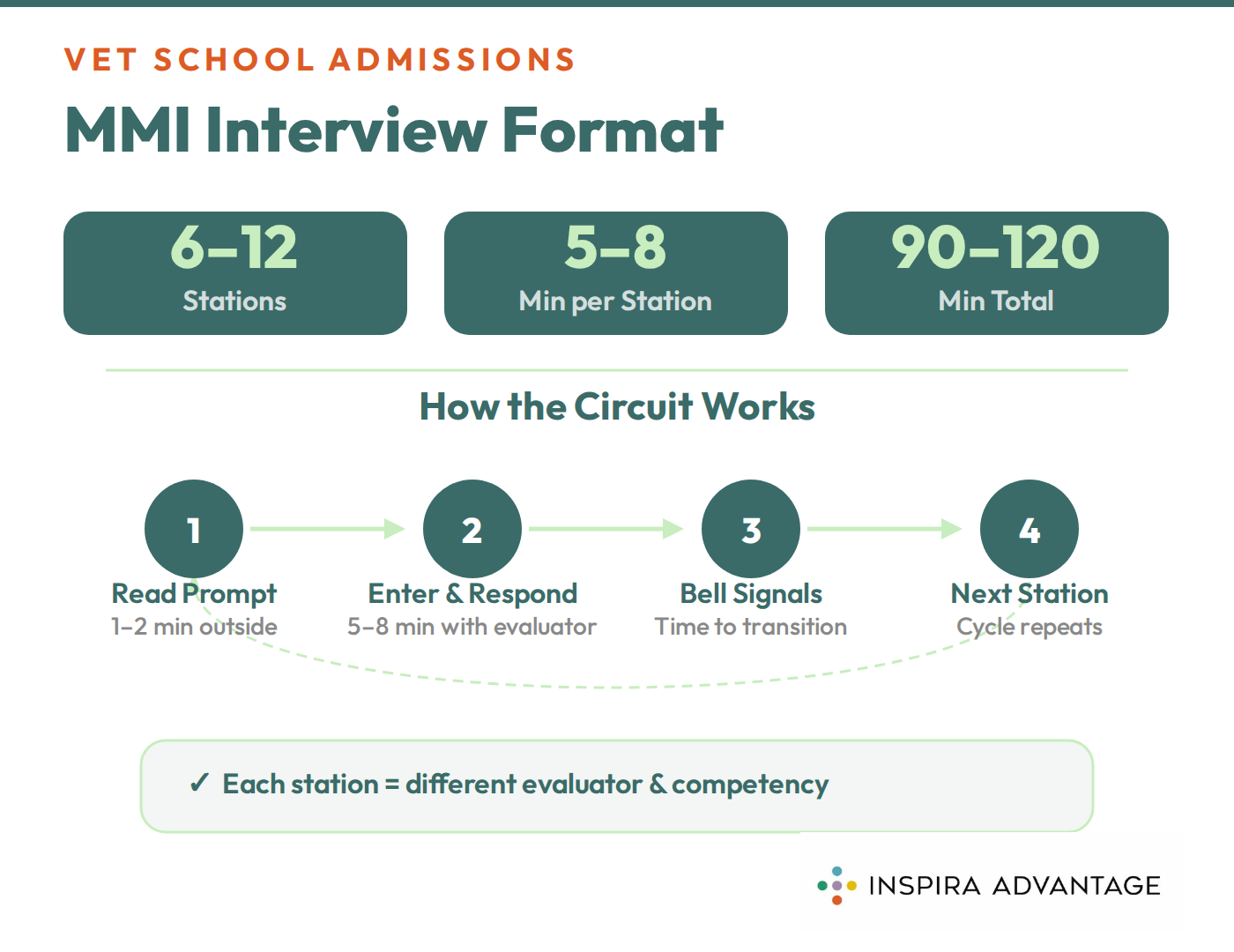
You rotate through six to 12 stations, each staffed by a different evaluator who scores you on a specific competency. The stations run back-to-back with brief transitions between them, and the entire circuit takes roughly 90 minutes to two hours, depending on the program.
A bell or signal marks each transition. Before entering a station, you get one to two minutes to read the scenario posted outside the door or on a screen. Once inside, you have five to eight minutes to respond. When the signal sounds again, you move to the next station, and the cycle repeats.
MMI stations span a range of formats designed to surface different professional competencies. At one station, you might work through an ethical dilemma involving animal welfare with an evaluator. At the next, you might role-play a difficult conversation with a trained actor playing a distressed pet owner. Another station could ask you to solve a problem collaboratively with a fellow applicant.
Other common formats include traditional behavioral interview questions about your motivation and experience, as well as critical-thinking exercises that test logical reasoning on a topic unrelated to veterinary medicine. Each station targets a specific attribute, and the variety ensures that no single skill set carries the entire evaluation.
The five- to eight-minute window at each station is purposely tight. Evaluators assess not just your final answer but also how you structure your reasoning, how you communicate under time pressure, and whether you demonstrate awareness of ethical complexity. Reaching a "correct" conclusion matters far less than showing a clear, thoughtful process for getting there.
Each evaluator scores independently using a standardized rubric. Scores from one station have no influence on scores at the next because a different evaluator handles each one. Your final result is an aggregate across all stations, which protects you from the impact of a single rough performance and rewards consistency across the circuit.
The following 10 questions reflect the types of scenarios you'll encounter across MMI stations. Study the reasoning behind each answer rather than memorizing the responses.
A client brings in a healthy 3-year-old Labrador and asks you to euthanize the dog because they're moving to an apartment that doesn't allow pets. They say rehoming isn't an option because the dog has separation anxiety and won't adjust. How do you handle the situation?
A dog has been hit by a car and needs emergency surgery that will cost approximately $5,000. The owner is visibly distressed and tells you they can't afford the procedure. What do you do?
During a clinical skills lab, you notice a classmate restraining a dog too aggressively. The dog is showing signs of distress, including panting, cowering, and trying to escape. Your classmate seems frustrated and unaware that their technique is causing the problem. What do you do?
You're working with a dairy farmer who asks you to clear cattle for sale before the mandatory withdrawal period for a recently administered antibiotic has passed. The farmer explains that they're under severe financial pressure and will lose the farm if they miss the market window. How do you respond?
You are the only veterinarian on duty at a small rural clinic on a Saturday night. Three cases arrive within minutes of each other:
How do you prioritize which one to treat?
You and three classmates are working on a research poster for a veterinary conference. One team member contributed very little to the data collection and analysis but has been presenting the project to faculty as primarily their work. Other team members have noticed, but no one has addressed it. What do you do?
A client brings in a sick cat and explains that they want to treat the animal with traditional herbal remedies from their cultural practice rather than the antibiotics you've recommended. The cat has a bacterial infection that will likely worsen without conventional treatment. How do you proceed?
During a morning shift at your clinical rotation, you notice that a senior veterinarian's hands are trembling, their speech is slightly slurred, and they smell faintly of alcohol. They're scheduled to perform a surgery in 30 minutes. What do you do?
You're a veterinarian in a rural community, and you diagnose rabies in a dog that has bitten three people in the past week. The dog's owner is a well-known and respected member of the community who insists the dog is fine and refuses to believe the diagnosis. Local authorities are asking for your guidance. What do you do?
During a veterinary school group project, a classmate makes a dismissive comment about a case study involving a low-income client, saying, "People who can't afford vet bills shouldn't own pets." Several group members laugh. One group member you know comes from a low-income background and goes quiet and looks uncomfortable. How do you respond?
Start preparing at least four to six weeks before your interview date. The MMI rewards structured thinking under pressure. And building that skill takes repetition across different scenario types. Candidates who wing it almost always sound scattered at stations three and four, even if they nailed station one on adrenaline alone.
I've spoken with MMI evaluators across multiple vet programs, and they all describe the same pattern: The applicants who score lowest aren't the ones who give wrong answers. They're the ones who ramble for five minutes without ever stating a clear position.
Evaluators can identify within the first 30 seconds whether a candidate has practiced with a timed structure or is just winging it. Candidates who wing it tend to repeat themselves after the two-minute mark, dodge their reasoning with phrases like "I think maybe," and run out of new material before the station ends.
Candidates with a structured framework know exactly how to spend each portion of their time. The strategies below are built around what evaluators actually score, not what most applicants assume they're looking for.
Use Inspira Advantage's CARE framework to answer MMI questions for vet school:
Context (15 seconds): Name the core tension in the scenario. "The central issue here is balancing client autonomy with an animal's welfare." One or two lines that show you understand what makes the scenario complex is all you need before moving into your analysis.
Analysis (30 seconds): Explore two to three perspectives and acknowledge competing values without dismissing any side. "The pet owner has a right to make decisions about their animal's care, but the veterinarian also has a professional obligation to advocate for the animal's well-being."
Resolution (30 seconds): State what you would do and why. "I would recommend the veterinarian have a transparent conversation with the owner about all available options, including palliative care, while making clear which option best serves the animal's welfare." Ground your decision in a specific principle such as duty of care, informed consent, or harm reduction.
Extension (15 seconds): Reflect on limitations or what you would do differently in a slightly changed scenario. "If the animal were in acute distress rather than managing a chronic condition, I'd weigh the urgency differently and prioritize immediate intervention over client deliberation." Showing you can qualify your own position signals intellectual maturity to evaluators.
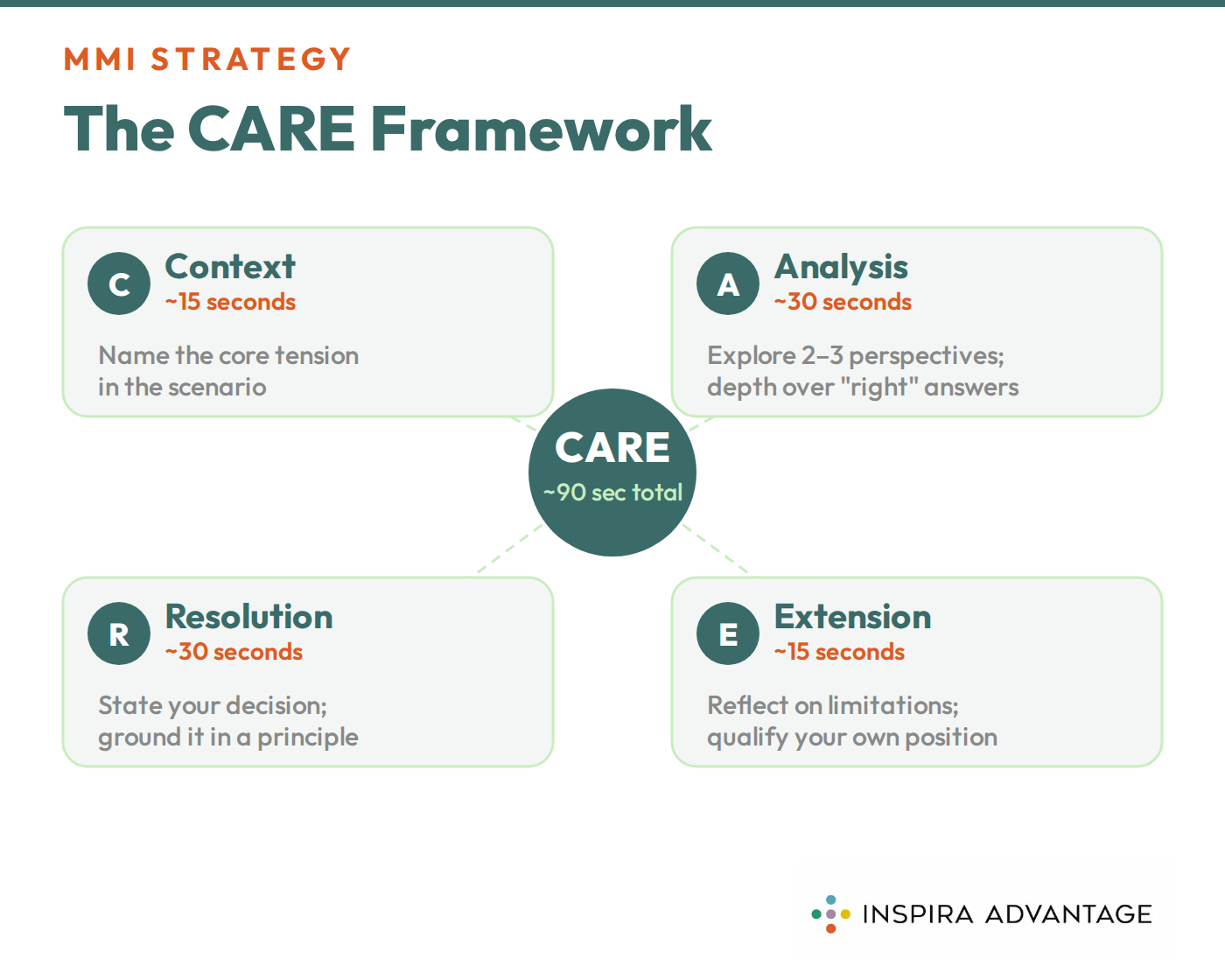
Practice delivering CARE responses in 90 seconds until the structure becomes automatic.
Run at least three full mock MMIs before your interview. You can run these mock interviews with friends, family, or an admissions counselor.
Set up each mock interview with eight stations, five minutes per station, and a two-minute transition between stations. Use a phone timer with an alarm. The transition period matters because it trains you to mentally reset. Many applicants carry the frustration of a rough station into the next one and underperform for the rest of the MMI.
Record at least one full mock interview on video. Watch for filler words, eye contact drops, and moments where you summarize instead of taking a position. Most applicants don't realize how often they use vague language until they see themselves doing it.
Spend the first 30 seconds reading the prompt carefully. Most applicants rush past the details and miss qualifiers that change the entire scenario. A prompt that says "your client cannot afford the recommended treatment" is very different from one that says "your client refuses the recommended treatment." One is a resource problem. The other is an autonomy problem.
Use the next 90 seconds to deliver your CARE response. Spend the remaining three minutes engaging with follow-up questions or expanding your reasoning. If the evaluator doesn't ask follow-ups, strengthen your own answer by exploring an alternative perspective you didn't initially cover.
Practice with a stopwatch until you internalize what 30 seconds and 90 seconds feel like. On interview day, you won't see a timer.
Start by naming the competing values in each ethical dilemma. Never pick one side immediately. Evaluators are not looking for the "correct" ethical answer. They want to see your reasoning process.
In a scenario where a farmer asks you to skip a withdrawal period for a medication to get livestock to market faster, the tension is between the client's economic pressure and public health responsibility. Acknowledge both sides before stating your position.
Anchor your resolution in a professional obligation. Veterinary codes of ethics, animal welfare legislation, and public health duties give you concrete reference points. Saying "I would follow the withdrawal guidelines because public health is a core professional duty" is stronger than "I think it's wrong to skip the withdrawal period."
Close by acknowledging the complexity. "I recognize the financial pressure the farmer faces and would want to explore alternative solutions that protect both the client's livelihood and public safety." Evaluators reward nuance over certainty.
Accept that one or two stations will feel like you answered poorly. Most applicants deal with similar feelings. The MMI is designed so that a single poor station doesn't automatically drop your overall score, because evaluators at each station score independently.
Between stations, take three slow breaths and reset. Don't replay what just happened. Focus on the physical sensation of breathing rather than overanalyzing your last answer. Walk into the next station as if it's your first.
If you freeze mid-station, say, "Let me take a moment to organize my thoughts." Evaluators expect pauses. Silence is always better than rambling, because rambling signals panic and makes it harder to recover your structure.
A strong vet school personal statement and solid academics carry weight alongside your interview performance. Treat the MMI as a chance to add a new layer to your candidacy rather than a pass-fail test.
Most veterinary admissions committees evaluate your MMI responses based on a structured competency framework. The Association of American Veterinary Medical Colleges (AAVMC) developed the Competency-Based Veterinary Education (CBVE) framework around nine domains of competence, each containing 32 individual competencies. Most accredited U.S. programs align their admissions criteria directly with these domains.
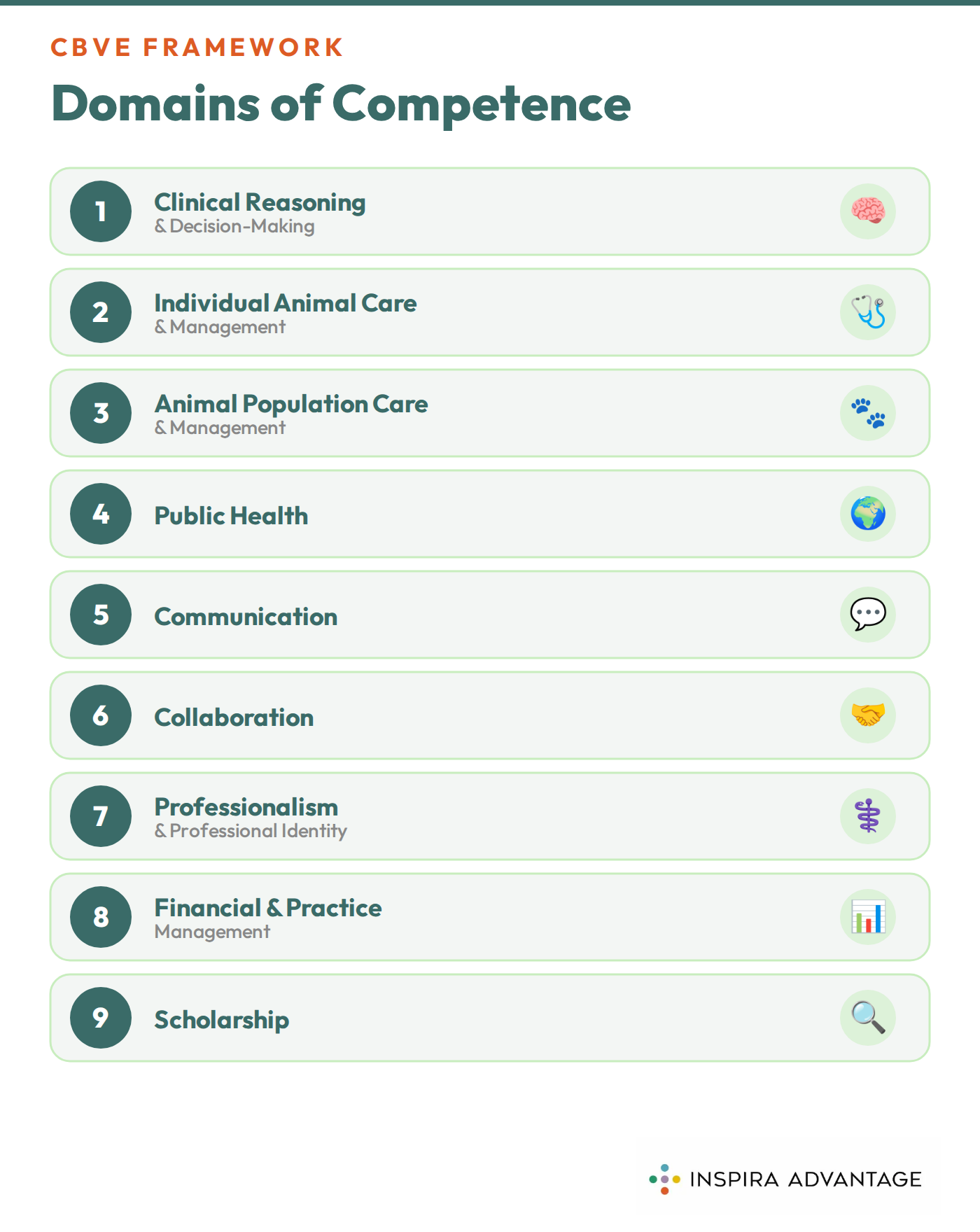
Knowing which of those nine domains drives interview decisions gives you a concrete advantage over candidates who walk in without a framework to guide their preparation.
Four of the nine AAVMC domains connect directly to the majority of MMI questions across vet programs:
Strong candidates listen more than they talk in the first 30 seconds of each station. Weak candidates start speaking before they've fully processed the prompt. Evaluators notice the difference immediately.
Active listening shows up in specific ways during an MMI station. When the scenario involves an actor, strong candidates paraphrase what the person said before responding. "It sounds like your main concern is the cost, not whether the procedure is necessary," demonstrates comprehension and buys you time to formulate a thoughtful answer. Jumping straight into a solution without confirming your understanding shows that you prioritize being helpful over being accurate.
Evaluators watch whether you catch the qualifiers and details that change the scenario's complexity. A prompt that says "the client has already consulted two other veterinarians" conveys something important about the client's state of mind. Missing that detail produces a generic answer. Catching it produces a specific one.
Evaluators distinguish between performed empathy and functional empathy. Saying "I understand how difficult that must be" is performed empathy. Adjusting your communication approach based on the person's emotional state is functional empathy. Only one of them scores well.
Functional empathy looks like slowing your pace when a client is overwhelmed. It looks like asking what the client's biggest concern is before launching into treatment options. It looks like validating a farmer's financial pressure before explaining why you still can't skip a withdrawal period. Each of these actions demonstrates that you read the emotional landscape of the interaction and adapted your behavior accordingly.
Evaluators also watch for empathy toward animals in scenarios where the animal isn't the focus. For example, a question about team conflict in a lab setting is primarily testing collaboration. But the candidate who also notices the stressed animal in the scenario and addresses its welfare demonstrates the kind of multi-layered awareness that admissions committees associate with strong clinical instincts.
Professional maturity shows up when a candidate acknowledges the limits of their own position. Evaluators score you higher when you say "I recognize that my approach has a tradeoff" than when you present your answer as the only reasonable option. Veterinary medicine rarely offers simple solutions, and admissions committees want to see that you already understand that.
Maturity also appears in how you handle situations that go poorly. Candidates who get flustered, apologize repeatedly, or try to restart their answer indicate that they lack the composure clinical environments demand. Candidates who pause, regroup, and continue with a slightly adjusted approach show that they can recover under pressure.
One overlooked marker of maturity is how candidates talk about other professionals. Scenarios involving colleagues who make mistakes or behave inappropriately test whether you can hold someone accountable without being self-righteous.
"I would report them immediately" scores lower than "I would raise my concern directly with them first and escalate if the behavior continued." Evaluators want to see judgment, not reflexive rule-following.
Evaluators penalize jargon, filler, and circular reasoning. Clear communication in an MMI station means short sentences, concrete language, and a logical progression from one point to the next.
Rambling for five minutes and eventually arriving at a good point still scores poorly because the evaluator had to work to find your argument.
Structure your response so the evaluator can follow it without effort. State your position in the first two sentences. Support it with two or three specific reasons. Address a counterargument. Close with a brief reflection.
Evaluators process six to 12 candidates in a row during an MMI circuit. The candidate whose reasoning is immediately clear has a significant advantage over the candidate who buries their best thinking inside a three-minute monologue.
Avoid passive language like "I think maybe" or "it could possibly be." Speak with the confidence of someone who has reasoned through the problem, even if you acknowledge uncertainty about the outcome.
"I would prioritize the cat with antifreeze poisoning because the treatment window is narrowing" is decisive. "I think I would probably start with the cat because antifreeze is pretty serious," communicates the same clinical knowledge with none of the conviction.
Candidates who can articulate their own biases, recognize gaps in their knowledge, and reflect on how their personal values shape their decisions stand out because most applicants never go that deep.
Self-awareness appears in small moments during MMI stations. A candidate who says, "My instinct is to prioritize the animal's welfare over the client's wishes, and I want to see whether that instinct is appropriate here," is demonstrating real self-awareness. Evaluators rarely see that level of reflection, and it scores exceptionally well.
You can build self-awareness into your preparation by reviewing your mock MMI answers and asking a specific question: "Where did I make an assumption I didn't examine?"
Every answer contains at least one. Maybe you assumed the client was being unreasonable. Maybe you assumed your colleague acted with bad intent. Maybe you assumed the financially constrained client hadn't already explored every option.
Identifying those assumptions now prevents them from flattening your reasoning on interview day. Evaluators reward candidates who interrogate their own thinking because that habit translates directly into better clinical judgment.
Veterinary schools use the MMI format to objectively assess non-cognitive skills, such as ethical judgment, empathy, critical thinking, and communication, that traditional interviews often miss.
The MMI assigns a different evaluator to each station, reducing bias for the overall interview. Your score becomes an average across six to 12 independent assessments rather than the product of one person's gut reaction.
No single evaluator sees enough of you to let a first impression overtake your answers. And one poor answer doesn't define your candidacy. Two interviewers could question the same applicant and walk away with very different impressions. The MMI's structure allows little room for bias.
Veterinarians deliver bad news to grieving pet owners, manage conflict with colleagues mid-surgery, and make judgment calls when protocols don't cover the situation at hand. No transcript or letter of recommendation shows how someone performs in those moments.
The MMI puts you in those moments. Instead of asking you to describe a time you handled a difficult conversation, a station drops you into one.
You might face an actor playing a distressed client whose dog needs a procedure they can't afford, or a scenario in which a colleague is cutting corners with patient records.
Your response happens in real time with an evaluator watching how you listen, how you structure your reasoning, and whether you default to empathy or defensiveness under pressure. Many vet schools use the MMI because the profession's hardest moments are interpersonal rather than technical.
Each station isolates a specific competency. One measures ethical reasoning. Another measures collaboration. A third tests how you communicate complex information to someone without a scientific background.
By the end of the circuit, the admissions committee holds a detailed profile of your strengths and gaps rather than a single overall impression.
Traditional interviews mix everything together. An applicant who tells a compelling story about teamwork might score well overall, even if they have poor ethical reasoning, because the interviewer's positive impression from the teamwork answer carries more weight. The MMI tries to prevent that from happening.
Strong performance at a collaboration station won't inflate your score at an ethics station, because a different evaluator assesses a different skill. Vet schools value the granularity because veterinary practice demands competence across multiple layers simultaneously.
In an MMI, each evaluator scores independently with no knowledge of how you performed at previous stations. So a stumble at station three has no effect on your score at station four.
Traditional interviews offer minimal opportunities for a reset. If a panel of interviewers forms a negative impression early in the conversation, the remaining 20 minutes become an uphill battle against confirmation bias.
Walk into each MMI station as a clean slate, because that's exactly how the evaluator sees you. The format also neutralizes the advantages that come from interview polish rather than actual competence.
Rehearsed applicants thrive in traditional interviews because they can steer the conversation toward prepared answers. The MMI removes that control by presenting unfamiliar scenarios that demand real-time reasoning. Your ability to think on your feet matters more than your ability to package a story you've told 10 times before.
The MMI is challenging for vet school applicants because it tests skills that most have never been formally evaluated on. Traditional interviews reward answers about your experiences and motivations. The MMI rewards real-time thinking, structured ethical reasoning, and emotional awareness under time pressure. Vet school applicants who feel confident discussing their clinical hours or animal research often struggle when a station asks them to navigate a conflict between a pet owner's wishes and an animal's welfare, with no preparation time between stations.
Start preparing for your vet school MMI at least four to six weeks before your interview date. The MMI tests real-time reasoning across veterinary-specific scenarios, so you need enough time to build a reliable response framework and pressure-test it under timed conditions. Spend the first two weeks learning a structured response approach and applying it across different scenario types until the framework feels automatic. Practice with prompts that reflect veterinary school priorities, such as animal-welfare dilemmas, client-communication challenges, ethical conflicts in clinical settings, and teamwork scenarios. The goal here isn't memorizing answers. You're training yourself to organize your thinking on the spot so you can walk into any station and deliver a clear, structured response.
You cannot retake an MMI interview within the same admissions cycle at the same school. Most vet programs offer one interview opportunity per application period, and your performance on that day is final. If you aren't admitted, you can reapply in a future cycle and interview again. Use the gap year to run more mock MMIs, gain additional clinical experience, and strengthen the areas where you felt least confident during your first attempt.
Each vet school MMI station is scored independently by a separate evaluator using a standardized rubric tied to a specific competency. Common competencies assessed at vet school MMI stations include ethical reasoning, communication skills, empathy, collaboration, and critical thinking. Evaluators score your reasoning process, how clearly you communicate, and your awareness of competing perspectives, rather than whether you reached a particular conclusion. Your final score is an aggregate across all stations, which means a single weak performance carries less weight than consistent quality throughout the circuit. A strong showing on an animal-welfare ethics station can offset a messy start in a teamwork scenario.
Not all veterinary schools use the MMI format. Many programs still rely on traditional panel interviews or one-on-one conversations with faculty. Vet programs like UC Davis use the MMI, while others use hybrid formats that combine elements of both approaches. Check your target program's admissions page or contact the admissions office directly to confirm the interview format before you begin preparing.
Yes, you should use personal experiences whenever they strengthen your reasoning or demonstrate a relevant competency in your MMI for vet school. A candidate who references a specific moment from a veterinary clinic rotation or animal shelter volunteer shift sounds more credible than one who speaks entirely in hypotheticals. The key is using the experience as evidence for your argument, not as the argument itself. Lead with your position on the scenario first, then bring in your experience to support it. If a station asks about balancing animal welfare with a client's financial limitations, state your reasoning framework before referencing the time you watched a veterinarian navigate that exact conversation during a clinical placement. Opening with a story and hoping the evaluator connects it to the prompt wastes valuable time and places the burden of interpretation on them rather than you.


.svg)


