Get in touch: +1 888 453 5021





I’ve seen hundreds of applicants write a personal statement they think veterinary admissions officers want to read. But they almost always fall flat.
A good statement needs to explain why you want to become a veterinarian rather than another healthcare professional. Don’t fall into the trap of writing about wanting to help animals, because thousands of other applicants write the exact same thing. You need something distinguishable.
I’ve spoken with some of our top veterinary counselors, and one common thread rings true: The best essays don’t just impress admissions officers; they also drop the reader into a specific transformative moment that shows their dedication to the field.
Standing out with a strong personal statement can be difficult, so below I outlined three examples that helped our students get accepted, as well as tips on how to structure your own.
Here are three examples of successful vet school personal statements from students we’ve helped get into vet programs:
To find even more examples, check out our free vet school personal statement database.
Admissions committees want a clear picture of who you are in your Veterinary Medical College Application Service (VMCAS) personal statement and why you want to pursue veterinary medicine. That sounds easy, but most applicants don’t understand what "clear picture" actually means.
After speaking with some of our top former vet admissions officers, I know reviewers can tell within the first paragraph if they’re reading a good essay. It ultimately comes down to whether the applicant wrote about veterinary medicine as something they'd seen first-hand or had only imagined from an early age.
Bad essays aren’t just poorly written. They’re full of vague statements about wanting to care for animals and make a difference, and nothing in the essay proves the applicant had ever stood in an exam room while restraining an animal or discussing a treatment plan with the owner.
Good essays drop you into a specific moment where the applicant watched something difficult happen, processed it, and came out the other side with a better understanding of what the work actually requires. That distinction between reality and imagined passion is what every criterion below is designed to surface in your writing.
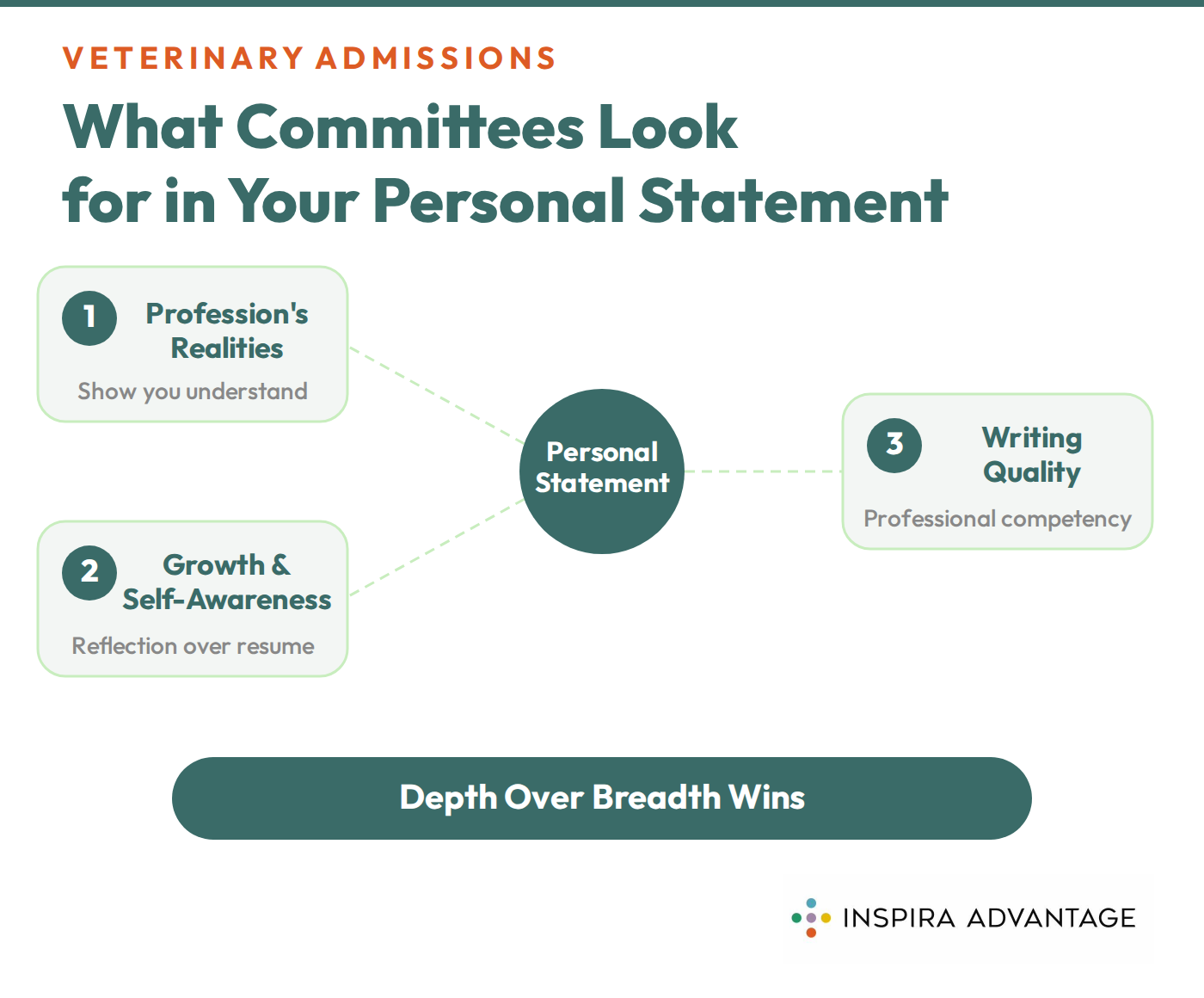
Admissions committees aren't looking for a highlight reel of your experiences (those already exist in your activities and transcript). They're reading your personal statement to answer three questions:
Veterinarians are medical professionals who make tough clinical decisions, perform difficult procedures, and deliver heartbreaking news to owners. Your personal statement needs to show that you've seen enough of the profession to understand that it goes far beyond just animal care.
Applicants who write only about their love for animals sound like every other essay in the stack of thousands. The ones who stand out describe a specific moment in their application requirements, such as during clinical shadowing when they watched a veterinarian navigate a difficult conversation with a client or make a treatment decision with incomplete information. That level of awareness shows maturity, knowledge, and readiness.
Admissions reviewers don't expect perfection. They want to see determination, resilience, growth, and triumph over adversity. A strong personal statement connects the dots between your experiences and the lessons they taught you.
Listing three clinical rotations tells an admissions committee nothing about you. Describing how your first emergency case in a large animal clinic changed the way you handle high-pressure situations tells them exactly who you'll be as a vet student.
Recognizing your faults and admitting they exist shows maturity, especially if you feel you've overcome them. Admissions committees read hundreds of essays from applicants who present themselves as flawless. Acknowledging a genuine challenge you worked through (and keeping it brief and purposeful) makes your narrative far more credible and memorable.
Communication skills play an important part in how admissions officers evaluation your application. Your personal statement doubles as a writing sample. Committees assess whether you can organize your thoughts clearly and express complex ideas in a limited space.
VMCAS limits personal statements to 3,000 characters, including spaces, which equals roughly 500 words. Every sentence has to earn its place. Rambling, vague language, and grammatical errors raise questions about your attention to detail in a profession where precision saves lives.
Admissions committee members at top veterinary programs review thousands of personal statements. Your essay should be so interesting that it catches the attention of a reviewer who’s read 50 essays that day.
In our vet school webinar, Dr. Passoro shares her insight on leaving a lasting impression.
“You want to be able to keep your personal statement interesting to the reader so that they're hooked on your story and that they remember you,” she says. “That doesn't necessarily mean fabricate everything or be so dramatic, but making sure that you can tell your story in a way that's not just factual or very generalized."
Front-load your most compelling material in the first two sentences, keep paragraphs short enough to process quickly, and eliminate any sentence a reviewer could skim without losing the thread of your argument.
If a paragraph works just as well whether someone reads it or skips it, cut it. Every section of your 3,000 characters should encourage the reader to keep going.
Estimate your odds of admission to vet school in just five minutes or less with our free tool.
Every paragraph of your VMCAS personal statement needs a specific role, and the structure you choose determines whether a reviewer follows your logic or loses interest by sentence three.
Before you write a single sentence, create a list of every experience that shaped your decision to pursue veterinary medicine. Include:
Don't categorize anything yet. The goal is to get everything on paper so you can see the full narrative of your journey. Most applicants have 10 to 15 experiences worth considering. You'll only use two or three in your final essay, but you need the complete picture to choose the right ones.
Once your timeline is in front of you, find the through line. Ask yourself: What changed between the first experience on your list and the most recent one?
The answer to that question is your narrative thread, the central idea that holds your essay together. Strong narrative threads focus on a transformation.
Maybe you started with a surface-level love for animals and developed a clinical understanding of veterinary medicine through progressively challenging experiences. Whatever your thread is, it should explain not just what you did but how your understanding of the profession evolved over time.
Choose three anchor experiences that each speak to the reason why you decided to study vet med. Avoid rehashing experiences and data already covered elsewhere in the application.
Your activity section lists titles, hours, and descriptions. Your personal statement should go deeper into the moments within those experiences that shaped your thinking.
A 200-hour shelter volunteer position is meaningful when you describe the specific case that taught you how emotional resilience and clinical detachment coexist in this profession.
Your hook should do two things:
Drop your reader into a specific moment. You can reference a 15-second snapshot from a clinical rotation, a pivotal conversation with a supervising veterinarian, or a decision point during an animal emergency. These experiences ground your essay in something concrete and separate you from the hundreds of applicants who open with "I have always wanted to be a veterinarian."
If your essay is about how progressively complex clinical experiences reshaped your understanding of veterinary medicine, open with a moment from the experience that challenged you most. The reader should finish your first two sentences already understanding the direction of your essay.
Keep your opening to two or three sentences. At 3,000 characters, spending more than 400 characters on your hook eats into the space you need later.
Reviewers at competitive programs have read thousands of essays that begin with a beloved childhood dog or cat sparking a lifelong dream. Even if that moment was real and formative for you, leading with it puts your essay in the largest and most forgettable category.
In our vet school admissions webinar, Dr. Caitlin Passoro, an Inspira Advantage vet counselor who earned a DVM from North Carolina State University, says you should know what the field entails, beyond just petting puppies.
“Sometimes, people think they want to become a vet, but they don't really understand what vet med entails, which is not just petting puppies ... Describing why you're passionate and what makes you unique will help them remember you,” she says.
Use a more recent, clinically grounded moment as your opener. Add a childhood connection later only if it serves your narrative. The goal is to show where you are now, not where every other applicant started.
The body of your essay carries the weight of your argument. Each of your three anchor experiences should get its own paragraph, and each paragraph should set the scene briefly, describe what happened, then explain what it taught you and how it connects to your narrative thread.
Don’t give the same background for every experience. You have roughly 1,500 to 1,800 characters for your entire body section, which means each experience gets around 500 to 600 characters. That's enough for one specific moment and one meaningful reflection, not an entire backstory. Open each paragraph at the point of action rather than explaining how you got there.
The experiences you chose in Step 1 should each show something different about your readiness for veterinary school. If your first paragraph demonstrates clinical competency, your second should show something like:
Connect each paragraph back to your central narrative thread. A reader should be able to trace a clear line from your opening hook through each body paragraph without wondering how the pieces fit together.
If you have to add a transition sentence explaining why you're suddenly talking about a different experience, that's a sign the experience may not belong in the essay.
Your personal statement should flesh out your relevant and unique experiences rather than restate accomplishments already presented elsewhere in the application.
Specificity is what separates a personal statement from a resume in paragraph form. Every sentence in your body section should contain information a reviewer could not find anywhere else in your VMCAS application.
Your strengths should remain cohesive throughout your entire application. In our vet school admissions webinar, Dr. Passoro provides her insight on this.
“If you have all your experience in small animal, don't put on your application that you're passionate about large animal and that that's all you want to do,” she says. “Try to match your experience so that it makes sense."
If your activities section says you completed 300 hours at an equine hospital, your personal statement shouldn't just restate that. Instead, focus on a single 15-minute window during those 300 hours that changed the way you think about equine medicine. Specificity at the moment level is what separates a personal statement from a resume.
Admissions committees notice when an applicant only mentions dogs and cats. Veterinary medicine spans:
You don't need experience across all of them, but your essay should show that you understand a lot of different species. If your background skews heavily toward one species type, acknowledge that directly and explain what drew you to that area rather than leaving reviewers to wonder whether you've considered the full scope of the field.
Every applicant writes about what they learned during veterinary hours. Very few write about what they found difficult.
Describing a moment where you felt unprepared, overwhelmed, or emotionally affected by an outcome gives reviewers something honest to hold onto. The key is pairing that struggle with how you addressed it afterward.
A sentence about freezing during your first euthanasia, followed by a sentence about how you processed that experience with your supervising veterinarian, tells a committee far more about your readiness than another paragraph about your passion for animal welfare.
Your final paragraph should shift from reflection to direction. Committees want to understand your career goals and objectives within the veterinary profession. You don't need a strict four-year plan, but you do need to show that your interest in veterinary medicine extends beyond getting accepted.
Connect your experiences to a specific area of the profession you want to explore, whether that's:
Naming a focus area signals that you've thought beyond the application itself and into the career that follows. A closing that looks forward gives reviewers a reason to remember your essay after they've moved on to the next one.
Avoid generic closings that could apply to any applicant in any health profession. "I look forward to contributing to the field of veterinary medicine," tells a committee nothing they didn't already assume. "My goal is to bring equine sports medicine into underserved rural communities where large animal veterinarians are in short supply," tells them exactly who you are and where you're headed.
Share your draft with three types of readers:
Aim for a conversational and professional tone that gives admissions committees insight into your personality. If a reviewer rewrites entire sections, the voice changes, and the essay no longer sounds authentic. Ask for feedback on clarity, flow, and whether each paragraph earns its place. Stick to the same voice throughout the revision process.
If you're looking for expert feedback on your personal statement, our team of vet school admissions advisors includes former admissions committee members who have read thousands of these essays. They know exactly what makes reviewers stop skimming and start paying attention, and they can identify gaps in your narrative that are hard to spot on your own.
Tell your readers to mark any sentence they'd skip if they were reading your application. Most feedback focuses on what sounds good or what has a typo. The more useful question is where a reader's attention drops. Those are the sentences that aren't doing enough work for your 3,000-character limit.
If a reader completely glosses over even one paragraph, it needs to be rewritten. At such a tight character count, every section should force the reader to slow down and read.
Remove any smart quotes, special characters, or indentation that won't render in the VMCAS submission box. Read your final version aloud at least twice to catch awkward phrasing, missing words, and pacing issues that you can’t catch by just reading it in your head.
Then have one of your readers read it again before you paste it into the application. Treating submission day as a final checkpoint rather than another editing session keeps you from second-guessing a draft that's already been through a thorough revision process.
Take a look at the video below for a full overview of the vet school admissions process.
A vet school personal statement is one of the most important components of your application. Your essay lets you tell your story, share your values and goals, and provide a theme that ties your entire application together. Your personal statement is what convinces a reviewer to advocate for you during committee discussions, especially when multiple applicants have similar academic profiles.
Include three experiences in your vet school personal statement. At 3,000 characters, covering more than three experiences forces you into surface-level summaries that read like an activities list rather than a narrative. Fewer experiences with deeper reflection give reviewers a stronger sense of how you think and what you've learned than a broader survey of everything you've done.
Yes, you can discuss a personal challenge in your vet school personal statement, as long as the focus remains on how you addressed it and how it relates to your readiness for veterinary medicine. Recognizing your faults and admitting they exist shows maturity, especially when you've overcome them. Keep these points brief and purposeful.
No, you shouldn’t mention specific vet schools in your VMCAS personal statement. VMCAS sends the same essay to every program you apply to, so naming one school shows to every other school on your list that they weren't your primary focus. Save school-specific details for secondary essays requested by individual programs.
Yes, you can write about research in your vet school personal statement, especially if your research directly involved animal health, veterinary pathology, zoonotic disease, or another area tied to clinical veterinary outcomes. The key is to frame your research through a veterinary lens rather than a purely scientific one. Describe what your findings mean for animal patients or veterinary practice rather than focusing only on methodology.
Yes, you should always have a veterinarian review your personal statement if possible. A veterinarian can catch clinical inaccuracies, flag terminology you've misused, and assess whether your reflections on veterinary experiences sound credible to someone who has lived them. Non-veterinarian readers can evaluate your writing quality and narrative, but they can't tell you whether your description of a surgical observation or a herd health assessment is valid enough.
Writing about wanting to help animals is fine as an underlying motivation, but it can’t be your primary argument for why you belong in vet school. Stating that you love animals and have wanted to be a vet since childhood is too common and superficial to set you apart. Write about how you want to help them, either through shelter medicine, improving livestock welfare standards, or advancing surgical techniques in equine orthopedics.
Dr. Akhil Katakam was the original author of this article. Snippets of his work may remain.


Get 15+ free vet school personal statements written by our succcessful applicants free of charge. No strings attached.

.svg)

