Get in touch: +1 888 453 5021





I connected with some of our 100+ 99th percentile MCAT tutors to get the specific strategies that actually improved their weaknesses and refined their study strategies. The tips in this guide are based on their expert insights.
Earning a competitive MCAT score comes down to how you study, not just how much you study. The difference between a 505 and a 515 is rarely more content knowledge. It's better diagnostics, sharper practice habits, and a study schedule built around your actual weaknesses. Below are the specific strategies that consistently improve scores.
Sit for a full-length diagnostic test under real conditions (7.5 hours, timed breaks, no notes) before you begin content review. Your score report will tell you exactly where your 300+ prep hours need to go. Most students skip this step and jump straight into studying, which costs weeks of wasted effort on subjects they already understand.
If your Chem/Phys score is already 127 but your CARS score is 123, you now know that CARS deserves triple the weekly hours. Without a baseline, you'll default to reviewing subjects that feel comfortable, which is the fastest way to plateau.
In our how to secure a 515+ MCAT score webinar, Ruchi Gupta, an expert tutor at Inspira Advantage who pursued her medical education at Yale School of Medicine, provides her advice on full-length diagnostic tests.
"There is no better way to start studying than taking a full length practice exam,” she says. “That can be really disheartening in the beginning because you're going to be a long way off than where you will eventually be. But it’s a good way to start identifying where you should start your content review — or what might be the most difficult for you after the test."
Take Inspira's free MCAT practice test to establish that baseline before committing to any plan.
A good study schedule will give you a day-by-day calendar with assigned topics, creating accountability and showing you when you're falling behind. Pick your MCAT test date first and work backward.
For most students, three to six months at 15 to 20 hours per week is the sweet spot. Divide that time into two phases:
In the beginning, spend 80% of your time on content review and 20% on targeted review. Near the end of your prep, flip that ratio and spend 20% of your time on content review and 80% of your time on targeted review.
Use this free MCAT study schedule to find out where you need to improve, and by how much.
If you'd prefer to create your study schedule by yourself, take a look at the video below.
Treat every missed question as a diagnostic tool, not just a number to glance at and forget. Most students finish a practice section, check their score, skim the ones they missed, and move on. That approach leaves the highest-value learning on the table.
In our MCAT 101 webinar, Dr. Aditya Khurana, a graduate of the Mayo Clinic Alix School of Medicine and expert counselor at Inspira Advantage, provides insight into maximizing your MCAT prep.
"Knowing the content is not going to be enough,” he says. “You need to know what curveballs they are going to throw at you. So, you need to do as many questions as possible. That is going to be what consistently keeps your score getting higher and higher as you study for this test."
Every wrong answer on the MCAT falls into one of these categories:
After each practice set, categorize every missed question into one of those buckets. Then spend your next study session drilling the exact category that keeps showing up.
A student who carefully reviews 50 incorrect answers will almost always outperform someone who completes 200 practice questions without analysis.
Start taking one full-length practice test per week, about 10 to 12 weeks before your exam. Wake up at the same time you will on test day. Take your breaks only when the MCAT schedule allows them. Treat the lunch break exactly as you would at the testing center.
In our MCAT secrets webinar, Dr. Austin Johnson, an experienced advisor at Inspira Advantage and a Stanford Medicine graduate, shares his insights on test-day simulation.
"Until you simulate the MCAT, you don't know how you're going to be able to respond cognitively over the course of eight to nine hours and the load that it takes to get through all of these questions,” he says. “And moreover, how do you develop weaknesses throughout that test? You may be really strong in the beginning and then you start showing your weaknesses in certain areas later on."
Building this kind of test-day stamina is what separates students who finish strong from those who lose 3 to 5 points in the final section because they run out of mental energy.
The video below provides more information on simulating test-day conditions to ensure you’re well-prepared.
The MCAT has four sections, but your score breakdown won't be evenly distributed across them. A balanced study plan sounds smart in theory, but it ignores how scoring actually works. If you need to go from 124 to 128 in CARS, that requires a fundamentally different study approach than going from 126 to 128 in Psych/Soc.
In our Psych/Soc MCAT workshop, Lois Owolabi, a tutor at Inspira Advantage who scored in the 99th percentile on the MCAT, explains how to adapt content review for different MCAT sections.
"One of the big secrets for achieving over 515 or or more on the MCAT is mastering the Psychology and Sociology section,” she says. “It's high yield, largely because it's one third of the MCAT, so it should be a large chunk of your focus."
Use your practice test score breakdowns to allocate time proportionally. Early weeks are when your motivation peaks. Spend that momentum on your weakest section, whether that's physics problem sets, CARS passage analysis, or Psych/Soc terminology.
You can use our MCAT score calculator to convert your practice scores and track improvement over time.
Cramming a full chapter of organic chemistry in one sitting feels productive. Two weeks later, you'll remember almost none of it. Spaced repetition (reviewing material at increasing intervals) is the single most evidence-backed memorization technique for high-volume exams like the MCAT.
Tools like Anki let you build custom flashcard decks that automatically resurface cards you struggled with. Pair those with daily practice questions or Inspira's MCAT Question of the Day to keep content fresh between full study sessions.
Knowing the content and finishing on time are two different skills. Many students who understand every concept on the exam still underperform because they spend too long on hard passages and rush through the final 10 to 15 questions.
In our Chem/Phys MCAT workshop, Dr. Jason Gomez, a Stanford Medicine graduate and an expert advisor at Inspira Advantage, gives his insight on proper MCAT timing.
"You have 90 seconds per question,” he says. “If a question is taking up time, move on. You can always come back to it. You want to prioritize high yields and easy wins. Even a tester who was aiming for a 515+ score doesn't get every question right. Your goal is to maximize the points per minute that you're getting on this exam. Don't let a question take up five to 10 minutes."
Practice flagging questions that take longer than 90 seconds, then move on. Come back to them after you've collected the easier points.
For passage-based questions, train yourself to identify the main argument within the first 30 seconds of reading. Our full guide on how to improve your MCAT timing breaks down pacing strategies for each section, including specific benchmarks for how many minutes to spend per passage.
Watch the video below for more strategies to improve your MCAT timing.
AAMC official materials are the closest thing to the real exam. That's exactly why you should save them for the last six to eight weeks of your prep. Students who burn through AAMC practice tests in month one lose access to the most accurate score predictor available right when they need it most.
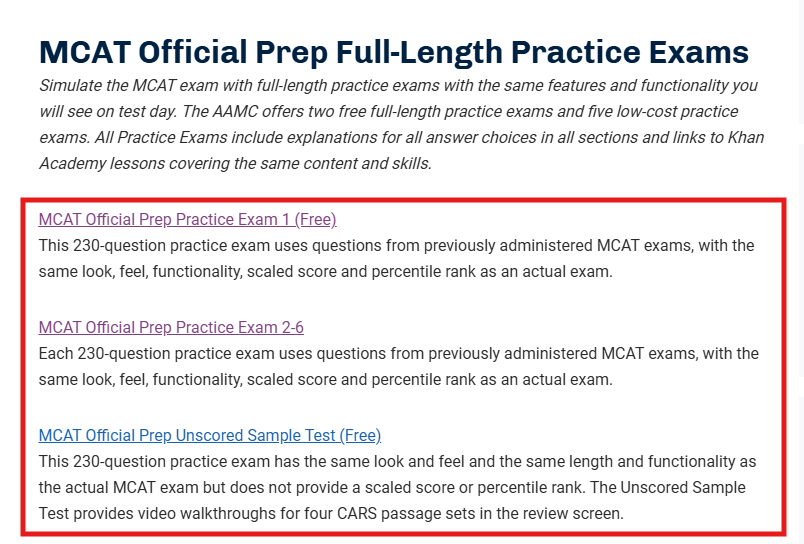
Use third-party resources and diagnostic exams for your early content review phase. Switch to AAMC question banks, section banks, and full-length exams once you've built a solid foundation. Your final two to three AAMC practice tests should serve as dress rehearsals under full testing conditions.
No one wants to think about retaking the MCAT, but approximately 95% of test-takers have. Choosing an early test date (ideally March of your junior year) gives you a built-in buffer to retake over the summer if your score doesn't hit your target range.
Find out when you should take the MCAT by watching the video below.
Start preparing for the MCAT by learning the exam format, taking a diagnostic test, setting a goal score, and building a study schedule around your weakest areas. Do not begin by reading every prep book from page one. Start with a clear baseline so your study plan matches the score gap you need to close.
The MCAT tests science knowledge, critical reasoning, data interpretation, and stamina. You need to understand the exam before you choose materials or create a study schedule.
The MCAT includes four sections:
Start by reviewing the official AAMC MCAT content outline. Use it to see which topics you already know from your college courses and which topics need more review.
If you’re still early in your prep, watch the video below for a complete breakdown on everything you need to know for the MCAT.
Take a full-length diagnostic test before you create your study plan. Your diagnostic score tells you where you’re starting and how much work you need to do before test day.
Review your diagnostic by section. Look for patterns:
Your diagnostic test should guide your first month of studying. Without it, you’re just guessing.
Set your MCAT goal score before you choose your weekly schedule. Your target score should surpass the median matriculant scores for the medical schools you plan to apply to.
In our MCAT 101 webinar, Dr. Khurana explains how to set your realistic score goal.
"I think part of the question that that students need to ask is what type of school they want to go to ... in an ideal world, what is the type of medical school you'd want to go to?” he says. “Look and see what their average MCAT is, and then, from there, that's essentially your goal. Your study strategy is going to differ depending on how high that is."
Look at the class profiles for your target schools. Compare your baseline score to the median MCAT scores of matriculants. That gap will help you decide how much time you need.
A student trying to improve by three points may need a different plan than one trying to improve by 12 points.
Choose a small set of resources and use them consistently. You do not need every MCAT prep book, question bank, video series, and study guide.
A strong starter set includes:
Use content books or videos to learn concepts. Use question banks to apply them. Use AAMC materials to understand the real exam style.
Create a weekly schedule based on your test date, baseline score, and goal score. Your schedule should include content review, practice questions, full-length exams, and review blocks.
A strong MCAT schedule includes:
Do not schedule only content review. The MCAT rewards application. Practice questions should become part of your routine early.
Begin your prep by reviewing high-yield content gaps. Focus on the topics your diagnostic exposed first.
As you improve, shift more time toward passage-based practice and full-length exams. Many students wait too long to practice under timed conditions. That makes the real exam feel harder than it needs to.
A simple progression works well:
That cycle should drive your entire MCAT prep plan.
Most students should study for the MCAT for three to six months, depending on their starting score, target score, schedule, and science foundation. A shorter timeline can work if you already have strong content knowledge and only need focused practice. A longer timeline makes more sense if you’re balancing school, work, extracurriculars, or a larger score increase.
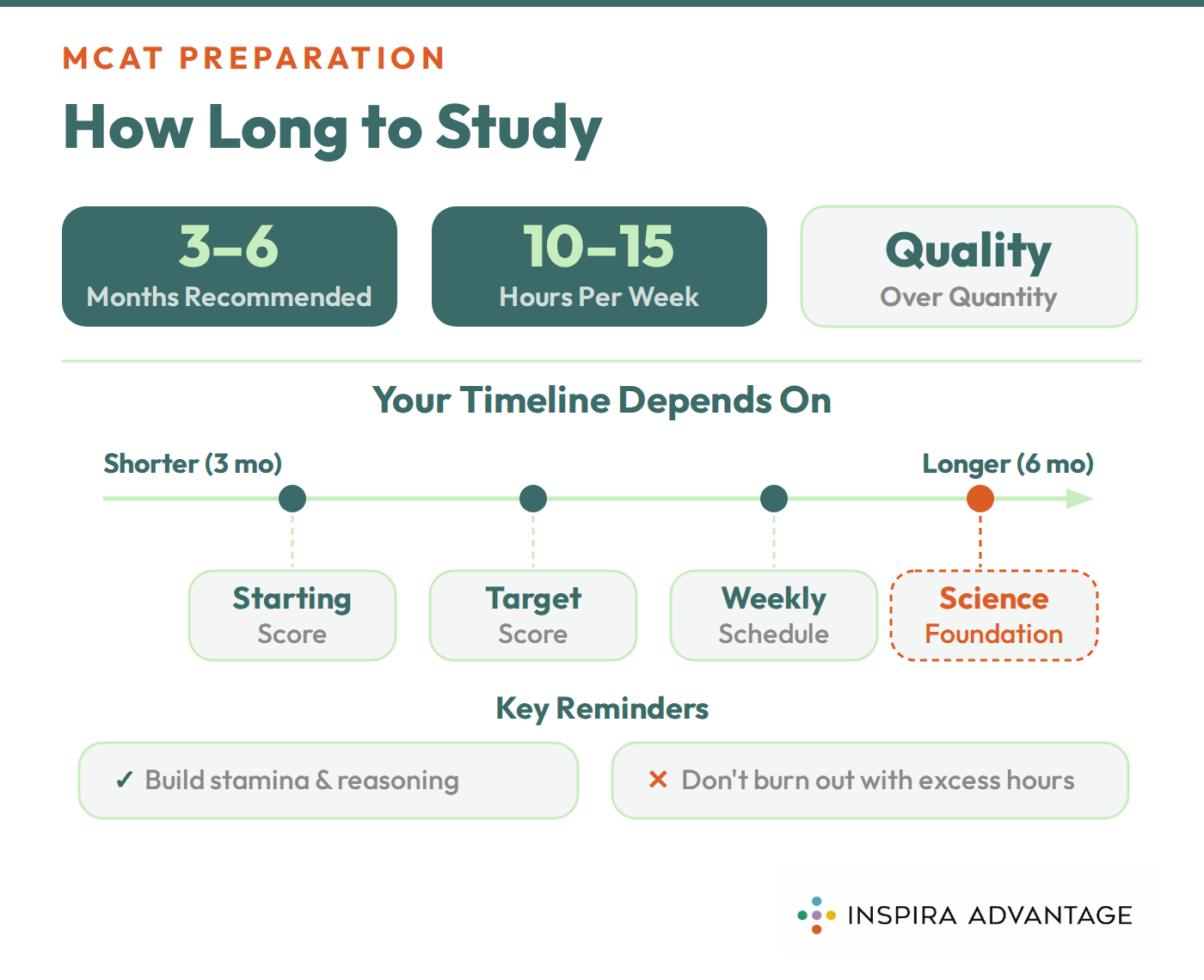
A good starting target is 10 to 15 hours per week for several months if you are studying while in school or working. If you’re studying full-time, you may be able to increase that number, but make sure to protect your energy. More hours won’t help if you’re too burned out to review carefully or think clearly during practice exams.
The number of months matters less than the quality of your study plan. The MCAT tests stamina and reasoning, so you need time to build both.
To avoid burnout when studying for the MCAT, incorporate recovery into your study plan from the start rather than treating it as something you earn after exhaustion. MCAT burnout is one of the most common reasons students underperform relative to their practice scores, and it usually hits hardest around month four of a six-month plan.
Schedule two full days of rest before you feel desperate for it. Many students treat breaks like rewards they only earn after perfect productivity. That mindset makes burnout more likely because it turns every day into a test of willpower.
Plan at least one lighter study day or full rest day each week. Use that time to sleep, exercise, see friends, or do something unrelated to the MCAT. Rest helps you come back to practice questions with better focus and better judgment.
A sustainable schedule usually beats an aggressive one. You will learn more from four focused hours than from eight exhausted hours where you reread the same paragraph repeatedly.
Tie your progress markers to outputs rather than time spent. A student can spend six hours watching videos and still avoid the harder work of passage review. Another student can spend two focused hours reviewing missed questions and make a real increase in their score.
Measure progress through outputs such as:
Use hours as a planning tool, not as your only success metric. The MCAT rewards how well you think under pressure. Your study routine should directly train that skill.
Burnout often happens when your study days feel repetitive. Reading chapter after chapter can make MCAT prep feel endless. Doing only practice questions can feel discouraging if you keep missing the same concepts.
In our MCAT retakes webinar, Benji Popokh, an expert tutor at Inspira Advantage and 99th percentile MCAT scorer, provides advice on how to avoid burnout in your MCAT prep.
"Finding a way to stack the modalities by which you study is really going to be a good strategy to avoid mental fatigue,” he says. “For me, that looked like at the beginning of my study period ... I would go through my Chem/Phys section for a bit, my CARS, Bio/Biochem, etc. And I would alternate every 30 to 45 minutes just so I never got bored of any subject."
Rotate your study blocks so each day has a clear mix of learning, applying, and reviewing. For example:
That structure gives your brain a specific task instead of asking it to “study biology” for hours.
Variety also helps you catch weaknesses sooner. You’ll know whether you truly understand a concept once you apply it to a passage.
Choosing the right study materials comes down to knowing where you are in your prep cycle and what tools will give you the maximum value.
Taking third-party diagnostic tests is one of the best ways to know your baseline score. Maybe you got a 125 in Psych/Soc, but a 130 in CARS. This helps you plan your study schedule efficiently to get the most value from each week.
Third-party tests become less effective later in your prep cycle, since the AAMC’s official practice tests use questions that appeared on previous exams.
Content review books help you organize biology, biochemistry, general chemistry, organic chemistry, physics, psychology, and sociology. Use them to build your foundation, not to memorize every paragraph.
A good MCAT book set should include clear explanations, chapter summaries, practice questions, and enough detail to connect concepts across subjects. Avoid resources that feel like college textbooks. The MCAT rewards application more than recall, so your materials should help you answer passage-based questions rather than just define terms.
A strong question bank like Inspira’s MCAT Question of the Day helps you build test-taking stamina before you start taking full-length exams every week.
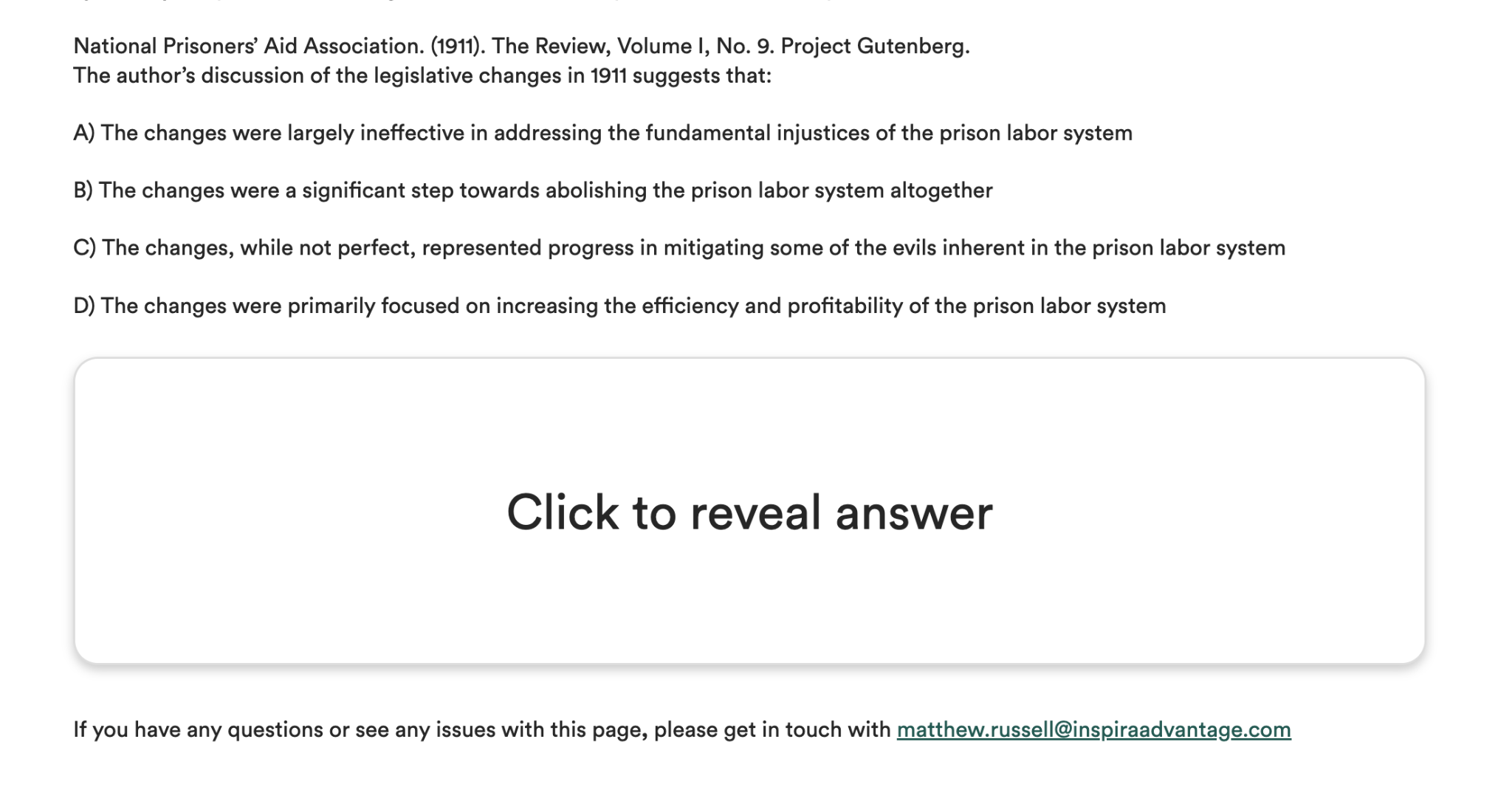
Use these question banks for volume, timing practice, and weakness review.
When comparing MCAT question banks, look for:
Don’t choose a question bank only because it has the most questions. A smaller set with better explanations will usually help more than poorly reviewing thousands of questions.
The right MCAT prep option depends on your starting score, schedule, learning style, and target score. Most students don’t need every type of MCAT support. You need the option that solves your biggest prep problem.
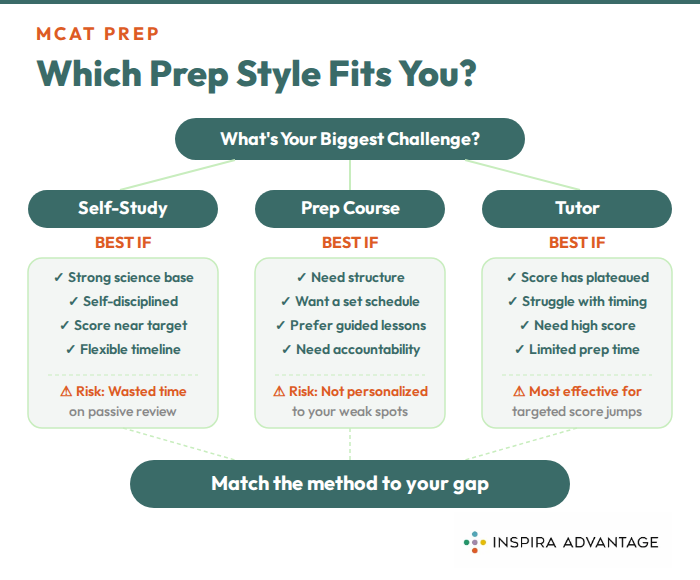
Self-study can work well if you already know how to manage your time, diagnose your weaknesses, and hold yourself accountable. It gives you the most flexibility and usually costs less than a course or tutor.
Self-study may be right for you if:
The biggest risk with self-study is wasted time. Many students spend weeks rereading content, highlighting notes, or watching videos without doing enough passage-based practice.
If you choose self-study, build your schedule around practice questions and full-length exams. Content review should support your practice, not replace it.
An MCAT prep course works best if you want a clear schedule, assigned lessons, and a guided path through the exam. Courses can help you stay organized because they tell you what to study, when to study it, and how to move through each section.
A prep course may be right for you if:
The main limitation is personalization. A course can give you structure, but it may not spend enough time on your specific weaknesses. For example, you might need more help with CARS timing while the course moves into biochemistry. You may also spend time reviewing topics you already know.
Choose a prep course if your biggest challenge is organization. Pair it with an independent review so you can focus extra time on the areas that affect your score most.
An MCAT tutor makes the most sense when you need individualized help. A tutor can review your score reports, identify patterns in your mistakes, and adjust your study plan based on what is actually holding you back.
Tutoring may be right for you if:
The strongest tutors do more than explain content. They teach you how to approach questions, eliminate trap answers, manage timing, and review mistakes. That level of feedback can make prep more efficient by reducing the time you spend guessing what to fix.
Start by identifying the problem you need to solve. Your prep method should align with the reason your score isn't where you want it to be yet.
Don’t choose based only on cost or popularity. Choose based on what will help you study more effectively. A low-cost self-study plan can work if you use it well. A course can fall short if you need personal feedback. A tutor can help most when you come prepared with practice results, score reports, and clear goals.
Your MCAT timing strategy should help you move through each section with enough control to think clearly. The goal is not to rush. The goal is to know when to slow down, when to move on, and how to protect time for the questions you can answer accurately.
Start by learning the timing rules for each section. The MCAT includes four scored sections, and each section gives you a different amount of time per question.
Use these numbers as a baseline, not as a strict rule for every question. Some discrete questions may take 30 seconds. Some passage-based questions may take closer to two minutes. Strong timing comes from managing the section as a whole.
Track your pacing by passage rather than by individual question. Checking the clock after every question creates stress and interrupts your reasoning. Passage-level timing gives you a rhythm without the constant mental disruption.
For the science sections, aim to spend about eight to 10 minutes per passage set, depending on the number of questions and difficulty. Move faster through familiar content and straightforward, discrete questions so you have more time for dense passages, data interpretation, and calculation-heavy items.
For CARS, aim for about 10 minutes per passage, including reading time and questions. Some passages will move faster. Others will require more careful reading. Your goal is to average out across the section without letting any one passage take up too much time.
Use checkpoints to stay aware of your pace without staring at the timer. Checkpoints give you a quick way to know whether you need to speed up, stay steady, or make faster decisions.
For the 59-question science sections, you can use this pacing model:
For CARS, you can use passage-based checkpoints:
Checkpoints should guide your decisions, not panic you. If you are a few minutes behind, make the next passage more efficient. Don’t rush so much that your accuracy falls apart.
Give yourself permission to leave a tough question behind. Some questions become time traps because they feel answerable if you just spend one more minute. That extra minute can cost you points later in the section.
Skip or flag a question when:
Make your best educated guess before moving on. Never leave a question blank. A flagged question with a reasonable guess protects you if you don’t have time to return.
Build your pacing skills through smaller practice sets long before you sit for a full-length exam. Timing is a muscle, and short reps train it faster than marathon sessions.
Start with untimed practice when you are learning new content. Once you understand the topic, move into timed sets. For example, complete 10 to 15 passage-based questions under a realistic time limit; then review both your answers and your pacing.
During review, ask yourself:
Timing review matters as much as answer review. A wrong answer caused by poor pacing needs a different fix than one caused by a content gap.
CARS timing requires a different approach than science timing. In CARS, your reading process drives your score. If you rush through the passage without understanding the author’s argument, the questions usually take longer and feel more confusing.
For CARS, focus on:
For science sections, focus on:
Each section rewards a slightly different version of speed. CARS rewards controlled reading. Science sections reward efficient problem-solving.
Start studying for the MCAT at least three to six months before your test date. Most competitive scorers dedicate 300 to 350 hours of total preparation across that window. Starting too early risks burnout before test day, while starting too late forces you to cram material that rewards deep conceptual understanding rather than memorization. Build your timeline backward from your target test date, mapping out content review, practice exams, and a final review phase so each block has a clear purpose.
Plan to spend 300 to 350 total hours studying for the MCAT, roughly 15 to 25 hours per week over a three- to six-month preparation period. Top scorers often log closer to 400 hours because they invest heavily in full-length practice exams and a detailed review of missed questions. Raw study hours matter less than how you distribute them. Spending 80% of your time on content review and only 20% on practice is a common mistake. Flip that ratio in your final month so you build test-day stamina and timing instincts.
Start preparing for the MCAT by taking a diagnostic practice exam before you open a single textbook. Your diagnostic score reveals which content areas need the most work and prevents you from wasting weeks reviewing subjects you already know well. After your diagnostic, build a study schedule that front-loads your weakest sections and assigns specific daily tasks rather than vague goals like "study biology." Gather your core materials early: AAMC's official question packs, a comprehensive content review set, and a bank of third-party full-length exams give you the foundation most high scorers rely on.
The most effective way to study for the MCAT is active practice over passive review. Reading a chapter and highlighting key terms feels productive but rarely translates to score improvement. High scorers build their preparation around practice questions, full-length exams, and detailed analysis of every wrong answer. Spaced repetition tools like Anki help you retain dense content in biochemistry and psychology/sociology without re-reading entire chapters. Dedicate at least one full-length practice exam per week in your final six weeks, and review each exam more thoroughly than you study new material. The exam tests your ability to apply concepts under pressure, not your ability to recall a textbook definition.
You should study four broad subject areas for the MCAT: biology and biochemistry, chemistry and physics, psychology and sociology, and critical analysis and reasoning skills. Biology and biochemistry carry the heaviest weight across two of the four exam sections, making them the highest-yield content areas. Many test-takers underestimate the psychology and sociology section because it was not part of their premed coursework, but it accounts for a full quarter of your composite score. CARS requires no outside content knowledge and instead tests your ability to analyze dense passages from the humanities and social sciences.


We’ll send you a 100+ page MCAT practice test created by one of our expert 99th percentile tutors. No strings attached.


.svg)

