Get in touch: +1 888 453 5021





Most pre-med students have no idea how many internship opportunities are actually available to them. Many only know about a handful of well-known hospital programs and completely overlook research fellowships, public health internships, specialty-specific experiences, and academic medical center programs that can be just as valuable.
Almost all of the consultants I spoke with to create this article also said students often misunderstand what internships are supposed to accomplish in the first place.
The goal is not simply to collect a prestigious name for your resume; it's to get meaningful clinical exposure, explore different areas of medicine, develop research or patient-care skills, and build experiences that strengthen your medical school application narrative.
Below, I'll break down the major types of pre-med internships, some of the strongest summer research and clinical programs available, alternatives to formal internships, and strategies to help you actually land these opportunities.
Pre-med internships fall into four core categories: clinical internships, research internships, public health internships, and specialty-specific internships. Each builds a different skill set that medical schools evaluate during admissions. The right type depends on where you are in your decision-making and what gap you need to fill on your application.
Below are 20 pre-med summer research programs and internships at top institutions across the country, ranked by the strength of their research mentorship, institutional affiliation, and career-building potential. Each program places undergraduate students in mentored research environments at accredited medical schools, research centers, or federal agencies.
*The deadlines shown are based on the most recent completed application cycle, but not all programs have released 2027 dates yet. This table will be updated once they become available.
Every program on the list above met three selection criteria designed to identify the internships that deliver the most meaningful experience for pre-med students:
I also prioritized geographic and institutional diversity across the list, ensuring representation from medical schools, cancer centers, federal agencies, and research hospitals across the country.
Getting a pre-med internship requires starting months earlier than most students expect, applying to far more programs than feels necessary, and writing personal statements specific enough that a review committee remembers your name.
Here’s a closer look at each of these strategies:
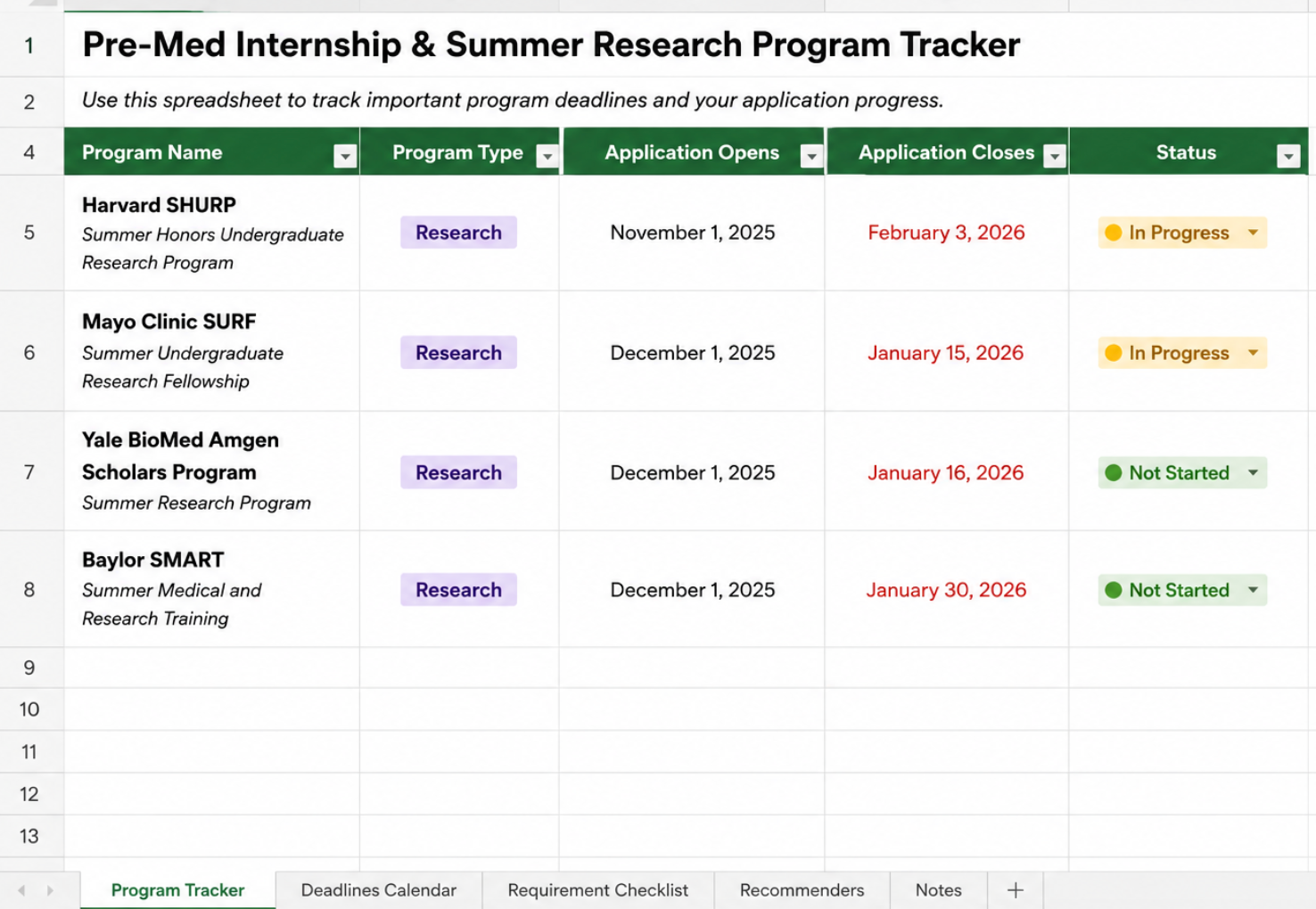
The single biggest mistake I see pre-med students make is starting their internship search in the spring. By then, the strongest programs have already closed. Harvard SHURP, Mayo Clinic SURF, Yale BioMed Amgen Scholars, Baylor SMART, and Case Western SURP all close applications between mid-January and early February.
Stanford SSRP opens as early as November. Build a spreadsheet of target programs in September, note every deadline, and work backward from there to give yourself time for transcripts, personal statements, and recommendation letters.
Here’s a spreadsheet I put together in just a few minutes as an example:
Even students with a 3.9 GPA, multiple semesters of lab experience, and strong letters get rejected from top programs. The applicant pools at programs like Harvard SHURP, Stanford SSRP, and Mayo Clinic SURF are enormous. Selection committees weigh factors beyond stats, including research fit, personal statement quality, and institutional diversity goals.
Protect yourself by applying to eight to 12 programs and mixing well-known programs at top-ranked institutions with strong programs at less name-recognized schools where applicant volume is lower.
A program like the Augusta University STAR or the Creighton Undergraduate Biomedical Research Training Program offers the same core experience (faculty-mentored lab research, a stipend, a poster presentation) as a program at Harvard or Stanford, but it receives a fraction of the applications.
Your odds of acceptance are significantly higher. And the research experience carries the same weight on a medical school application.
Most applications share common components: a personal statement, transcripts, and two recommendation letters. Once you build your core materials for the first application, adapting them for additional programs takes far less time than starting from scratch.
The personal statement is the most underinvested part of most applications. Review committees read hundreds of essays that say, "I am passionate about research and want to contribute to scientific discovery." Those statements all sound identical; they’re forgettable.
Before you write a single sentence, go to the program's faculty research page and identify two to three labs whose work aligns with your interests. Read at least the abstract of one recent paper from each lab.
Then write your personal statement around a specific connection: what question in their research interests you, how your coursework or prior experience prepares you to contribute, and what you want to learn from working in that environment.
Programs like the Baylor SMART and Mayo Clinic SURF ask you to rank faculty preferences or describe research interests. A statement that references a specific Principal Investigator's recent publication on cardiac tissue regeneration signals a candidate who did real preparation, not one who bulk-applied to every program on a list.
If the structured program deadlines pass or every application comes back as a rejection, reaching out directly to faculty is a strong alternative that many students overlook. Cold emailing a professor whose research interests you is standard practice in academia. It works more often than students expect.
In our webinar on How to Get Ahead in Med School Admissions, Dr. Bima Hasjim, a former UC Irvine admissions officer and current admissions counselor at Inspira Advantage, emphasizes that finding a research position is often a numbers game:
"The more you put yourself out there, the luckier you get," he says.
He recalls emailing 50 faculty members at the University of Pittsburgh for a research tech position and receiving only one response. But that single reply was the only opportunity he needed to get his foot in the door.
After speaking with several of our admissions counselors, the ratio stays roughly the same across the hundreds of students they've guided through this process: expect about one response for every 20 emails you send
The key to a cold email that gets a response is specificity. Reference a recent paper the professor published, explain what about their work connects to your interests, and state clearly that you’re looking for a summer research position.
Keep the email to three to four short paragraphs. Early December through early February is the best window to send these, because professors are finalizing summer staffing and grant budgets during that period.
For more personalized help building your pre-med application, including choosing the right internships, work with one of the experts at Inspira Advantage.
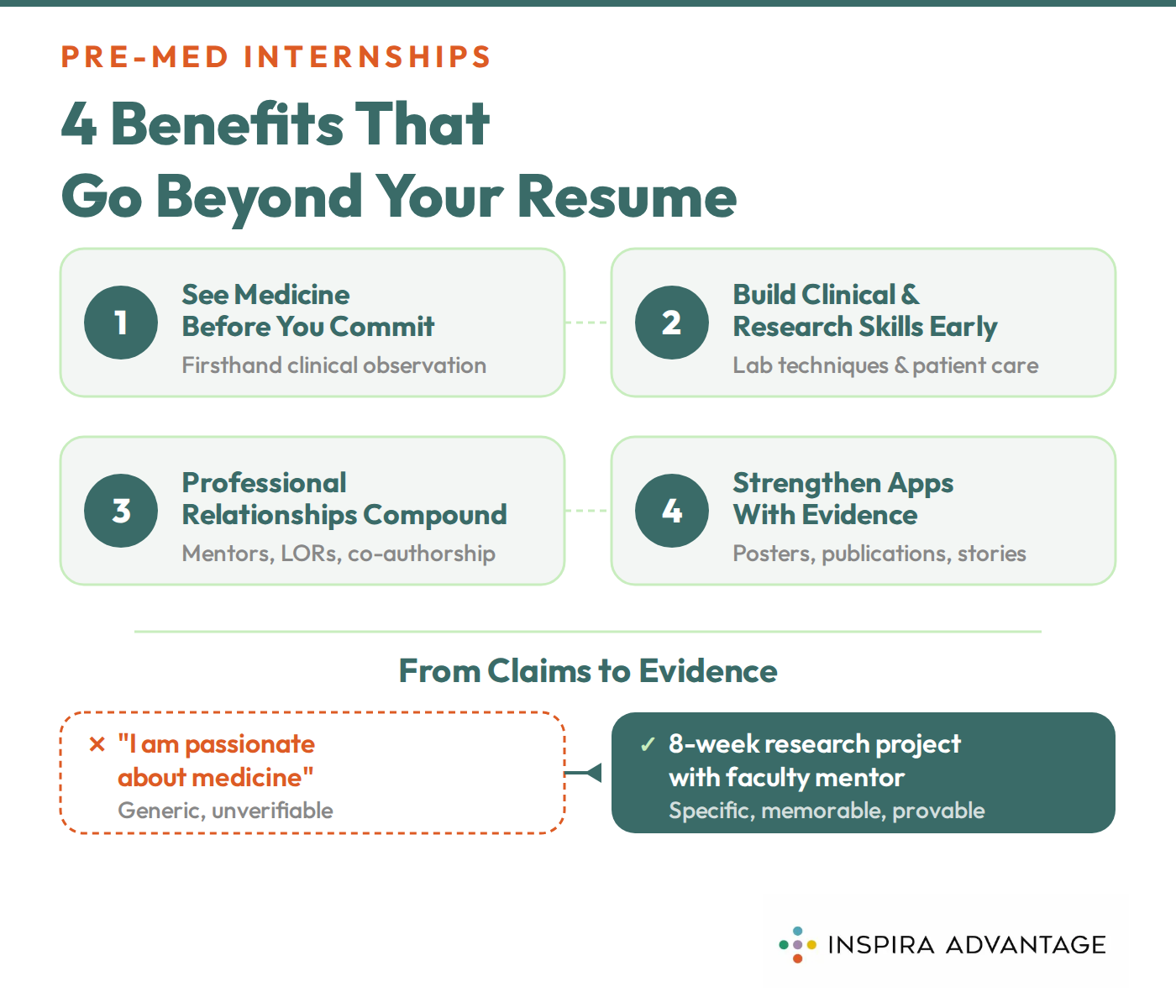
A pre-med internship’s benefits go beyond resume building. You leave with a clearer understanding of what medicine actually looks like, whether you belong in it, and how to position yourself for the next step.
Reading about patient care and standing in a room while it happens are fundamentally different experiences.
Many pre-med internships involve physician shadowing or other clinical components that put you inside the daily reality of healthcare: the pace of hospital rounds, the weight of a diagnosis conversation, and the coordination between specialists on a treatment plan. Students who complete an internship before applying to medical school make better decisions about their path because they’re working from firsthand observation, not assumptions.
The most valuable experiences are those that place students in authentic healthcare settings, whether locally or through structured international programs. Opportunities like those offered by Go-Elective Abroad, typically running 2 to 12 weeks, give early exposure to the day-to-day life of a physician—how clinical decisions are made, how patients are engaged, and how care is delivered in resource-constrained environments. Students also begin to understand how sociocultural factors shape global health and influence outcomes.
Experiences like these help build adaptability, resilience, and a more grounded understanding of medicine. Ultimately, what matters most isn’t where the experience takes place, but how students reflect on it and how it shapes their long-term path toward a career in healthcare.
An internship teaches you skills that your classmates won’t develop until their first year of medical school or graduate training. Students in clinical internships learn medical terminology, patient communication, and documentation workflows.
Students in research internships learn lab techniques (PCR, gel electrophoresis, cell culture), data analysis, and how to present findings at a poster session. When you arrive at medical school already comfortable reading a patient chart or pipetting in a wet lab, you spend less time catching up and more time going deeper.
The faculty mentor you work with during an eight- or 10-week summer program isn’t just a supervisor for the summer. That relationship can produce a strong letter of recommendation for medical school, co-authorship on a publication, or a direct introduction to colleagues at institutions you apply to later.
Programs like Harvard SHURP, Mayo Clinic SURF, and the Weill Cornell Gateways program are designed to create these long-term pipelines. The earlier you build these relationships, the more time they have to develop into the kind of advocacy that moves your application from a pile to an interview.
Two of our admissions experts explain exactly how to turn short-term mentorship into the kind of longitudinal relationship that produces a standout letter of recommendation in this webinar:
Admissions committees review thousands of applications from candidates who write "I am passionate about medicine" without demonstrating what that means in practice.
A pre-med internship replaces that claim with evidence: a poster presentation, a faculty mentor who can speak to your work ethic, a specific clinical experience you can describe in your personal statement, or a research contribution you can reference in your secondary essays.
The difference between an applicant who writes "I am interested in oncology" and one who can describe spending eight weeks at Northwestern's Robert H. Lurie Cancer Center advancing a research project in cancer immunology alongside a faculty mentor is the difference between a generic application and a memorable one.
Our admissions experts break down exactly how admissions officers distinguish applicants who demonstrate their experiences from those who only claim them in this webinar:
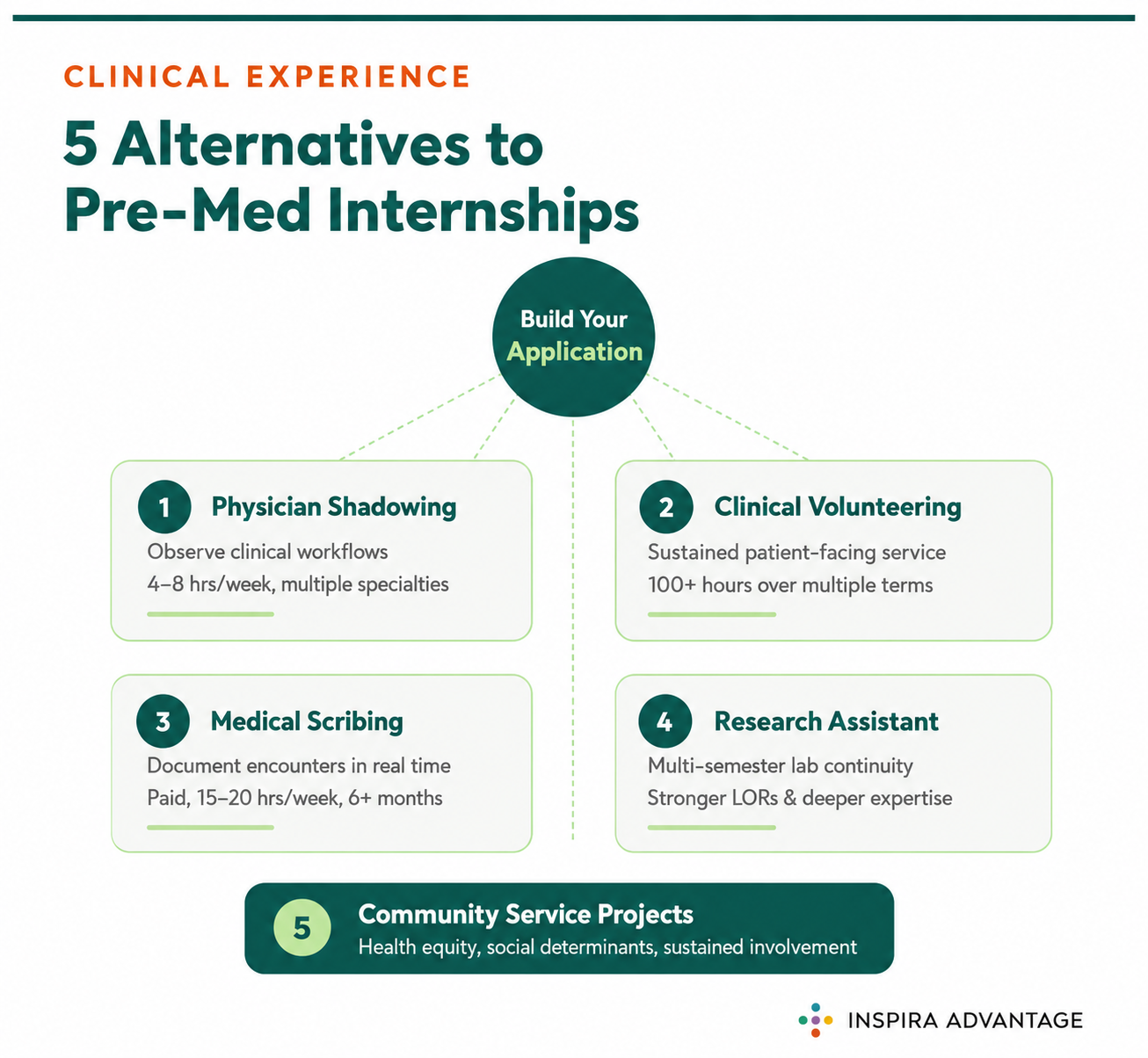
A formal internship isn’t the only path to meaningful clinical or research experience. If securing an internship proves competitive or logistically difficult, several alternatives build the same skills and carry real weight on a medical school application.
Physician shadowing lets you observe a practicing doctor during patient encounters, procedures, and clinical decision-making without performing clinical tasks yourself. Most medical schools expect applicants to log shadowing hours across multiple specialties.
Shadowing requires less commitment than a formal internship (typically four to eight hours per week), making it accessible even during the academic year.
The tradeoff is that shadowing is observational, not participatory. You won’t develop hands-on skills, but you will build an understanding of clinical workflows, patient-physician communication, and the realities of specific specialties.
Finding a physician to shadow typically requires direct outreach. Contact doctors through your university's pre-med advising office, reach out to physicians at local hospitals or clinics, or ask family members, professors, or mentors for introductions.
Clinical volunteering places you in a healthcare setting where you contribute to patient-facing or support tasks on a recurring basis. Hospitals, free clinics, hospice programs, and rehabilitation centers all accept volunteers.
Medical schools value clinical volunteering because it demonstrates sustained commitment to serving others, not just a one-time experience. Admissions committees look for consistent, long-term involvement (typically 100+ hours over multiple semesters) rather than a single concentrated block.
You can apply to these through your local hospital's volunteer services department, contact community health centers or free clinics, or search through organizations like the American Red Cross or local hospice networks.
Medical scribing places you alongside a physician as the person documenting patient encounters in real time. You learn medical terminology, diagnostic reasoning, and clinical documentation standards while gaining direct exposure to the pace and complexity of patient care.
Scribing is one of the few pre-med experiences that’s both paid and deeply clinical. Companies like ScribeAmerica, PhysAssist, and Proscribe hire and train pre-med students. And many hospital systems run their own in-house scribe programs. A typical commitment runs 15 to 20 hours per week over six months or more.
Scribing gives you a vocabulary and clinical fluency that most applicants don’t develop until their first year of medical school. Admissions committees recognize scribing as meaningful clinical experience because it requires real-time engagement with patient care, not passive observation.
Research assistant (RA) positions during the academic year offer many of the same benefits as a formal summer research internship, with the added advantage of continuity. Working in the same lab for multiple semesters allows you to contribute to longer-term projects, develop deeper expertise, and build a stronger relationship with your faculty mentor.
Most universities have processes for undergraduates to join research labs, either through formal programs (course credit for research) or by contacting faculty directly. An RA position that spans two or three semesters often produces a stronger letter of recommendation and a more substantive research narrative than a single eight-week summer program.
Review your department's faculty research profiles, attend lab open houses, ask your professors if they have openings, or check your university's undergraduate research office for posted listings.
Community service projects focused on health or wellness demonstrate your commitment to underserved populations and your understanding of the social determinants that affect patient outcomes. Medical schools increasingly value applicants who show awareness of how socioeconomic factors, access barriers, and community resources shape health.
Strong examples include volunteering with organizations that provide health screenings, tutoring underserved students in science, coordinating health fairs, or working with nonprofits that address food insecurity, housing instability, or mental health access. The key is sustained involvement with a clear connection to health or wellness, not a one-day event.
The Association of American Medical Colleges (AAMC) competencies for med school explicitly include "service orientation" and "cultural competence." Community service projects give you concrete examples to draw on in your personal statement, secondary essays, and interviews when demonstrating that you understand healthcare beyond the clinic walls.
No, finding a pre-med internship is not hard. The AAMC publishes a directory of summer undergraduate research programs at medical schools across the country. And platforms like Pathways to Science, LinkedIn, and Indeed list hundreds of clinical and research opportunities specifically for pre-med students.
Your university's pre-med advising office and undergraduate research office also maintain lists of local and institutional programs.
The challenge is landing the most competitive positions, because top programs at institutions receive hundreds of applications for limited spots and close by early February. Start your search in the fall semester.
No, most pre-med internships don’t require previous clinical experience. Most programs just evaluate your academic record, coursework, and interest in research rather than prior clinical hours.
A few programs are exceptions: Harvard SHURP prefers at least one summer or semester of lab experience, and the NYU Summer Undergraduate Research Program requires at least one semester of bench work.
Yes, international students can apply for some medical pre-med internships, but eligibility varies by program. Most federally funded programs (including Harvard SHURP and Boston University STaRS) restrict participation to U.S. citizens and permanent residents.
Baylor SMART, Mayo Clinic SURF, and Augusta STAR all accept international students enrolled at U.S. institutions, though each requires work authorization documentation after acceptance.
Read each program's eligibility section before applying. And confirm your work authorization status with your university's international student services office early in the process.
Yes, virtual internships count on your medical school application, but they carry less weight than in-person clinical or research experiences. Admissions committees prioritize experiences that place you in a clinical or laboratory environment with real patients or research teams. And virtual formats can’t replicate that direct exposure.
Virtual roles work best in public health, health policy, or data analysis fields, where the work itself happens on a computer regardless of location.
Hospital internships for pre-med students are competitive, especially at academic medical centers. Formal programs at hospitals receive large applicant pools and evaluate candidates on GPA, personal statements, letters of recommendation, and prior research or clinical experience.
Your best chance of landing a hospital internship is applying early (most deadlines fall between January and February), targeting programs that match your current experience level, and applying to multiple institutions rather than a single reach program.
Students who have at least one semester of research or clinical experience before applying are significantly more competitive than those applying with coursework alone.


.svg)


