Get in touch: +1 888 453 5021



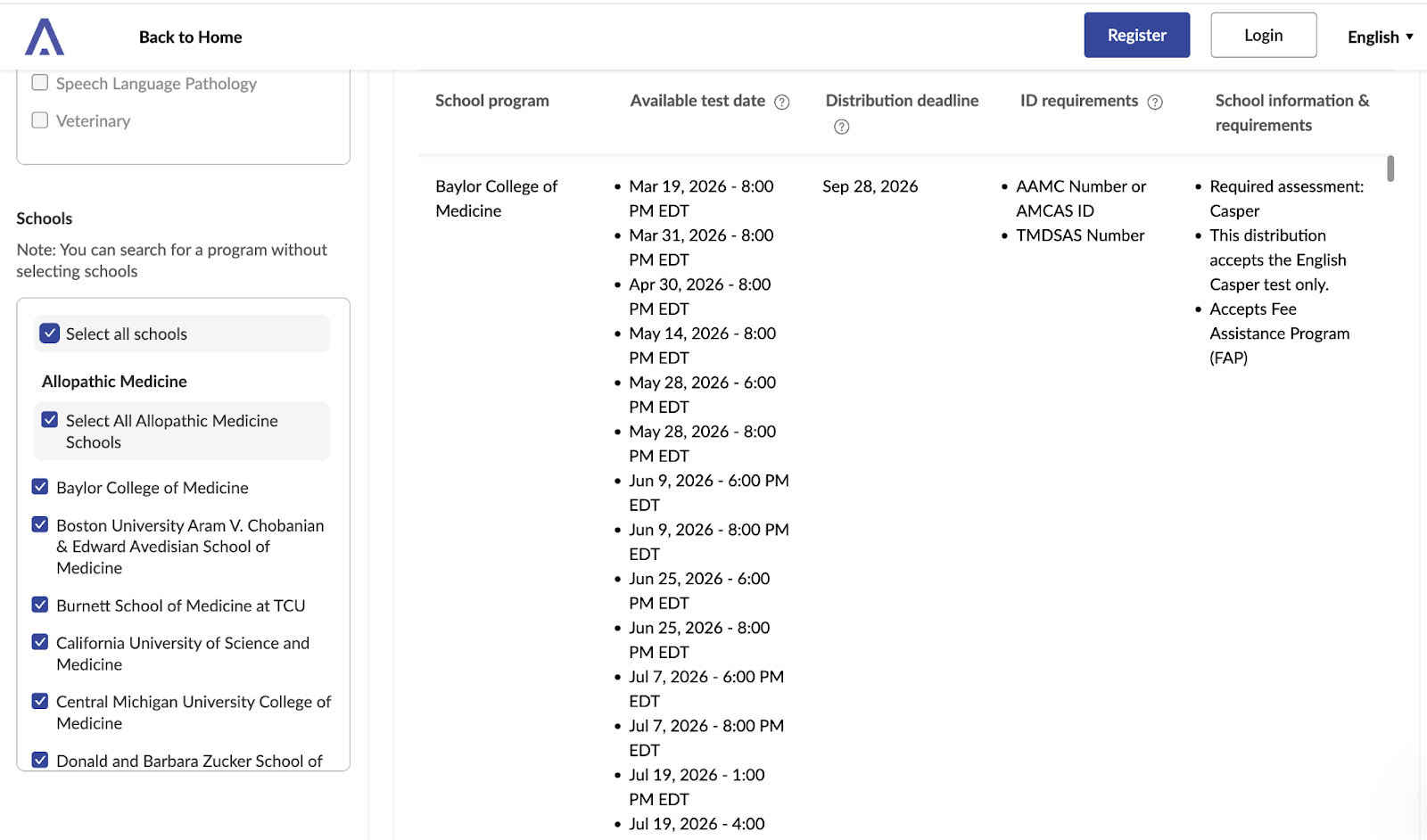
There are 34 medical schools that require, recommend, or accept Casper as part of their application for the 2026-2027 cycle:
Every school on this list appears on Acuity's official Casper distribution list. We verified each requirement directly against the school's admissions website to confirm the exact status.
For test dates, scheduling windows, and additional details, visit Acuity's test date and information page.
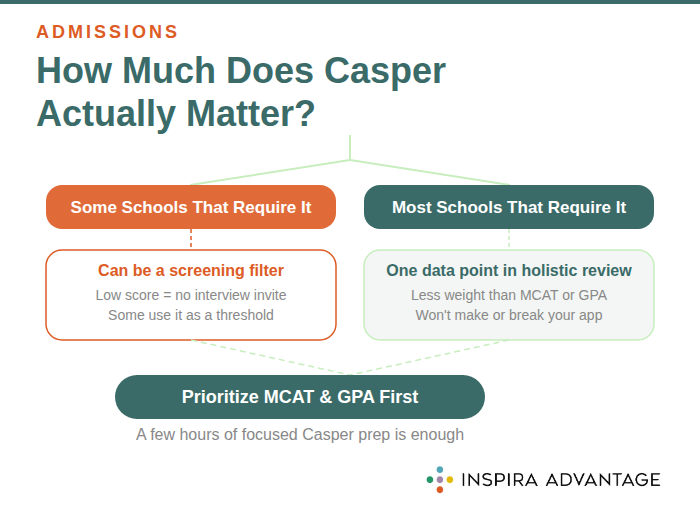
Casper scores matter at schools that require or recommend them. Some schools use Casper as a screening filter. At UT Health San Antonio, for example, you cannot receive an interview invitation unless you complete it. A handful of programs treat Casper as a threshold, meaning your score needs to clear a minimum bar before your full application gets reviewed.
At those schools, a very low score could keep you out of the interview pool even if everything else looks competitive.
However, at most schools, Casper is one data point folded into a holistic review and won’t make or break your application on its own. The test carries less individual weight than your MCAT, GPA, or personal statement.
As Dr. Aditya Khurana, a radiology resident at Mayo Clinic and advisor at Inspira Advantage, explains in our Casper Prep webinar, Casper gives applicants a way to add a humanistic dimension to their application and demonstrate what they bring to the table beyond their numbers.
The test helps programs identify candidates who already have the interpersonal qualities that protect against compassion fatigue across the medical profession.
At most schools, your Casper score is just one data point among many in a holistic review. Prioritize your MCAT and GPA first, but set aside a few hours of focused practice to understand the format and pacing. That level of preparation is enough for most applicants to score well.
Take your Casper test early in your application cycle, ideally in May or June after your junior year. Scores take approximately three weeks to reach schools. And you want them on file before admissions committees begin reviewing applications.
Late scores can push your file to the bottom of the pile at schools that screen in real time.
You can only take the Casper test once per application cycle. Pick a test date that gives you enough preparation time without cutting it close on delivery windows.
Medical school applicants must take the American Professional Health Sciences test (CSP-10111). You select this test type when you register for your Acuity Insights account. Each Casper score is tied to a specific application cycle and test type, so you cannot transfer scores between program types or reuse a score from a previous cycle.
No, medical schools don’t see your raw Casper answers. Med schools receive a detailed score report that ranks you against everyone else who took that version of the test. Schools receive both your Casper score and your percentile rank.
As an applicant, you receive even less information than schools do. You will only receive the quartile your score placed you in, not the actual score itself.
Yes, medical schools care about Casper scores, but the weight varies significantly by program. Some schools use Casper results to corroborate observations they make in other parts of your application, such as your written documents, letters of recommendation, and interviews. Others use it as a prescreening filter before issuing interview invitations.
You can’t study for the Casper test in the traditional sense. Casper tests your judgment and communication, not memorized knowledge, so there is no content to review like there is for the MCAT. The test developers claim that situational judgment tests like Casper are relatively immune to test prep.
Instead, practice answering sample questions by typing and recording yourself. Focus your prep on pacing and structure rather than trying to memorize "right" answers, because there are none.
The difference between an average score and a top-percentile score comes down to how clearly you frame your reasoning under time pressure, and that is a trainable skill. Our expert Casper tutors provide comprehensive Casper support through virtual, private lessons built around the insider strategies that consistently push students into the highest scoring tiers.
No, you don’t need to take Casper for each med school you apply to. You only need to take Casper once per application cycle. A single test sitting covers every school on your distribution list. When you register, you select which programs should receive your scores.
Casper scores are divided into four quartiles, and a third- or fourth-quartile score is considered competitive at most programs. Scoring in the fourth quartile means you performed better than 75% of other test takers. Scoring in the first quartile means 75% of test takers scored higher than you.


.svg)


