Get in touch: +1 888 453 5021


You need to master nine primary concepts when studying for the MCAT to answer biochemistry questions confidently.
The MCAT tests protein structure as a hierarchy:
Understand how denaturing agents (heat, pH extremes, urea, detergents) unfold proteins and why refolding doesn't always work. Water molecules surrounding a protein contribute to the thermodynamics of folding through entropy. Know how to use the isoelectric point to predict protein behavior in electrophoresis.
Not every protein is an enzyme, and the MCAT wants you to know what the others do. Binding proteins recognize specific ligands with high affinity — antibodies binding antigens are the classic example.
Understand the immune system connection: antibody structure (variable vs. constant regions), MHC proteins presenting antigens, and how specificity is generated. Motor proteins like myosin, kinesin, and dynein convert ATP hydrolysis into mechanical movement along cytoskeletal tracks.
Structural proteins like collagen (triple helix, hydroxyproline) and keratin provide tensile strength to tissues.
For hemoglobin, know cooperative binding (sigmoidal curve vs. myoglobin's hyperbolic curve), the Bohr effect, and how BPG shifts the oxygen dissociation curve.
Enzymes lower activation energy without changing the thermodynamics of a reaction — ΔG stays the same.
Classify them by reaction type:
The active site model (lock-and-key) says the enzyme's shape is perfectly complementary to the substrate. The induced-fit model says the enzyme changes shape upon substrate binding.
Know how local conditions affect activity:
Cofactors are inorganic ions (Zn²⁺, Mg²⁺) that assist catalysis. Coenzymes are organic molecules, and many are derived from water-soluble vitamins (NAD⁺ from niacin, FAD from riboflavin, coenzyme A from pantothenic acid). Know which vitamins produce which coenzymes.
Michaelis-Menten kinetics is the framework for everything here. Km is the substrate concentration at half Vmax — a low Km indicates high affinity.
Be able to read and interpret Lineweaver-Burk (double reciprocal) plots, where the x-intercept is -1/Km and the y-intercept is 1/Vmax. Competitive inhibitors increase apparent Km but don't change Vmax because you can outcompete them with more substrate. Non-competitive inhibitors decrease Vmax without affecting Km, as they bind at a site other than the active site.
Mixed inhibitors affect both Km and Vmax. Uncompetitive inhibitors bind only the enzyme-substrate complex, decreasing both apparent Km and Vmax. Allosteric enzymes don't follow Michaelis-Menten kinetics. They exhibit sigmoidal curves and are regulated by effectors that bind at sites other than the active site.
Covalent modifications like phosphorylation can activate or inactivate enzymes. Zymogens are inactive precursors that require cleavage to become active.
DNA is a double-stranded helix with antiparallel strands running 5' to 3' and 3' to 5'. The backbone is sugar-phosphate (deoxyribose connected by phosphodiester bonds), and the bases pair adenine with thymine (two hydrogen bonds), guanine with cytosine (three hydrogen bonds).
More G-C content means a higher melting temperature because three hydrogen bonds are harder to break than two. Know the difference between nucleotides (base + sugar + phosphate) and nucleosides (base + sugar only).
DNA denaturation separates strands with heat or high pH; reannealing brings them back together when conditions normalize. Hybridization is the same principle applied using a complementary probe to find a specific sequence. Replication is semiconservative. (Each new double helix has one old strand and one new strand, proven by Meselson-Stahl.)
Know the enzymes:
The leading strand is synthesized continuously; the lagging strand is synthesized in Okazaki fragments. Eukaryotes have multiple origins of replication to speed up DNA replication. Telomerase extends chromosome ends to prevent shortening during replication, and its absence contributes to cellular aging.
RNA uses ribose instead of deoxyribose, uracil instead of thymine, and is typically single-stranded. The genetic code is read in triplets (codons), and it's degenerate.
Wobble pairing at the third position of the codon explains why degeneracy exists. AUG is both the start codon and codes for methionine. Three stop codons (UAA, UAG, UGA) don't code for any amino acid. Missense mutations change one amino acid to another; nonsense mutations create a premature stop codon.
Know the three types of RNA and what each does:
Aminoacyl-tRNA synthetases charge each tRNA with the correct amino acid — there's one synthetase per amino acid, and this step is where the genetic code gets physically translated.
Know the classification system first: monosaccharides by carbon count (triose, pentose, hexose) and by functional group (aldose has an aldehyde, ketose has a ketone). D and L configurations refer to the orientation of the hydroxyl group on the highest-numbered chiral carbon — nearly all biologically relevant sugars are D-form.
In solution, monosaccharides cyclize into ring forms, and the MCAT expects you to recognize both Haworth projections and chair conformations. Anomers differ at the anomeric carbon (C1 for aldoses) — α has the hydroxyl axial (down in glucose); β has it equatorial (up).
Epimers differ at exactly one chiral center other than the anomeric carbon (glucose and galactose are C4 epimers). Glycosidic bonds link monosaccharides together — α-1,4 linkages form starch and glycogen, β-1,4 linkages form cellulose (which humans can't digest because we lack the enzyme to break β linkages).
Glycogen is the animal storage form with extensive α-1,6 branching for rapid mobilization. Starch is the plant equivalent with less branching. Understand the hydrolysis of glycosidic bonds as the mechanism for breaking these polymers back into usable monosaccharides.
Fatty acids are long hydrocarbon chains with a carboxyl group at one end. Saturated fatty acids have no double bonds and pack tightly (solid at room temperature); unsaturated fatty acids have one or more cis double bonds that create kinks and reduce packing (liquid at room temperature).
Triglycerides store energy as three fatty acids esterified to a glycerol backbone — they're the most energy-dense macromolecule because their carbons are highly reduced.
Phospholipids replace one fatty acid with a phosphate-containing head group, making them amphipathic and ideal for forming biological membranes.
Sphingolipids are built on a sphingosine backbone instead of glycerol and play roles in cell signaling and recognition.
Cholesterol is a steroid with four fused rings — it's amphipathic (nonpolar rings, polar hydroxyl group) and modulates membrane fluidity by preventing tight packing at high temperatures and preventing solidification at low temperatures.
Steroids derived from cholesterol include:
Fat digestion requires bile salts (made from cholesterol in the liver) to emulsify lipids into micelles for absorption. Lipoproteins (chylomicrons, VLDL, LDL, HDL) transport fats through the blood because lipids are insoluble in aqueous plasma.
β-oxidation breaks fatty acids into two-carbon acetyl-CoA units in the mitochondrial matrix. Each cycle removes one acetyl-CoA and produces 1 NADH and 1 FADH₂ — so a 16-carbon palmitate goes through seven rounds, yielding eight acetyl-CoA, seven NADH, and seven FADH₂. That's an enormous ATP yield, which is why fat is such an efficient energy store.
Unsaturated fatty acids require extra isomerase and reductase enzymes to handle their double bonds during β-oxidation. Fatty acids must be activated with coenzyme A and transported into mitochondria via the carnitine shuttle, and carnitine shuttle regulation is a key control point.
Ketone bodies (acetoacetate, β-hydroxybutyrate, acetone) are produced in the liver from excess acetyl-CoA during prolonged fasting or uncontrolled diabetes, when oxaloacetate gets diverted to gluconeogenesis and cannot keep the TCA cycle running.
The brain, which normally runs on glucose, adapts to use ketone bodies during starvation. Fatty acid biosynthesis occurs in the cytoplasm using acetyl-CoA (shuttled out of mitochondria as citrate), NADPH as the reducing agent, and fatty acid synthase as the key enzyme — build this in two-carbon increments.
Protein metabolism starts with transamination (transferring an amino group to α-ketoglutarate to form glutamate) or oxidative deamination (removing the amino group as ammonia).
The resulting carbon skeletons feed into glycolysis or the TCA cycle. Ammonia is toxic and gets converted to urea in the liver through the urea cycle for excretion.
Nearly every biochemistry topic on the MCAT connects back to amino acids. Spend your first week drilling amino acids until you can classify any of the 20 by structure alone, predict where each would sit in a protein, and calculate net charge at any given pH.
Know that histidine's pKa (~6.0) makes it uniquely suited for enzyme active sites because it can donate or accept protons at physiological pH — this comes up constantly in catalytic triad questions.
Know that phosphorylation only happens on serine, threonine, and tyrosine because they're the only three with hydroxyl-bearing side chains.
Know that glycine's tiny hydrogen side chain gives it conformational flexibility that shows up at tight turns, while proline's rigid cyclic structure forces kinks that break α-helices.
Dr. Austin Johnson, a 99th percentile MCAT tutor at Inspira Advantage, reinforces this point in our MCAT secrets webinar:
“The gap between a low and high MCAT score isn't whether you can define Km and Vmax — it's whether you can apply them to a problem you've never seen,” he says. “Memorizing that uncompetitive inhibitors decrease both Vmax and Km won't help if you don't understand why — the inhibitor binds the enzyme-substrate complex, which changes the kinetic behavior in ways that only make sense when you reason through the mechanism.”
He also notes that you should build your enzyme knowledge around repetition and application, not flashcard definitions.
The MCAT almost never asks you to name the intermediate between steps four and five of glycolysis. It asks if ATP levels are high and a patient just ate a large meal, which enzyme is inhibited, and what happens downstream?
Build a single-page map that connects:
Connect these concepts through their shared regulatory molecules — ATP, AMP, NADH, acetyl-CoA, citrate, fructose-2,6-bisphosphate, insulin, and glucagon. For each pathway, know three things:
Once you understand the TCA cycle, every regulation question becomes a reasoning exercise rather than a recall exercise. Draw this map by hand, from memory, once a week until test day.
Dr. Jason Gomez, an expert tutor at Inspira Advantage and a Stanford Medicine graduate, frames biochemistry prep similarly in our MCAT Crash Course. He says memorizing metabolic pathways and amino acid properties is necessary but insufficient.
The MCAT demands that you apply that foundational knowledge to identifying control variables, interpreting passage figures, and drawing conclusions from results you've never seen before. Treat your content knowledge as a toolkit, not a checklist.
Biochemistry passages on the MCAT are mini-research papers featuring gel images, kinetic plots, and Western blot results.
Don’t wait until you've finished content review to start passages. Start working on the Association of American Medical Colleges’ (AAMC) Section Bank passages for Bio/Biochem by the halfway point of your content review. You'll quickly learn which topics you understand conceptually but can't apply under pressure.
Build a specific skill set for passage interpretation. When you see an SDS-PAGE gel, immediately look at the molecular weight markers and band intensity. A missing band means a protein isn't expressed, and a shifted band means a mutation changed the protein's size.
When you see a Michaelis-Menten curve, identify Vmax first. Then find half-Vmax to estimate Km.
When you encounter an unfamiliar enzyme or pathway (and you will), don't panic — the passage always gives you enough information to answer the questions if you read the figures carefully.
Do at least two experimental passages per week starting from week three of your study schedule. And for every question you miss, identify whether you lacked the content knowledge or the data interpretation skill.
Download our free MCAT study schedules to help you know what to prepare and when. We have many options, whether you want to study for one, three, or six months. Our expert MCAT tutors designed these schedules to help you master the biochemistry section.
Many MCAT biochemistry questions ask what the body does when energy is abundant versus when energy is scarce. Build two columns in your head:
When you see a metabolism question, your first step should be to identify which metabolic state the passage describes. That single determination immediately narrows your answer choices.
Insulin binds a receptor tyrosine kinase, triggering autophosphorylation that activates downstream pathways including PI3K and MAPK. The net effect is the activation of phosphoprotein phosphatases that dephosphorylate metabolic enzymes.
Glucagon binds a GPCR, activates adenylyl cyclase, raises cAMP, and activates protein kinase A (PKA). PKA phosphorylates enzymes to activate glycogenolysis and gluconeogenesis while inactivating glycolysis and glycogen synthesis.
The key insight is that phosphorylation is not universally "activating" or "inactivating." Phosphorylation activates glycogen phosphorylase (breakdown) but inactivates glycogen synthase (synthesis).
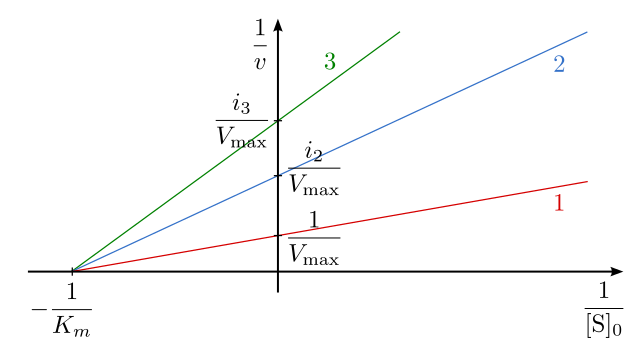
Memorizing that competitive inhibitors compete for the active site won't help when the MCAT hands you a double-reciprocal plot and asks you to identify the inhibition type from the data.
Train yourself to read Lineweaver-Burk plots by pattern:
Memorize all four of them until you can sketch them in under 30 seconds. The MCAT passage will provide data, but your job is to match the pattern, not to recall a textbook definition.
Connect each type of inhibition to a real biological scenario so the patterns stick. When the MCAT presents a drug development passage, the inhibition type often determines the experimental outcome, and the question tests whether you can read that from the kinetic data rather than from a stated definition.
Expert MCAT tutors at Inspira Advantage can help you master the MCAT. Our expert tutors, like Alexander, have scored in the top 1% of the biochemistry sections, so they know exactly where students lose points and how to fix it.

The Biological and Biochemical Foundations of Living Systems section (Bio/Biochem) on the MCAT is where you'll see the most biochemistry content. About 25% of the 59 questions in this section draw directly on first-semester biochemistry, with another 65% coming from introductory biology, which overlaps heavily with biochemistry concepts such as cell signaling, membrane transport, and molecular genetics.
The section runs 95 minutes and presents 10 passages with four to six questions each, plus 15 standalone discrete questions.
The Chemical and Physical Foundations of Biological Systems section (Chem/Phys) also pulls about 25% of its questions from biochemistry, but the angle is different. Here, biochemistry shows up through:
The content overlaps with Bio/Biochem, but Chem/Phys asks you to approach it as a physics or chemistry problem rather than a biology one.
The AAMC organizes all MCAT content around Foundational Concepts, and biochemistry appears across five of them.
Foundational Concept 1 accounts for 55% of the Bio/Biochem section and covers:
That makes FC 1 the single highest-yield content block on the entire exam.
Foundational Concept 2 makes up 20% of the Bio/Biochem section and covers:
Foundational Concept 3 accounts for 25% of the Bio/Biochem section and covers:
Together, FCs 1 through 3 make up the entire Bio/Biochem section.
The MCAT uses biochemistry content inside research-style passages that describe experiments, present data in figures and tables, and ask you to interpret results. A typical passage might describe a research group studying a novel enzyme inhibitor, present a Lineweaver-Burk plot showing kinetic changes, include a Western blot confirming protein expression levels, and then ask you four questions that require integrating the data with your foundational knowledge.
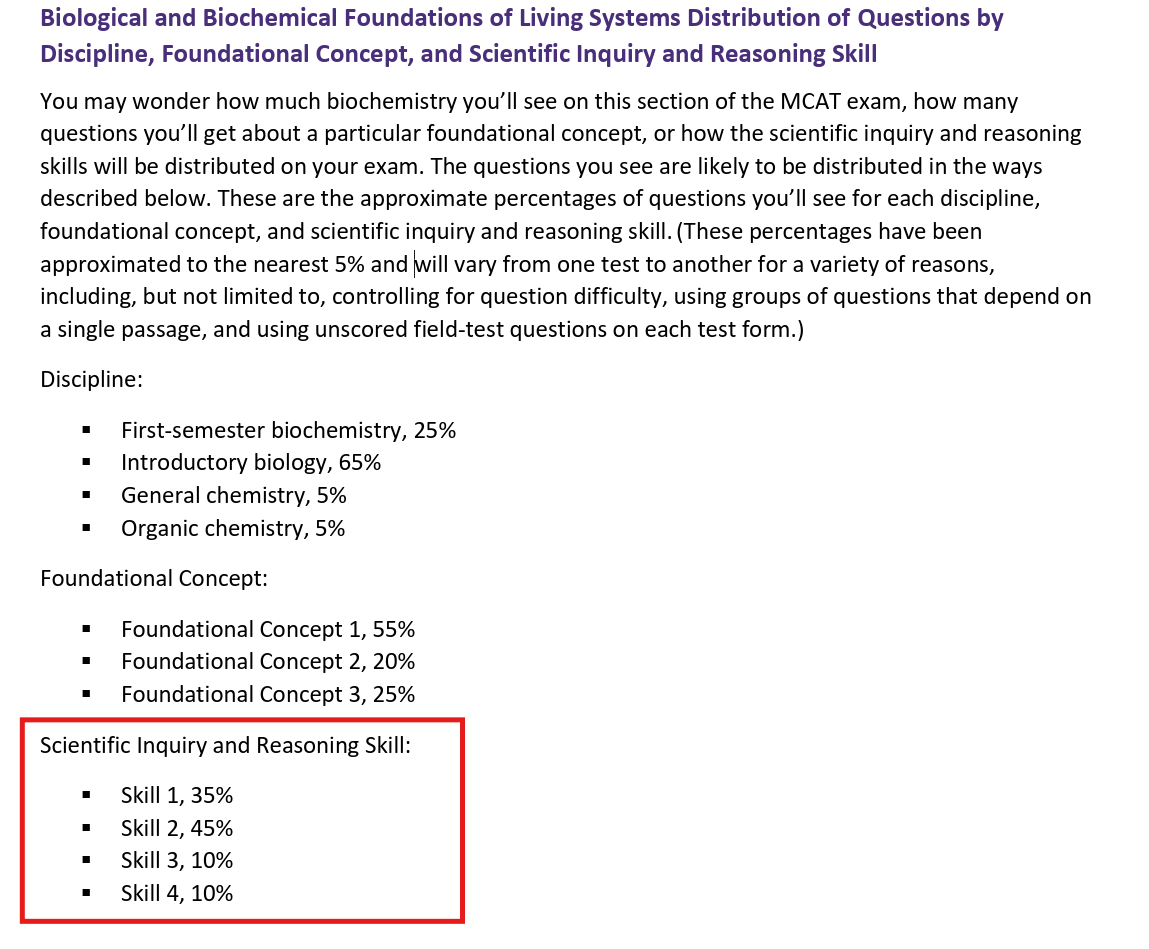
The AAMC tests four Scientific Inquiry and Reasoning Skills across these passages:
Roughly 35% of questions test Skill 1 and 45% test Skill 2, meaning the majority of your score comes from applying and reasoning with biochemistry knowledge, not simply remembering it.
The best biochemistry MCAT prep involves consistent practice. You can make daily practice part of your routine with a new exam-style question and clear answer breakdown every weekday.
Let’s take a look at examples of real biochemistry questions you might see on test day. We used the biochemistry questions in our free full-length MCAT Practice Test, designed by our expert tutors.
Retinoblastoma is a rare eye cancer caused by mutations in the RB1 gene, a tumor suppressor gene responsible for regulating cell division. The RB1 gene encodes the retinoblastoma protein (pRB), which plays a crucial role in the control of the cell cycle. In normal cells, pRB is phosphorylated by cyclin-dependent kinases (CDKs) during the G1 phase of the cell cycle, allowing the cell to progress to the S phase.
Question: Which of the following best describes the function of the retinoblastoma protein (pRB) in normal cells?
A) pRB phosphorylates cyclin-dependent kinases (CDKs) during the G1 phase
B) pRB promotes the progression of cells from the G1 phase to the S phase
C) When pRB is phosphorylated by CDKs, it allows cell cycle progression from G1 to S phase
D) pRB is a proto-oncogene that stimulates cell division when activated
Question: According to the principles of Michaelis-Menten kinetics, which of the following are true if an uncompetitive inhibitor is added to a solution of enzyme and substrate?
A) Vmax and Km are unchanged
B) Vmax is unchanged while Km increases
C) Vmax decreases while Km is unchanged
D) Both Vmax and Km decrease
Hypoxia inhibits the tricarboxylic acid (TCA) cycle and leaves glycolysis as the primary metabolic pathway responsible for converting glucose into usable energy. The passage discusses phosphofructokinase (PFK) as one of the enzymes involved in both the gluconeogenesis and glycolysis pathways.
Question: If the gene that codes for the PFK enzyme undergoes a nonsense mutation, which of the following would be a likely result?
A) One metabolic pathway will be downregulated
B) One metabolic pathway will be affected
C) More than one metabolic pathway will be affected
D) More than one metabolic pathway will be upregulated
Question: Which of the following disaccharide compounds are described correctly?
A) Maltose: glucose and glucose joined by a β-1,4-glycosidic bond
B) Sucrose: galactose and fructose joined by an α-1,β-2-glycosidic bond
C) Lactose: galactose and glucose connected by an α-1,4-glycosidic bond
D) Lactose: galactose and glucose connected by a β-1,4-glycosidic bond
Question: Which type of bond is primarily responsible for the secondary structure of proteins?
A) Disulfide bonds
B) Hydrogen bonds
C) Ionic bonds
D) Peptide bonds
Yes, you can self-study biochemistry for the MCAT using a combination of content review books, video resources, and practice questions. Many students do this. You don't need a formal biochemistry course to score well, though having taken one does give you a head start on topics like amino acid chemistry, enzyme kinetics, and metabolic pathways.
You can sit for the MCAT without having taken a formal biochemistry course, but walking in without biochemistry knowledge is a different story. Biochemistry content appears heavily across the Bio/Biochem section (roughly 25% of the entire exam) and shows up in Chem/Phys questions involving organic molecule behavior and enzyme catalysis. Amino acid properties, enzyme kinetics, metabolic pathways, and nucleic acid structure are tested directly and frequently.
Spend the first two to three weeks studying for biochemistry on pure content review. The MCAT tests whether you can apply knowledge inside a passage describing a novel experiment. Start working through passage-based biochemistry questions by week three, even if you haven't finished reviewing every topic. Getting questions wrong early and analyzing why you missed them teaches you more about how the MCAT tests biochemistry than another week of reading ever will.
The nine highest-yield biochemistry topics are:
These areas account for the majority of biochemistry questions on the MCAT. Mastering them gives you a foundation that makes every other biochemistry topic easier to learn.
Orthopaedic Surgery Resident Physician
Lewis Katz School of Medicine at Temple University


We’ll send you a 100+ page MCAT practice test created by one of our expert 99th percentile tutors. No strings attached.


.svg)

