Read our comprehensive guide on how to get into Yale School of Medicine (YSM), including its admissions statistics, important deadlines, and tuition costs.
If you're just here for the requirements, click here.
Privacy guaranteed. No spam, ever.
Yale School of Medicine Acceptance Rate: 1.41%
Yale School of Medicine's acceptance rate is 1.41%. According to Medical School Admissions Requirements (MSAR) data, YSM received 7,352 verified applications in the most recent admissions cycle. And 104 students matriculated. Fewer than 2 out of every 100 applicants earned a seat in the entering class.
The table and graph below show YSM's acceptance rate data over the past five years, as reported by the Association of American Medical Colleges (AAMC):
Year
Number of Applications
Number of Matriculants
Acceptance Rate
2025-2026
7,352
104
1.41%
2024-2025
6,597
104
1.58%
2023-2024
6,388
105
1.64%
2022-2023
6,338
104
1.64%
2021-2022
7,254
104
1.43%
0%
Acceptance Rate
Yale School of Medicine — 2025–2026 Admissions Cycle
0
Total Applicants
0
Matriculants
<2 in 100
Your Odds
Out of every 100 applicants…
Matriculant
Did not matriculate
i
Yale's acceptance rate has never exceeded 1.64% in the last five cycles. Even as application volume fluctuated between 6,338 and 7,352, the entering class has remained remarkably consistent at 104–105 matriculants.
Acceptance rate by cycle
Yale School of Medicine's average acceptance rate from 2021-2022 through 2025-2026 is approximately 1.54%. That means only about 1 out of every 65 applicants ultimately matriculated.
Class size held steady throughout the period, with YSM enrolling between 104 and 105 matriculants per cycle. Even in the years with the highest acceptance rates (2023-2024 and 2022-2023, both at 1.64%), fewer than two applicants out of every 100 earned a seat.
How Hard Is It to Get Into Yale School of Medicine?
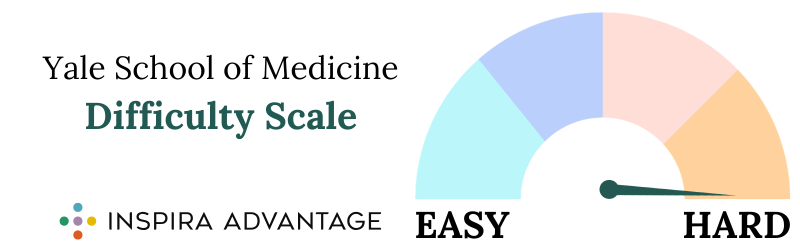
Getting into Yale School of Medicine is extraordinarily difficult. A 1.41% acceptance rate places YSM among the most selective medical schools in the country.
What Is Yale School of Medicine's Acceptance Rate for In-State Applicants?
The acceptance rate for Connecticut residents at Yale School of Medicine is 2.26%. YSM received 266 verified in-state applications, extended 14 interview invitations, and matriculated six students. Connecticut residents make up only 3.61% of the total applicant pool and fill 5.78% of the entering class.
While that 2.26% rate is higher than the overall 1.42%, the advantage is modest. Yale School of Medicine is a private institution. Unlike public medical schools that may reserve half or more of their seats for residents, YSM does not set aside a significant share of its class for Connecticut applicants. A 2.26% acceptance rate still means roughly 44 Connecticut residents competed for every in-state seat.
What Is Yale School of Medicine's Acceptance Rate for Out-of-State Applicants?
The acceptance rate for out-of-state applicants at Yale School of Medicine is 1.41%. Of 6,541 out-of-state verified applications, 608 received interview invitations, and 92 students matriculated. Out-of-state applicants represent 88.97% of the total pool. And they fill 88.46% of the entering class.
The near-identical proportions between the applicant pool (88.97%) and the entering class (88.46%) confirm that YSM evaluates out-of-state candidates on the same footing as everyone else. Residency status is effectively a non-factor at Yale School of Medicine. That’s a key distinction from public medical schools, where out-of-state acceptance rates can drop to below 1%.
What Is Yale School of Medicine's Acceptance Rate for International Students?
The acceptance rate for international applicants at Yale School of Medicine is 1.10%. Of 545 international applications, 25 received interview invitations, and six matriculated.
International applicants face a slightly lower acceptance rate than domestic applicants (1.10% vs. 1.42% overall). But the fact that YSM matriculated six international students is notable. Many U.S. medical schools accept zero international students in a given cycle.
The interview rate for international applicants is 4.59%. Compare that to 5.27% for in-state and 9.30% for out-of-state applicants. International candidates face the tightest screening at the interview stage. But those who receive an invitation convert to matriculation at a rate comparable to domestic interviewees.
How Many People Apply to Yale School of Medicine Every Year?
Approximately 6,300 to 7,400 applicants apply to Yale School of Medicine each year. Despite noticeable swings in application volume over the past five years, YSM holds its class size steady at 104 to 105 matriculants per cycle.
Privacy guaranteed. No spam, ever.
Admissions Statistics
Yale School of Medicine Median MCAT Score: 522
Yale School of Medicine’s recent admits had a median MCAT score of 522. YSM matriculants had a median MCAT score of 523. YSM does not have a minimum MCAT score for admission consideration.
According to MSAR data, successful YSM admits scored high across each section of the exam:
MCAT Section
Median Score
Chemical and Physical Foundations of Biological Systems
131
Critical Analysis and Reasoning Skills
130
Biological and Biochemical Foundations of Living Systems
131
Psychological, Social, and Biological Foundations of Behavior
131
522
Median MCAT Score of Accepted Applicants
516
10th
519
25th
522
Median
525
75th
526
90th
Your MCAT Score522
472486500514528
At the median of accepted applicants
Note: Yale School of Medicine does not publish a minimum MCAT score requirement. MCAT scores are one factor in a holistic review process that also considers GPA, extracurriculars, research, clinical experience, and personal statements.
The table below shows the MCAT score range for YSM admittees and matriculants based on percentile data:
Percentile
MCAT Score for Accepted Applicants
MCAT Score for Matriculants
10th Percentile
516
513
25th Percentile
519
517
Median
522
523
75th Percentile
525
525
90th Percentile
526
526
To put this score range into perspective, a 516 already ranks at the 92nd percentile of all MCAT test-takers nationally. Even the lowest-scoring YSM admits outscore more than 9 out of 10 people who sit for the exam.
That narrow range means YSM is not admitting a mix of "good" and "great" scorers. Nearly everyone in the entering class is scoring at the very top of the national distribution. And the admissions committee treats elite MCAT performance as a baseline expectation rather than a differentiator.
MSAR also shares that the 2025 admits had an average MCAT score of 521.4. The AAMC reports that the average national medical school applicant has an MCAT score of 506.3, meaning successful admits scored about 15.1 points higher on average.
What MCAT Score Makes You Competitive at Yale School of Medicine?
A 525+ MCAT score makes you competitive at Yale School of Medicine because it aligns with the top 25% of accepted students.
Here’s what each score level means for your competitiveness:
⚈ A 522 MCAT score places you at YSM’s median for accepted students and confirms you meet the academic benchmark of the admitted pool. With a 1.42% acceptance rate, matching the median on stats alone is not enough. Your research experience, clinical exposure, and secondary essays need to differentiate you from other high-scoring applicants.
⚈ A 525 MCAT score puts you in the top 25% of accepted students and gives your application a noticeable academic edge within an already elite pool.
⚈ A 526 MCAT score places you in the top 10% of accepted students and signals exceptional academic readiness.
Yale School of Medicine Median GPA: 3.96
The median total GPA for admitted students at Yale School of Medicine is 3.96. The 2025 matriculants had a median total GPA of 3.94.
YSM doesn’t have a minimum GPA requirement. The table below shows the total GPA percentile range for the 2025-2026 admits and matriculants:
Percentile
Total GPA for Accepted Students
Total GPA for Matriculants
10th Percentile
3.77
3.72
25th Percentile
3.88
3.84
Median
3.96
3.94
75th Percentile
3.99
3.98
90th Percentile
4.00
4.00
3.96
Median GPA of Accepted Applicants
3.77
10th
3.88
25th
3.96
Median
3.99
75th
4.00
90th
Your GPA3.96
2.002.503.003.504.00
At the median of accepted applicants
Note: Yale School of Medicine does not publish a minimum GPA requirement. GPA is one factor in a holistic review process that also considers MCAT scores, extracurriculars, research, clinical experience, and personal statements.
A 3.77 is not a "low" GPA by any normal standard. But at Yale School of Medicine, it represents the floor. The middle 50% of the entering class falls between 3.88 and 3.99. That means half of all admitted students are essentially clustered within a tenth of a point of a perfect 4.00.
That compression tells you something important: GPA alone will not set you apart at YSM. Nearly everyone who gets in has a GPA above 3.88. The admissions committee treats near-perfect grades as a baseline expectation, not a differentiator.
MSAR reports that the average GPA of accepted YSM students is 3.92, while the AAMC reports a national average GPA of 3.67 for applicants. In other words, YSM’s admits students with a GPA about 0.25 points higher than the average applicant, reinforcing just how compressed and competitive the academic range is at this level.
What GPA Makes You Competitive at Yale School of Medicine?
A 3.99 GPA makes you highly competitive at Yale School of Medicine, as it’s higher than 75% of the admitted students’ GPAs.
Here is what each GPA level means for your competitiveness:
⚈ A 3.96 GPA places you at YSM’s median for admitted students. You meet the academic benchmark of the accepted pool, but you aren’t above it.
⚈ A 3.99 GPA puts you in the top 25% of admitted students. Combined with a strong MCAT and compelling extracurriculars, a GPA at this level removes academics as a concern in your application.
⚈ A 4.00 GPA places you at the 90th percentile of admitted students. A perfect GPA is a clear asset, but at a school where the 75th percentile is already 3.99, the gap between “very strong” and “perfect” is minimal. Your research productivity, leadership, and essays still carry the same weight.
Yale School of Medicine Median Science GPA: 3.96
The median science GPA among Yale School of Medicine applicants is 3.96. The median science GPA among matriculants is 3.94.
The science GPA distribution sits lower than the total GPA at the bottom of the range (3.66 vs. 3.77 at the 10th percentile). That’s typical. Pre-med science courses tend to be graded more harshly than humanities and social science courses. So a lower science GPA floor is expected.
What is notable is that the 75th and 90th percentiles both hit a perfect 4.00. That means the top quarter of the accepted applicants earned straight As in their science coursework.
The wider spread on the science GPA (0.34 points from 10th to 90th, compared to 0.23 for total GPA) also means YSM shows slightly more flexibility on science grades than on overall academics.
What Science GPA Makes You Competitive at Yale School of Medicine?
A science GPA of 4.00 is competitive at Yale School of Medicine. If your science GPA falls in the 3.87 to 3.96 range, you’re within the middle 50% of admits and will pass the initial academic screening benchmarks.
If your science GPA sits closer to the 3.66 to 3.87 range, focus on strong MCAT performance in the science sections to reinforce your readiness and an upward trend in your upper-division science coursework.
A science GPA that starts low but climbs steadily through organic chemistry, biochemistry, and advanced biology courses tells the admissions committee you found your footing and finished strong.
Privacy guaranteed. No spam, ever.
Yale School of Medicine Admissions Requirements
Here is a comprehensive list of Yale School of Medicine's admissions requirements:
A bachelor’s degree from an accredited college, university, or institute of technology
MCAT scores (scores must be three years old or less)
Pre-medical committee recommendation letter (or three individual letters, including at least one from a science professional, if your school does not have a pre-med committee)
AP courses will not count toward these prerequisites. So, plan to take every prerequisite at the college level regardless of any AP credit you received in high school.
Yale School of Medicine Interview Format
Yale School of Medicine conducts traditional, conversational, one-on-one interviews with faculty or senior students. Interviews are conducted virtually and last 30-60 minutes.
What Is Yale School of Medicine's Interview Rate?
Yale School of Medicine's overall interview rate in the most recent admissions cycle was approximately 9.84%. Of 6,597 verified applications, 649 applicants received interview invitations (16 in-state, 572 out-of-state, and 61 international).
The interview rate varies by applicant type:
Type of Applicant
Applied
Interviewed
Interview Rate
Connecticut Residents
216
16
7.41%
Out-of-State Applicants
5,891
572
9.71%
International Applicants
490
61
12.45%
Connecticut residents have the lowest interview rate (7.41%), which reinforces that YSM, as a private institution, does not give meaningful preference to in-state applicants.
Privacy guaranteed. No spam, ever.
Secondary Application Essays
All Yale School of Medicine MD and MD/PhD applicants receive a secondary application via email within two weeks of submitting their primary AMCAS application. The secondary consists of two required essay prompts (with one offering a choice between two options) and one optional essay.
Your secondary essays should reinforce your personal narrative, demonstrate self-awareness and intellectual depth, and clearly connect your background and goals to Yale School of Medicine's values, including diversity, community health, and research excellence.
Yale School of Medicine's 2025-2026 secondary essay prompts are:
Required Essay 1: "Yale School of Medicine is committed to improving the health of all people. How have your background and experiences prepared you to care for all people including those unlike yourself?" (500 words)
How to Approach This Prompt
The main question adcoms want answered in this prompt is: how have your experiences prepared you to care for people different from you?
Pick 1–2 specific experiences (clinical, volunteer, personal) where you worked with people unlike yourself
⚈ Show what you did, not just what you saw
⚈ Explain what changed in how you think, communicate, or approach care
⚈ Be explicit about skills you gained: listening, adapting, handling bias, building trust
Close your essay by connecting this to how you will care for diverse patients at YSM. Avoid generic statements about “valuing diversity.”
Required Essay 2 (choose one):
MD applicants should answer either one of the following questions. MD/PhD applicants should answer Question 2 as it pertains to their proposed PhD research.
Option 1: "While there is great emphasis on the physician-patient relationship, Yale School of Medicine also emphasizes the importance of training future physicians to care for communities and populations. Describe how your experiences would contribute to this aspect of the mission of the Yale School of Medicine." (500 words)
How to Approach This Prompt
This prompt is about impact beyond individual patients. To answer it strongly:
⚈ Choose experiences tied to communities or systems (public health, outreach, advocacy, education)
⚈ Show your specific impact: what changed because of your work in particular?
⚈ Make it clear that you understand population health vs. one-on-one care
⚈ Highlight your initiative or leadership
End the prompt by explaining how you would continue this type of work at YSM and find specific initiatives, extracurriculars, or mentors you’d like to work with to do so.
Option 2: "Research is essential to patient care, and all students at Yale School of Medicine complete a research thesis. Tell us how your research interests, skills and experiences would contribute to scholarship at Yale School of Medicine." (500 words)
How to Approach This Prompt
Focus on how you think as a researcher, not just what you did in your previous research projects.
⚈ Start with your main research interest and why it matters for patient care
⚈ Pick 1–2 key research experiences
⚈ Clearly explain your role (not the lab’s work, your work)
⚈ Show the skills you developed: problem-solving, independence, critical thinking
⚈ Mention outcomes if relevant (poster, publication, thesis)
For MD/PhD applicants, briefly connect your interests to what you want to study long-term. End by tying your interests to a specific research focus or project at YSM that you hope to be involved in.
Current and Future Plans (Optional): "If you are not enrolled in college or graduate school classes for the duration of the current academic year, please tell us how you are spending your time. Include both your current and any planned activities prior to enrolling in medical school." (500 words)
How to Approach This Prompt
Show that you are using your gap year(s) intentionally.
⚈ State what you are doing now (job, research, volunteering, etc.)
⚈ Include hours/commitment if possible
⚈ Briefly mention what you plan to do before starting med school
Keep it structured and straightforward. There’s no storytelling needed here, just stick to the facts.
Additional Information (Optional): "This section is optional. It should be used to bring to the attention of the Admissions Committee any important information (personal, academic, or professional) not discussed in other sections of your Yale Secondary Application." (500 words)
How to Approach This Prompt
Only answer this prompt if you have something important to clarify, such as:
⚈ Academic issues (low grade, gap, trend)
⚈ Personal or professional challenges
⚈ Anything not explained elsewhere
Be direct:
⚈ Explain what happened
⚈ Explain why it happened (briefly)
⚈ Explain what changed or improved and how
Avoid repeating what you’ve already shared in your main essays.
Background and Identity (Optional): "Is there anything else about your background or identity you wish to share?" (500 words)
How to Approach This Prompt
Only answer this prompt if there is something meaningful about your background that adds real context.
Focus on one clear theme, such as the following:
⚈ Cultural or immigrant background
⚈ Language barriers or being bilingual
⚈ Socioeconomic challenges or being first-gen
⚈ Caregiving or family responsibilities
⚈ Personal or family experiences with illness
⚈ Identity (race, religion, gender, etc.)
⚈ Growing up in an underserved community
⚈ A non-traditional path
Then:
⚈ Show how your background/identity shaped how you think or interact with others
⚈ Be specific about what you learned
⚈ Connect it to how it's informed how you plan on caring for patients
Keep your essay focused. Avoid being broad or listing too many parts of your identity. You should only highlight one or two main aspects of your background that have clearly shaped your perspective and approach to patient care.
Privacy guaranteed. No spam, ever.
How to Improve Your Chances of Getting Into Yale School of Medicine
The most effective tips to get into Yale School of Medicine are building sustained research or lab experience before you apply, crafting a cohesive application narrative across your primary and secondary essays, and prioritizing depth over quantity in your extracurricular profile.
Here’s a closer look at each of these strategies:
Build Sustained Research or Lab Experience Before You Apply
Research experience is not optional at Yale School of Medicine. The MSAR reports that, in the two most recent entering classes (2024 and 2025), 100% of matriculants reported research or lab experience on their applications. In the two cycles before that (2022 and 2023), the figures were 98% and 99%, respectively.
100%
Had Research Experience
Yale School of Medicine — 2025 Entering Class
4 Years
of data tracked
98%+
Every cycle
100%
Last two classes
Research experience rate by entering class
i
Research experience is effectively a prerequisite at YSM. In both the 2024 and 2025 entering classes, every single matriculant reported research or lab experience — and in the two prior years, the rate never dipped below 98%.
No other extracurricular category (shadowing, employment, or volunteering) has that level of universality among YSM matriculants.
Yale School of Medicine is looking for students who have already demonstrated the curiosity, persistence, and analytical skill to drive a research project forward because every YSM MD student is required to complete an original research thesis.
If your application lacks research experience, you’re asking YSM to admit a candidate who has never done the core academic work that the school builds its entire curriculum around. That’s a hard sell at any medical school and an even harder one at a program where the thesis is non-negotiable.
How to Build the Best Research Profile for YSM
Here’s a framework for building a research profile that aligns with what YSM expects:
Start early and commit long-term. A single summer research program is a starting point, not a finish line. Aim for at least 12 to 18 months of sustained involvement in one lab or research group. Longitudinal commitment shows the ability to see a project through, which is exactly the skill the thesis requirement demands.
Aim for tangible output. Conference presentations, co-authored publications, or a completed honors thesis all signal productivity. You don’t need a first-author paper in a top journal. But you do need evidence that your research generated results.
Connect research to clinical questions. YSM's thesis requirement exists because the school believes research improves patient care. Frame your research interests in terms of the clinical problems they address, not just the methods you used.
Write a Yale School of Medicine Personal Statement That Beats 95% of Applicants
According to Dr. Katherine Munoz, an Inspira Advantage admissions expert who served on the Virginia Commonwealth University School of Medicine admissions board, about 90% of personal statements are "just fine" but generic and interchangeable. They do not move the needle. Another 5% raise red flags by saying something controversial or inappropriate.
The remaining 5% are outstanding. And those are the ones that make an admissions reviewer want to meet the applicant and advocate for an interview, regardless of the rest of the application.
In our webinar on personal statements, Dr. Munoz recommends spending three to four months writing your personal statement. You should spend that time brainstorming, drafting, editing, and potentially scrapping your first version and starting over.
The authenticity that separates a top-5% essay from a generic one takes time to develop. Rushing your personal statement in two weeks almost guarantees you will produce something forgettable.
Ensure you also lead with a specific moment, not a broad theme. The strongest personal statements open with a scene or interaction that only you experienced. Vague openings about "wanting to help people" or "being fascinated by science" land squarely in the 90%.
Lastly, align your personal statement with YSM's identity. Yale School of Medicine's culture centers on intellectual curiosity, self-directed learning, and research. A personal statement that conveys genuine excitement about asking questions and pursuing answers fits the school's ethos far better than one focused solely on clinical empathy.
Build a Cohesive Application Narrative Across Every Component
Another top strategy to improve your chances of admission to YSM is to ensure your application reads like a single, unified story rather than a collection of disconnected parts.
In our Pre-Med 101 webinar, Dr. Jason Gomez, an Inspira Advantage admissions expert who earned his MD and MBA from Stanford University and served on the Stanford School of Medicine admissions committee, explains why consistency across your application matters so much.
"It's really important to try to be as consistent as possible from your primary, your personal statement, to your secondaries," he says. That consistency "... tells us who you are and it gives us a sense of who we meet when you're invited to an interview."
When the narrative is cohesive, it creates what he calls "an all-encompassing understanding of your values, your journey, and the type of future physician and colleague that you would be."
Dr. Gomez recommends that applicants take a step back and look at their application as a whole.
“The more cohesive you can make your application, the easier it is to read and the more positive feelings the person on the other side reading it will have," he says.
At Yale School of Medicine, narrative cohesion matters even more than at most schools because the secondary application asks you to address your background, your community engagement or research experience, and potentially your current activities and identity across multiple essays.
Each essay covers a different angle. But they all need to point in the same direction.
How to Build Cohesion Throughout Your Application
Here’s exactly how you can ensure your entire application is cohesive and tells a unified, strong narrative:
Map your themes before you start writing. Identify two or three core threads that run through your experiences. Every essay, activity description, and letter of recommendation should connect back to at least one of those threads.
Align your personal statement with your secondary essays. Your AMCAS personal statement goes to every school, so it sets your narrative foundation. Your YSM secondary essays should build on that foundation with new examples and specific connections to YSM's programs, not repeat it or pivot to an unrelated topic.
Brief your recommenders on your narrative. Share your core themes with the mentors or professors writing your letters of recommendation to reinforce the same story. A letter that praises your research while your essays focus entirely on your volunteer experience creates a disconnect that the admissions committee will notice.
Prioritize depth over quantity in your activities. An applicant who only has five extracurriculars but can prove they’ve been meaningfully involved in those five experiences for three or four years is going to far outweigh a person who has 15 extracurricular activities but very superficial experiences.
Read your full application out loud before you submit. Print your personal statement, all five YSM secondary prompts, and your activity descriptions side by side. If the voice or values shift between documents, tighten the narrative.
If you want expert guidance on getting into Yale School of Medicine, Inspira Advantage can help you strengthen every part of your application. Our experts build personalized programs for each student, ensuring they submit the most unique and competitive profiles.
Privacy guaranteed. No spam, ever.
MD Programs Offered
Yale School of Medicine offers a core MD program and several dual-degree tracks for students who want to expand their training across medicine, research, public health, business, law, and divinity:
MD Program
Length
Key Information
MD Program
4 years
Traditional MD with the Yale System (pass/fail grading, no class rankings)
MD/PhD Program
7-8 years (avg. 8)
For students pursuing careers as physician-scientists
MD/MPH Program
5 years
Joint degree with the Yale School of Public Health. Adds one year of public health coursework and an applied practice experience to the MD curriculum.
MD/MHS Program
5 years
Adds one intensive research year between the third and final years of the MD program. Includes mentored research, monthly seminars, and completion of a thesis.
MD/MS in Personalized Medicine and Applied Engineering
5 years
Joint degree with the Yale School of Engineering and Applied Science. Designed for students interested in 3D printing, robotics, computer navigation, and extended reality for personalized surgical and medical treatments.
MD/JD
6 years
Joint degree with Yale Law School. Designed for students interested in health policy, bioethics, regulatory law, or medico-legal practice.
MD/MBA
5 years
Joint degree with the Yale School of Management. Designed for future leaders in healthcare administration, innovation, and entrepreneurship.
MD/MDiv
6 years
Joint degree with Yale Divinity School. Designed for students interested in bioethics, chaplaincy, international health and missions, or the intersection of theology and medicine.
Tuition and Scholarships
First-year MD students at Yale School of Medicine pay $76,700 in tuition for the 2026-2027 academic year. When you add in fees, books, equipment, housing, food, and personal expenses, the total first-year cost of attendance reaches $120,448.
The table below breaks down YSM's student budgets across all five years of the MD program. (Yale School of Medicine students frequently take a fifth year for additional research or clinical electives, so YSM publishes a five-year budget.)
Expense
M1
M2
M3
M4
M5 (full tuition)
Tuition
$76,700
$76,700
$76,700
$76,700
$76,700
Activity Fee
$750
$750
$750
$750
$750
Books and Supplies
$3,261
$3,261
$3,261
$3,261
$3,261
Equipment
$1,645
$0
$0
$0
$0
Technology Fee
$925
$925
$925
$925
$925
Health Fee
$975
$975
$975
$975
$975
Housing and Food
$26,236
$28,859
$31,483
$26,236
$31,483
Personal and Transportation
$5,147
$5,662
$6,176
$5,147
$6,176
Yale Hospitalization and Misc. Medical Expenses
$3,764
$3,764
$3,764
$3,764
$3,764
Travel to Rotations
$1,045
$3,417
$3,727
$5,780
$3,727
USMLE Step 1 and Step 2 CK
$0
$0
$1,360
$0
$0
Total
$120,448
$124,312
$129,121
$123,537
$127,761
How Much Does Yale School of Medicine Cost for 4 Years?
The total estimated cost for four years of the Yale School of Medicine MD program is approximately $497,418, based on the 2026-2027 published budgets.
Tuition alone across four years totals $306,800. If you take a fifth year at full tuition, the total cost of attendance rises to approximately $625,179.
Scholarships and Financial Aid at Yale School of Medicine
Yale School of Medicine offers need-based financial aid to reduce family contributions and student debt. YSM doesn’t offer merit-based scholarships. All financial aid awards are determined by demonstrated financial need.
YSM's financial aid package may include a combination of institutional grants (which do not need to be repaid), federal loans, and work-study opportunities. The university requires all students to file the FAFSA to be considered for federal aid.
Yale School of Medicine Application Timeline
Below is Yale School of Medicine's full application timeline based on the most recent admissions cycle:
Date
Deadline
Late May/Early June
AMCAS application opens, and applicants may begin submitting
Within 2 weeks of AMCAS submission
Yale School of Medicine emails a secondary application to all MD and MD/PhD applicants
September
Interview season begins
October 15
AMCAS application deadline
November 15
YSM secondary application deadline
November 15
Letters of recommendation deadline
January
Interview season ends
By March 15
Admissions decisions communicated to all applicants
April 30
Deadline to respond to the offer of admission
FAQs
Does Yale School of Medicine Accept Transfer Students?
No, Yale School of Medicine does not accept transfer students to its MD program. If you are currently enrolled at another medical school and want to attend YSM, you would need to apply as a new applicant through AMCAS and complete the full admissions process from the beginning.
What Is the Yale System, and How Does It Affect Medical Education at Yale School of Medicine?
The Yale System is Yale School of Medicine's distinctive educational model. YSM uses pass/fail grading with no class rankings and no mandatory lecture attendance. Exams are anonymous and used for self-evaluation, not for competitive sorting.
The philosophy is that students learn best when motivated by curiosity rather than competition or external pressure. In practice, the Yale System means you are responsible for directing your own learning, choosing how to spend your time, and pursuing the topics that interest you most within the framework of the curriculum.
How Old Can My MCAT Score Be When Applying to Yale School of Medicine?
Yale School of Medicine accepts MCAT scores that are no more than three years old at the time of application. If you are applying in 2026 to begin in August 2027, the oldest MCAT score YSM will accept is from January 2023.
YSM won’t review your application until it receives your MCAT scores. So plan your test date accordingly and request that scores be released to Yale School of Medicine through AMCAS.
Arush Chandna is the Co-Founder of Inspira Advantage and a nationally recognized expert on graduate school admissions. Arush has used his 12+ years of experience in higher education to help 10,000+ applicants get into their dream graduate programs.







.svg)


