Get in touch: +1 888 453 5021


Read on for expert tips, statistics, and advice on how to get into Vanderbilt University School of Medicine (VUSM).
If you’re just here for the requirements, click here.
Vanderbilt University School of Medicine's acceptance rate in the 2025-2026 admissions cycle was 1.24%. In the 2025-2026 admissions cycle, VUSM received 7,685 verified applications and 95 students matriculated.
Here is a table with VUSM’s acceptance rates over the past five admissions cycles, according to archived data from the AAMC.
The average matriculation rate across the past five admissions cycles is about 1.35%. Even in its most generous year (2024-2025), the matriculation rate only reached 1.50%, while the lowest (2025-2026) dropped to 1.24%.
On average, VUSM received about 7,154 applications per year, with just 97 annual matriculants. That translates to roughly 74 applicants competing for every available seat.
The 2025-2026 cycle saw a significant jump in applications, from 6,873 to 7,685 (an 11.8% increase), while the class size returned to 95 after briefly expanding to 103 in the prior year. The combination of more applicants and fewer seats made the 2025-2026 cycle the most competitive in the five-year data set.
Getting into Vanderbilt University School of Medicine is extremely challenging. On average, VUSM receives enough applications each year to fill its incoming class roughly 74 times over. That means only the most exceptional and well-rounded candidates earn a seat, and your application must be truly compelling to stand out.
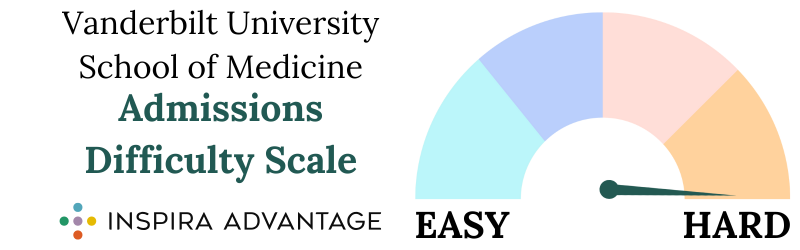
We created the Vanderbilt University School of Medicine Admissions Difficulty Scale by comparing acceptance rates and overall selectivity across all accredited U.S. medical schools.
The median MCAT score of Vanderbilt University School of Medicine accepted applicants is 522. The median MCAT score among matriculants is 521. VUSM does not have a minimum MCAT score requirement to be considered for admission.
The table below depicts the range of MCAT score percentiles for VUSM's 2025-2026 accepted applicants and matriculants.
| Percentile | MCAT Scores of Accepted Applicants | MCAT Scores of Matriculants |
|---|---|---|
| 10th Percentile | 516 | 516 |
| 25th Percentile | 520 | 519 |
| Median | 522 | 521 |
| 75th Percentile | 524 | 522 |
| 90th Percentile | 525 | 525 |
For the most recent accepted applicants, the section medians were as follows:
| MCAT Section | Median Score |
|---|---|
| Chemical and Physical Foundations of Biological Systems | 131 |
| Critical Analysis and Reasoning Skills | 129 |
| Biological and Biochemical Foundations of Living Systems | 131 |
| Psychological, Social, and Biological Foundations of Behavior | 131 |
In comparison, the AAMC reports that the national average MCAT score is 506.3, which is nearly 15 points lower than VUSM's accepted student average of 521.1.
The median GPA of Vanderbilt University School of Medicine accepted applicants is 3.97. The median GPA among matriculants is 3.96. VUSM does not have a formal GPA cutoff, though applicants are generally expected to present at least a 3.0 to be considered for admission.
The table below shows the range of GPA percentiles for VUSM's 2025-2026 accepted applicants and matriculants.
| Percentile | Total GPA of Accepted Applicants | Total GPA of Matriculants |
|---|---|---|
| 10th Percentile | 3.81 | 3.77 |
| 25th Percentile | 3.91 | 3.88 |
| Median | 3.97 | 3.96 |
| 75th Percentile | 4.00 | 4.00 |
| 90th Percentile | 4.00 | 4.00 |
According to the AAMC, the national average GPA for medical school applicants is 3.67. VUSM's accepted student average of 3.93 is 0.26 points higher, underscoring the school's competitiveness.
The median science GPA of Vanderbilt University School of Medicine accepted applicants is 3.97. The median science GPA among matriculants is 3.95.
The table below shows the range of science GPA percentiles for VUSM's 2025-2026 accepted applicants and matriculants.
| Percentile | Science GPA of Accepted Applicants | Science GPA of Matriculants |
|---|---|---|
| 10th Percentile | 3.76 | 3.75 |
| 25th Percentile | 3.88 | 3.85 |
| Median | 3.97 | 3.95 |
| 75th Percentile | 4.00 | 4.00 |
| 90th Percentile | 4.00 | 4.00 |
Below are the admissions requirements to get into Vanderbilt University School of Medicine.
The table below shows the course prerequisites for Vanderbilt University School of Medicine.
Vanderbilt University School of Medicine has shifted from strict course requirements to broader course recommendations. Given the evolving nature of medicine, applicants are expected to show strong competencies across the natural and life sciences, social sciences, and mathematics.
These competencies can be demonstrated through subjects in humanities or science and other interdisciplinary fields of study that reflect modern approaches to healthcare.
Vanderbilt University School of Medicine uses a two-part virtual interview process conducted via Zoom. Applicants complete one long live interview with a faculty member and one asynchronous interview.
The asynchronous portion means you record your responses to pre-set questions on your own time rather than speaking live with an interviewer. You receive a prompt, get a set amount of time to prepare, and then record a video response.
Prepare for both formats, since the live interview tests your ability to engage in real-time conversation while the asynchronous interview evaluates how clearly and concisely you communicate without the benefit of back-and-forth dialogue.
Vanderbilt University School of Medicine's overall interview rate in the most recent admissions cycle was approximately 8.69%. Of 7,685 verified applications, 668 applicants were interviewed (20 in-state, 622 out-of-state, and 26 international).
The interview rate varies significantly by applicant type:
Out-of-state applicants receive interviews at a notably higher rate than both in-state and international applicants (9.14% vs. 5.32% and 5.19%).
The data reflects VUSM's national draw as a private institution, where the vast majority of both interview slots and matriculants come from outside Tennessee.
Of the 668 interviewed applicants, 95 matriculated. The interview-to-matriculation rate was highest for in-state applicants (6 of 20, or 30.00%), followed by out-of-state (86 of 622, or 13.83%) and international (3 of 26, or 11.54%).
Vanderbilt University School of Medicine's prompts are introspective and personal, so the admissions committee is looking for self-awareness and genuine reflection, not polished résumé summaries.
The 2025-2026 secondary essay prompts are:
"Please reflect on the upbringing, background, and experiences in your life that have shaped who you are as a person and will help define the person you want to be in the future. In other words, what makes you who you are?" (800 words)
"Tell us about a time when you interacted with someone who is different than you. What did you learn? Would you do anything differently and if so, what?" (600 words)
"It is important to understand that everyone needs help at various times in their lives. Reflecting on the last five years, describe a time you asked for help and what you gained from that experience that has influenced your approach to asking for help." (600 words)
"If you have completed your undergraduate education, please comment on what you have done or have been doing since graduation." (200 words)
Follow these expert tips to help you improve your chances of getting into Vanderbilt University School of Medicine.
VUSM’s Curriculum 2.0 is unique among the top medical schools, as students finish the pre-clinical phase in just 13 months, then explore a flexible Immersion Phase where they choose advanced clinical, research, or scholarly work.
Showing that you’ve researched this structure demonstrates intentionality and that you aren’t just applying anywhere; you want VUSM’s accelerated training and the freedom to personalize your path.
Applicants who connect their goals to this design show the admissions committee that they will thrive in (and take advantage of) VUSM’s unique system.
The Immersion Phase requires students to produce a scholarly product suitable for publication. Applicants who outline the kind of research question they'd pursue, the VUSM centers or faculty they'd approach, and how they'd see the project through prove they've thought beyond generic research interest.
For example, if you're interested in health disparities, you might reference the Vanderbilt Center for Health Services Research and explain how your prior work studying diabetes outcomes in rural populations could evolve into an Immersion project examining barriers to insulin access in Middle Tennessee.
Name a faculty member whose work aligns with yours if possible. The more specific your plan, the more the admissions committee can see you thriving in the Immersion Phase rather than scrambling to find direction once you arrive.
In the last three admissions cycles, only 1% of matriculants applied without research experience. That means having significant research experience signals to VUSM’s committee that you’re prepared for their expectations of academic output, not just clinical training.
If your research background is lighter, use your essays to show how your existing skills (data analysis, literature review, patient recruitment, IRB processes) translate into readiness for independent scholarly work.
VUSM emphasizes case-based, small-group learning from the first year instead of long lectures. This approach requires collaborative, well-prepared students who are able to think aloud in clinical scenarios.
By citing experiences where you thrived in a team-based or problem-solving environment, you prove you’ll fit VUSM’s culture and add value to your peers’ learning, not just your own.
However, don’t overemphasize your achievements. In a recent webinar with Inspira Advantage, Benjamin Park, a resident physician at Vanderbilt University School of Medicine, highlighted a common mistake most applicants make. He said:
“One big pitfall is over-emphasizing achievements. You have plenty of space in other parts of your application to list accomplishments. In your statement, it’s more important to reflect and explain what you took away from them.”
Park suggests that instead of mentioning all your achievements, mention the experiences that resonate with VUSM. For example, don’t highlight an experience that shows your organizational skills. An experience that shows you’ll excel in case-based learning will be much more impactful for VUSM.
VUSM structures advising with multiple overlapping mentors: College Mentors, Portfolio Coaches, Preceptors, Research Directors, and Specialty Advisors. Few schools have such a layered support system.
In your essays, you can frame yourself as someone who actively seeks out feedback, tests new approaches, and iterates on improvement. VUSM’s system is built for students who understand that becoming a physician is not about proving you already know everything, but about using mentorship as a way to grow into the kind of doctor patients and communities need.
You might highlight specific ways you’d use these relationships: for example, leaning on a Research Director to refine your scholarly project design, checking in with a Portfolio Coach to track progress against your long-term goals, or drawing on a Specialty Advisor’s expertise to explore fields you’re uncertain about.
At the same time, it’s important to balance ambition with authenticity. Park highlights a common misstep:
“It’s important to highlight that you’re well-qualified, but you don’t want to come off as arrogant, like saying you’re going to save the world or develop the next cure. Admissions committees can see right through that.”
Show how you’ll use VUSM’s mentorship ecosystem to realistically refine your existing strengths, address your weaknesses, and move forward with humility.
Park reminds applicants that the most compelling essays are written in an authentic voice, grounded in realistic self-awareness.
Work with an expert admissions counselor at Inspira Advantage to help you highlight your strengths and craft a standout application. Learn how we can help you get into your dream school.
One of the signature elements of VUSM’s Immersion Phase is the Integrated Science Course (ISC) requirement. ISCs take focused themes such as immunology, pharmacology, or neuroscience and integrate them directly into patient care contexts. This approach allows students to strengthen their foundation in areas that align with their career goals while learning how to apply that knowledge in real-world settings.
When writing about ISCs, it’s not enough to simply say you’re excited about them. Admissions committees want to see if you’ve thought about which theme resonates with your interests and why.
For example, a student interested in oncology might highlight an ISC in immunology to deepen understanding of immune therapies, or a student leaning toward psychiatry might choose neuroscience to strengthen their grasp of brain–behavior relationships.
By connecting an ISC to your intended specialty, research path, or even a personal experience that shaped your interest, you demonstrate foresight and intentionality.
This ties directly to Park’s advice on signaling your trajectory:
“Admissions committees like to hear that you’ve thought about your long-term goals. Even if they change, being able to state where you see yourself shows that you’ve thought about your trajectory.”
Park’s point is that this specificity reads as dedication to long-term development, not arrogance. It proves you’re not just coming to medical school to “see what happens,” but that you’ve already begun mapping out how to take advantage of VUSM’s academic structure.
Here are the seven MD programs offered at Vanderbilt University School of Medicine.
Vanderbilt University School of Medicine tuition for the 2026-2027 academic year is $73,028, with no difference between in-state and out-of-state students since Vanderbilt is a private institution.
The estimated total cost of attendance for a first-year medical student, including tuition, fees, and living expenses, is $119,046:
Vanderbilt University School of Medicine costs approximately $472,168 over four years:
Vanderbilt University School of Medicine offers both merit- and need-based scholarships, along with access to outside funding opportunities.
All admitted applicants are automatically considered for merit-based scholarships; no separate application is required. Awards are renewable for all four years and are available to both U.S. and international students. For 2026–2027, merit scholarships include 75% tuition and full tuition awards.
Students not receiving merit awards may apply for institutional need-based aid by completing the CSS Profile with parental financial data, regardless of age or marital status. International students are also eligible. In 2026–2027, awards will cover up to 45% of demonstrated financial need.
Students are encouraged to seek funding from organizations such as county medical societies, civic groups, fraternal organizations, employers, unions, and foundations.
This federal program covers tuition, fees, and a stipend in exchange for practicing in underserved communities. U.S. citizens and nationals are eligible, with a two- to four-year service obligation. VUSM does not administer this program.
Here is the 2026-2027 application timeline for Vanderbilt University School of Medicine:
Yes, Vanderbilt University School of Medicine uses a rolling admissions process. This means applications are reviewed and interview invitations are sent as materials arrive, starting in late summer.
Vanderbilt University School of Medicine's Curriculum 2.0 allows students to complete their pre-clinical training in just 13 months, nearly half the time of the 24-month preclinical period used by most medical schools.
This accelerated phase is followed by the Immersion Phase, where students design a personalized path in advanced clinical training, research, or a scholarly project. The curriculum also includes Integrated Science Courses (ISCs) that link science with clinical reasoning.
No, research experience isn't required at Vanderbilt University School of Medicine. However, an average of only 1% of matriculants applied without research experience in the last three admissions cycles, so it's highly recommended. Applicants without research may still be admitted, but they will need to compensate with extraordinary clinical or leadership experience.
Yes, Vanderbilt University School of Medicine uses a pass/fail system. At Vanderbilt University School of Medicine, both P (Pass) and P (Pass)** indicate that a student has technically met the minimum academic requirements to move forward:
In the second year, grades expand to Honors (H), Pass (P), Pass* (P*), or Fail (F). During the clinical years, students are graded as Honors (H), High Pass (HP), Pass (P), Pass* (P*), or Fail (F).
Dermatology Resident Physician
The George Washington University School of Medicine and Health Sciences


.svg)


