Get in touch: +1 888 453 5021




A good GRE score is 327 or higher. Scoring at this level places you in the 80th percentile or above (top 20% of test-takers), based on the newest GRE General Test Interpretive Data. Here's how that breaks down by section:
That means you should aim for at least a 327 GRE score to be competitive.
Get a 320+ guaranteed GRE score with Inspira Advantage. Our expert tutors can help you maximize your study plan to receive a competitive score for most graduate programs.
Most medical schools use the GRE for programs within schools of medicine, such as:
For MD/PhD dual-degree applicants, some programs ask for GRE scores alongside the MCAT, particularly when the PhD component falls outside traditional biomedical sciences.
If you already have strong GRE scores and you're exploring dual-degree or research-heavy medical pathways, those scores can work in your favor. But if your goal is a traditional MD seat at a competitive program, you’ll need to take a different test. Build your GRE study schedule around where you actually want to end up, not which exam feels easier to prepare for.
Your GRE score functions as one data point inside a larger evaluation. No admissions committee pulls up your GRE score in isolation and automatically admits or rejects you. How much weight it carries depends entirely on the program type and what else your application brings to the table.
STEM programs lean hardest on the Quantitative section. A 165+ Quant score tells an engineering or computer science admissions committee you can handle graduate-level math without remediation. Verbal and Analytical Writing scores matter less here, though they won't ignore an obviously bad Verbal score.
Humanities and social science programs emphasize the opposite. Verbal and Analytical Writing signal whether you can process dense academic texts and construct rigorous arguments.
However, a balanced profile across both sections matters more than one dominant score, because graduate programs demand both quantitative and communication skills from day one.
Find whether your target program weighs Quant, Verbal, or both, and then allocate your prep time where it directly impacts your competitiveness.
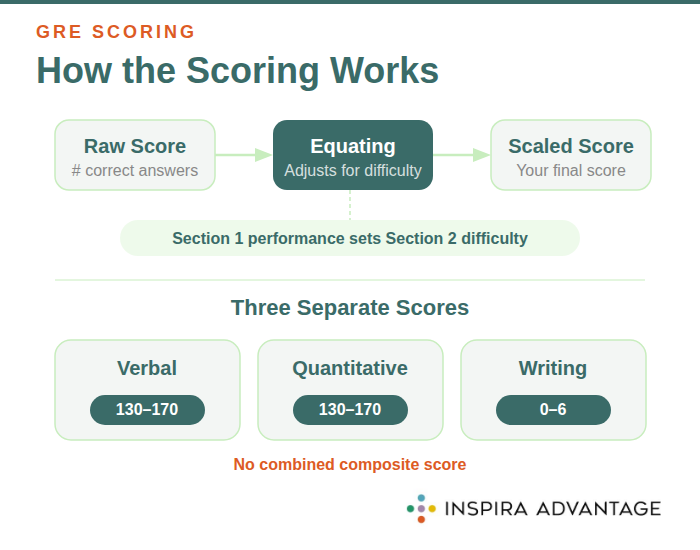
The GRE scoring system uses section-level adaptive testing for both Verbal Reasoning and Quantitative Reasoning. Your performance on the first section of each measure determines the difficulty of your second section. Every question within a section carries equal weight toward your final score.
Your raw score is the number of correct answers. The Education Testing Service (ETS) then converts that raw score into a scaled score through a process called equating. Equating adjusts for slight difficulty differences between test editions and accounts for the adaptive section you received.
Each section uses a different scoring scale, and none of them combine into a single composite score.
However, many graduate programs use a "total score" that adds Verbal Reasoning and Quantitative Reasoning (260-340 range). Analytical Writing never factors into that total.
Here’s a detailed look at the GRE scoring breakdown, according to the ETS:
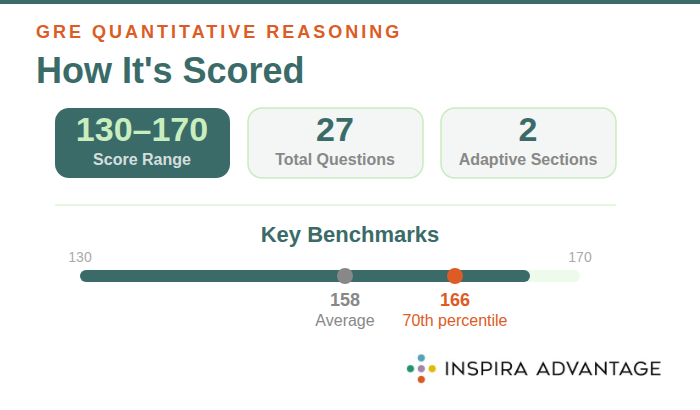
Quantitative Reasoning uses a 130-to-170 scoring scale with one-point increments. You will encounter 27 questions across two adaptive sections, and every correct answer counts equally within a section.
A score of 160 in the Quantitative Reasoning section only aligns with the 50th percentile, with an average score of 157.58. To be competitive, aim for around the 70th percentile, or a Quantitative Reasoning score of 166.
In the Analytical Writing section, your score lands on a 0-to-6 scale in half-point increments. A trained human rater reads your essay and assigns a holistic score based on overall quality.
ETS then runs the essay through its e-rater software, an algorithm that evaluates features like sentence variety, vocabulary sophistication, and usage accuracy. If the human score and e-rater score closely agree, ETS averages them for your final score.
If they disagree, a second human rater steps in, and ETS averages the two human scores instead.
Adaptive testing means that everyone starts with a medium-difficulty Section 1 for both Verbal Reasoning and Quantitative Reasoning. Your accuracy on that first section determines whether Section 2 is easier, medium, or harder.
Scoring well on Section 1 routes you into a harder Section 2, which is exactly what you want. A harder second section gives the equating algorithm room to place you at the top of the 130-170 scale.
A strong performance on an easy second section, by contrast, caps your scoring potential in a lower range. Focus on accuracy in those first sections. Rushing to finish every question matters less than getting the ones you answer right, so make sure you study well to fully prepare for test day.
The idea of performing too well in the first section may seem intimidating. However, receiving a more challenging second section is actually preferable to receiving an easier one.
If you encounter a difficult second section, it indicates that you performed well in the first section by answering numerous questions correctly. This not only earns you valuable points but also significantly contributes to achieving a high score.
On the other hand, if you come across an easy second section, it implies that your performance in the first section may not have been as strong.
Use our Practice GRE Question Pop Quiz to help you prepare for the exam. This tool provides sample questions and detailed explanations to help you study for the GRE.
The GRE scores Verbal Reasoning and Quantitative Reasoning on identical 130–170 scales in one-point increments, giving you a combined score range of 260–340.
Analytical Writing uses a separate 0–6 scale scored in half-point increments. Your Analytical Writing score doesn't factor into that combined total. Admissions committees evaluate it independently.
Score tiers work like this in practice:
Yes, a score of 320 is considered a good score on the GRE. An overall GRE score of 320 shows that you rank in the top 60% of test-takers.
Yes. You can retake the GRE once every 21 days, up to five times within any 12-month period. Your scores stay valid for five years from your test date, and ETS offers ScoreSelect, meaning you choose which test dates to send to schools. If your first attempt misses the mark, retaking is a low-risk move since admissions committees only see the scores you want them to see.
Most graduate programs accept any score within five years, but some PhD programs and medical-related tracks require two to three years in certain cases. Check your target program's admissions page for specific expiration policies before assuming your older score still qualifies.
Yes, a strong application can compensate for a lower GRE score. Most graduate programs run holistic admissions reviews, which means your GPA, research experience, letters of recommendation, and personal statement all factor into the decision. A 305 might not disqualify you from a program that averages 315 if the rest of your profile demonstrates clear academic readiness and relevant experience.
The average overall GRE score is 309 among all test-takers who tested between July 1, 2021, and June 30, 2024. That breaks down as an average Verbal Reasoning score of 151 and an average Quantitative Reasoning score of 158.


.svg)


