Get in touch: +1 888 453 5021





Most pre-med applicants have heard of Casper. Far fewer know what Duet is or realize that Snapshot was discontinued several admissions cycles ago.
I spoke with a few of the admissions counselors on my team, and they said they run into the same problem each year. Applicants don’t know which assessments still matter, what each one measures, or how med schools use these results in their admissions decision process.
This guide aims to clear up that confusion. In it, I break down each of the Casper, Duet, and Snapshot assessments, explain how they work, and clarify the role they play in the 2026-2027 admissions cycle.
Important note on Snapshot: We cover the Snapshot assessment briefly here for reference purposes only. The exam was discontinued in 2023.
Casper, Snapshot, and Duet are three separate assessments, all administered through Acuity Insights (formerly Altus Assessments). Each assesses different traits that are important for medical school applicants to have:
Here’s a comparison of each Altus Suite assessment:
The applicants who perform best don’t treat Casper like a traditional exam you can memorize and study material for. They approach each scenario as if it were a real human interaction. They take the time to understand what’s happening, consider multiple perspectives, form an opinion, and clearly explain it without worrying about whether it’s the “right” answer.
That's because there isn’t a right answer. Casper isn't testing medical knowledge or ethics trivia. It's evaluating how you navigate complex situations involving real people. Once you understand that, preparing for the assessment becomes much more straightforward.
Here’s a closer look at how the Casper test works, how it’s scored, what questions you can expect, and how to prepare for it strategically.
Some medical schools require Casper because they want a standardized way to evaluate how applicants handle ethical conflict, communicate under pressure, and treat people who are frustrated or vulnerable. GPA and MCAT scores measure cognitive ability, not character.
GPA and MCAT scores can help predict academic performance, but they can’t provide insight into the kind of physician the applicant will become. Casper was created to help bridge that gap.
Baylor College of Medicine describes Casper as a tool that "complements other instruments used for applicant screening" by capturing noncognitive skills and interpersonal characteristics that their process can’t assess through transcripts and test scores alone. The school notes it "further enhances fairness and objectivity" in holistic review.
Casper gives admissions committees early evidence of the qualities that determine whether a high-performing student becomes a high-performing physician. However, few med schools use strict cutoffs for Casper scores, so a lower score doesn’t automatically disqualify you.
Casper consists of 11 scenarios split into two sections:
The test is completed 100% online, usually at your home or another private location. Acuity Insights provides an optional 10-minute break after the video section and a five-minute break midway through the typed section, making the total testing time 65 to 85 minutes, depending on whether you take the breaks.
Human raters score the Casper test. A different person evaluates each of the 11 scenarios, so 11 independent raters provide 11 separate scores. Raters give each response a score on a scale from 1 to 9.
Raters don't have an "answer key" to score each scenario; they see how well your responses demonstrate 10 traits:
All of these scores are added and averaged. Then, the testing system standardizes those scores into a quartile (1st to 4th) that compares your performance to the other test-takers:
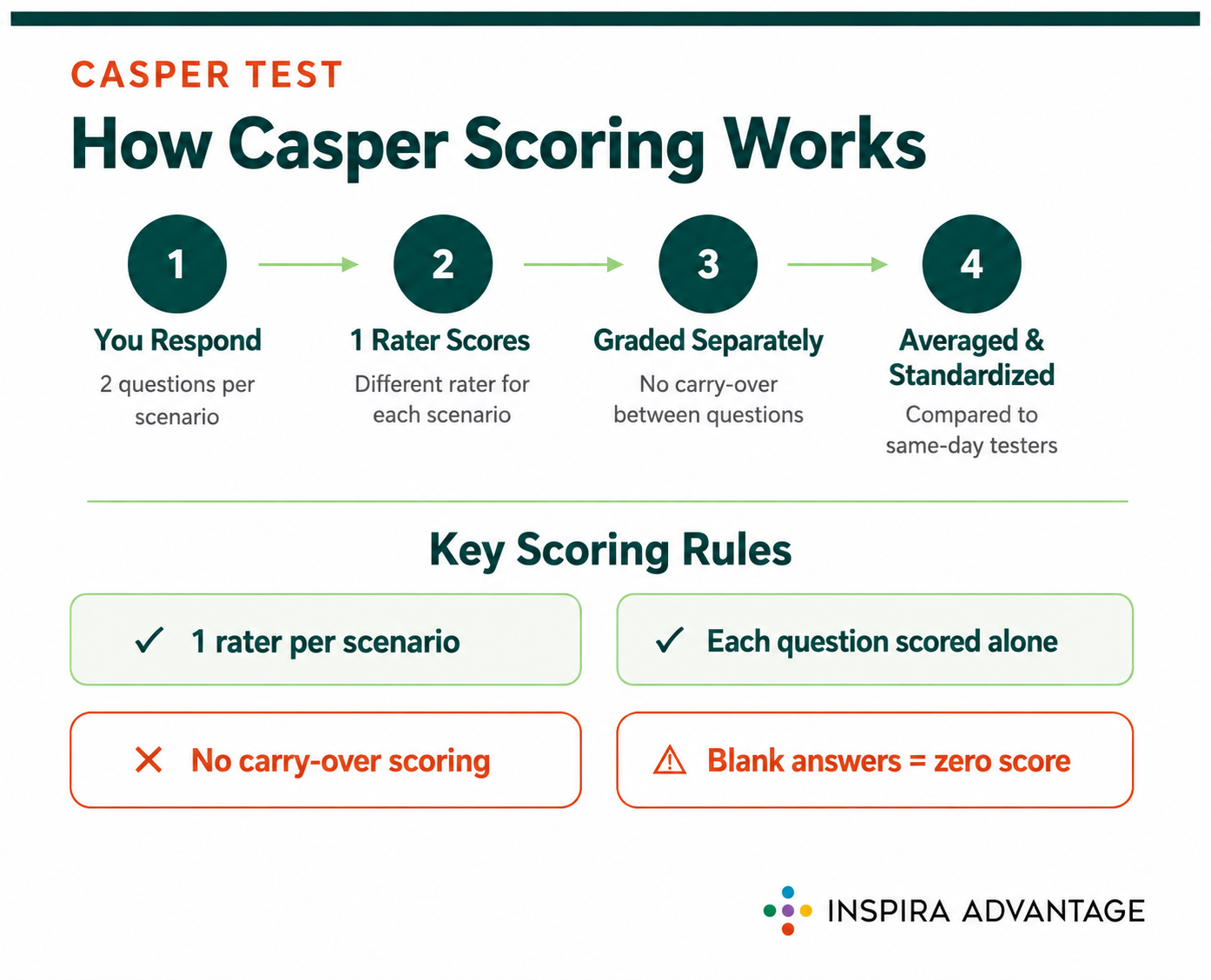
That quartile is the final score you’ll receive about four weeks after your test. The medical schools you’re applying to won’t see this quartile. They see a different score, called a z-score, a couple of weeks before you receive your quartile score.
A z-score tells admissions committees how many standard deviations your score is above or below the mean of your test cohort. In simple terms, it answers the following:
In practical terms:
The further from 0, the stronger or weaker your performance.
You can only take the Casper test once per admissions cycle. You won’t be allowed to retake it, meaning one score will go to every program you selected when you registered for the test.
If you reapply for a second cycle, you have to take the Casper again. Scores don’t carry over to the next year.
We recommend taking Casper in May or June of your application year. Testing in May or June keeps you well ahead of peak slot demand. Test dates in July, August, and September fill fast, and late-cycle slots increase your risk of applying before your scores reach schools.
Most medical schools use rolling admissions, so they won’t review your file until you submit all required components. Every week your score is delayed is another week where your application sits incomplete while other candidates' applications move forward.
Testing in May or June also gives you a buffer. If a technical problem disrupts your session, you have time to reschedule without blowing past anyone's deadline.
Here’s the exact timeline we recommend students follow:
Casper asks three main types of questions:
Only personal questions ask about your experiences directly, but situational and policy questions become stronger when you can anchor your reasoning to real experiences.
To register for the Casper test, you will need to create an Altus Suite account, select the correct exam for your program and region, choose a test date, and complete payment. Here’s a closer look at each step:
Go to the Acuity Insights website and sign up for an account.
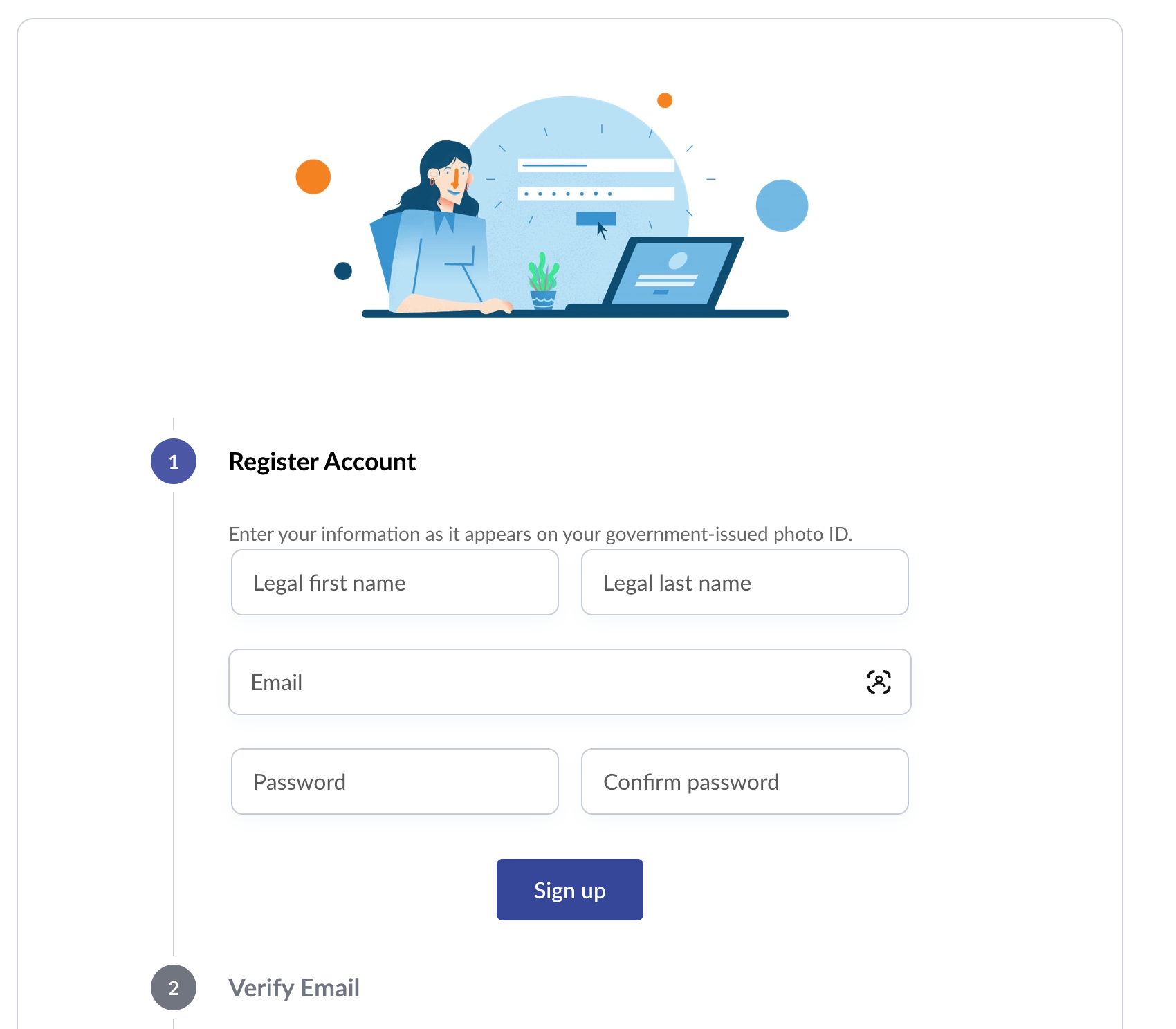
Source: Acuity Insights
You’ll need:
Once logged in, you will see a list of available Casper exams. You’ll see options filtered by program category and region. Select "Allopathic Medicine" and/or “Osteopathic Medicine” as your program type; then choose either "United States" or "Canada," depending on where your target schools are.
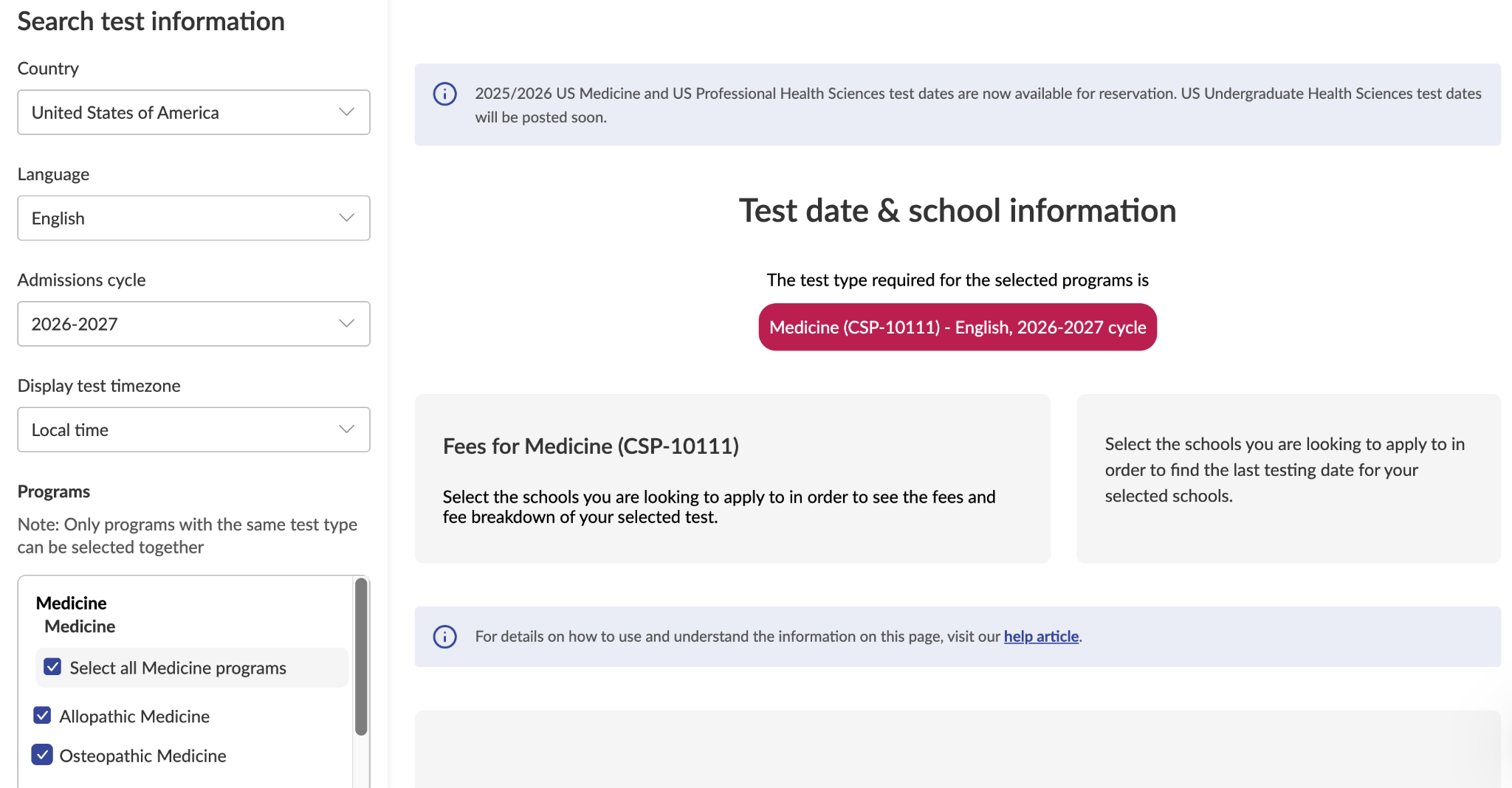
Source: Acuity Insights
If you’re applying to both U.S. and Canadian medical schools, you’ll need to register for two separate exams and pay two separate fees. The exams are not interchangeable, and scores from one version won’t go to schools in the other region.
Choosing the wrong version means your scores won’t reach your target schools. And all fees are non-refundable.
After selecting your exam, you’ll see a calendar of available test dates and time slots. Aim to test at least four to six weeks before your earliest application deadline so your scores have time to process and be distributed.
Test slots fill up the fastest between July and September. That’s peak med school application season. If you’re applying in the summer cycle, book your date by June at the latest.
Review your exam type, region, and test date one final time before entering your payment information. All fees are final and non-refundable, and Altus Suite doesn’t offer exceptions for applicants who select the wrong exam or miss their test date.
After payment, the system processes your registration and verifies your ID. That process takes a minimum of three days. That’s why you can’t register the day before your test and expect to sit it on time.
You can only take Casper once per admissions cycle. Treat your registration date as a firm commitment, not a placeholder you can adjust later.
It costs $85 to take the Casper test and have your score sent to up to nine schools of your choice. If you need to send your score to more than nine schools, it’ll cost $20 extra per additional school.
Since very few medical schools still require the Casper, it’s unlikely you’ll need to pay for additional schools.
Prepare for the Casper test by building three habits:
Here’s a closer look at how to build and perfect each of these habits:
Start your Casper prep at least four to six weeks out and work through scenarios in both written and video formats. (Casper uses both.) The goal is not familiarity with specific questions, as Casper never repeats prompts. The goal is training your brain to quickly identify what a scenario is actually testing.
Most prompts fall into recognizable categories: professional boundary violations, resource allocation under constraint, interpersonal conflict, ethical ambiguity, and competing loyalties. Once you can categorize a prompt within the first few seconds, your response time and clarity both improve.
As Dr. Aditya Khurana, an admissions expert at Inspira Advantage and Radiology Resident at Mayo Clinic Rochester, puts it in our Casper webinar:
"You need to be able to quickly, within the first couple seconds of reading the prompt, dissect what it is they're asking you and what the key parts of the situation are," he says.
After each practice response, ask yourself two questions:
Graders evaluate how you think, not just what you decide. Answers that skip the reasoning step score lower even when the conclusion is correct.
The best way to get more comfortable with Casper test content is to work with practice questions. You can find more sample Casper practice questions in our tool below:
You can also consider getting private Casper tutoring with an expert who knows exactly how to get you to the fourth quartile.
Casper scenarios are fictional. But your strongest answers won’t feel that way. Graders can tell the difference between an answer you built on lived experience and one you assembled from abstract principles under pressure.
Specificity signals authenticity. And authenticity matters on the Casper.
Before your test date, identify eight to 10 real experiences that involved ethical complexity, interpersonal tension, or difficult decisions. These don’t need to be dramatic. A disagreement with a supervisor, a time you had to advocate for someone else, or a moment where you changed your position after hearing a different perspective are all strong source material.
For each experience, know what the tension was, what you chose to do and why, and what you learned. Keep the summaries short. You’re building raw material you can transplant into a scenario response in real time, not writing complete answers.
The mechanics work like this: A prompt describes a colleague cutting corners on documentation. You recognize the tension as professional integrity versus peer loyalty. You have a real story with the same dynamic. You pull the decision-making logic from that story, apply it to the fictional scenario, and deliver a grounded answer instead of a generic one.
You can try this technique out for yourself below:
Having a set structure for your answers will save you time under pressure. A four-part template works for most prompts:
Two mistakes consistently pull students’ Casper scores down:
"They're really looking more for your thought process — why you chose a specific route or why you chose a specific answer, and what you considered in giving that answer versus what your actual decision was," she says.
Practice the template until it feels automatic. If you’re consciously recalling the steps during the actual test, you haven’t practiced enough.
Medical schools rarely use the Duet assessment now. But a few schools still require or recommend it. Here, we break down Duet’s purpose, format, scoring system, and more.
Medical schools require Duet because the rest of your application shows what you’ve accomplished but not whether your values and professional goals align with a specific program's mission.
Duet fills that gap by generating a compatibility score between your responses and each participating school's institutional profile. That gives admissions committees a data point on fit that transcripts, MCAT scores, and personal statements cannot provide.
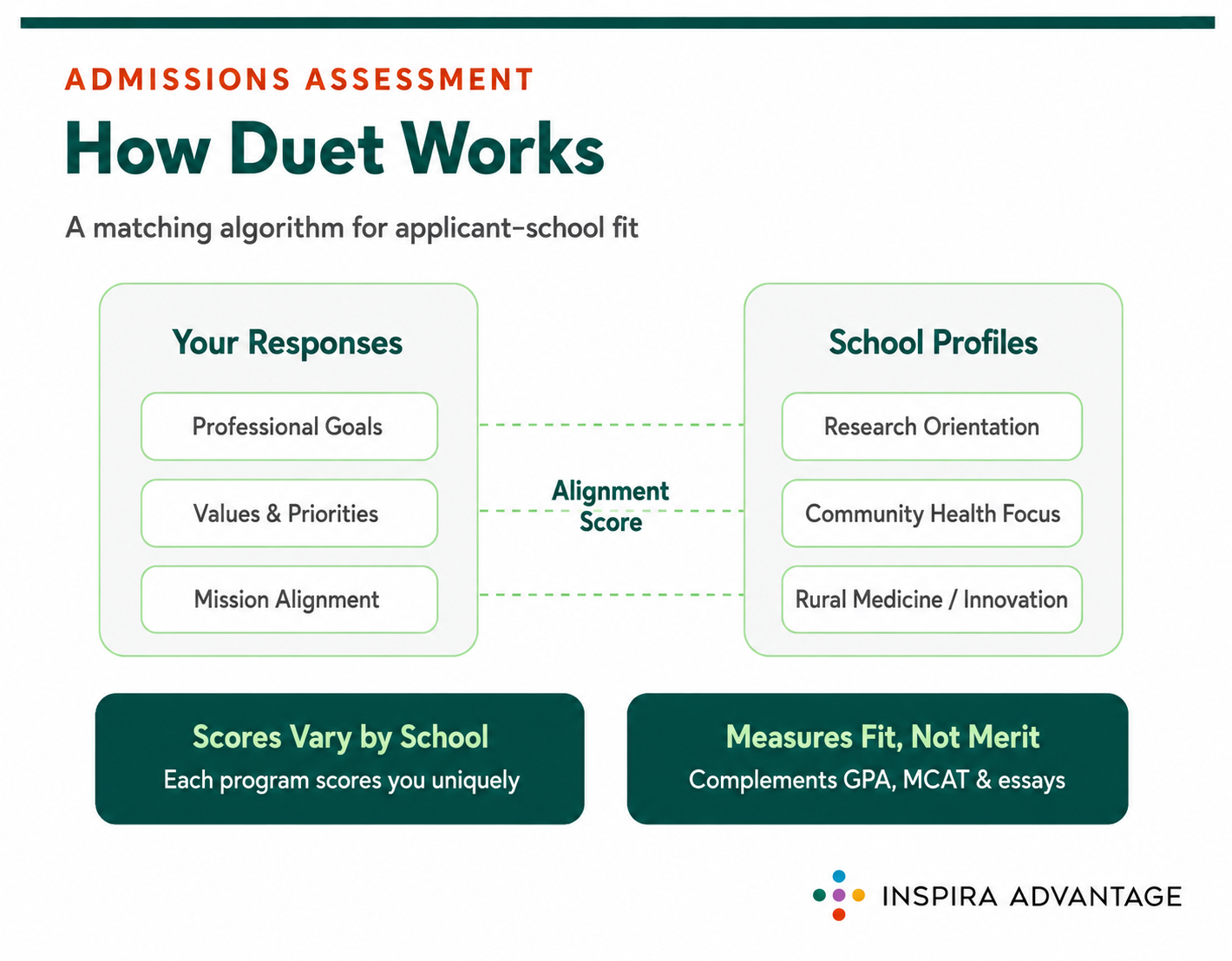
The mechanism works like a matching algorithm. Each school that uses Duet has defined its own value profile, covering priorities like research orientation, community health focus, rural medicine commitment, or clinical innovation.
Your responses produce an alignment score against each school individually, which means your Duet results vary by program. A strong match with one school doesn’t guarantee a strong match with another.
Duet presents you with pairs of program characteristics and asks you to choose which one you value more. The comparison categories include things like research opportunities, teaching style, faculty interaction, curriculum structure, and community focus.
After working through individual pairings within each category, you compare categories against each other to establish a value hierarchy.
Some key features of this test:
Duet doesn’t use human raters. Your score is generated automatically by an algorithm that compares your value preferences against the profiles that participating medical schools have submitted for themselves.
Each school has its own Duet profile. Your alignment score is calculated separately for each program, meaning your Duet result isn’t a single number but a school-by-school compatibility measure. The better your priorities align with a program's stated values, the stronger your alignment score for that school.
You don’t see your Duet score or alignment results. Schools receive the compatibility data directly. Because the scoring is algorithmic, there’s no rubric to study and no response strategy to optimize. The most effective preparation is genuine self-reflection about what you actually want from a medical program.
We recommend completing Duet within two weeks of your Casper test date. Schools receive Casper and Duet results together when they’re submitted close in time. If you complete Duet several weeks after Casper, there can be a gap between when your Casper score reaches a school and when your Duet data arrives.
Some programs won’t consider your application complete until they’ve received both. Register for Casper first to set your anchor date. Then complete Duet in the days following. For instance, if you booked Casper for June, aim to finish Duet by mid-June at the very latest.
Duet doesn’t ask questions in the traditional sense. Instead, it presents you with side-by-side comparisons of program attributes and asks you to select which one matters more to you.
Examples of comparisons it will present to you include:
The format continues through multiple categories. Then, it asks you to compare the categories themselves. The total comparison set takes about 15 minutes to work through.
Because there are no right or wrong answers, the goal is not to select what you think programs want to hear. Misrepresenting your values in Duet produces an alignment score that pairs you poorly with the schools you want.
The University of Texas at Tyler School of Medicine is the only medical school that requires Duet as part of its admissions process for the 2026-2027 cycle.
The University of Texas Medical Branch, John Sealy School of Medicine, recommends that students complete the Duet assessment but explicitly says they don’t use it to make admissions decisions.
You can only take the Duet assessment once per admissions cycle since you aren’t actually being evaluated on your skills. You don’t have to practice or prepare for this test, so there’s no reason to need to take it more than once anyway.
Duet registration is bundled with your Casper registration. After you book your Casper test date through your Acuity Insights account, Duet becomes available to complete at any time before your earliest program distribution deadline. You don’t select a separate date or time slot for Duet.
To access Duet, log in to your Acuity Insights account after completing Casper registration. The assessment will appear as an available component. Complete it from any private location with an internet connection. No webcam is required.
The $85 testing fee you pay to write the Casper test and have your score sent out to nine schools covers the Duet test as well. You don’t have to pay any additional fees.
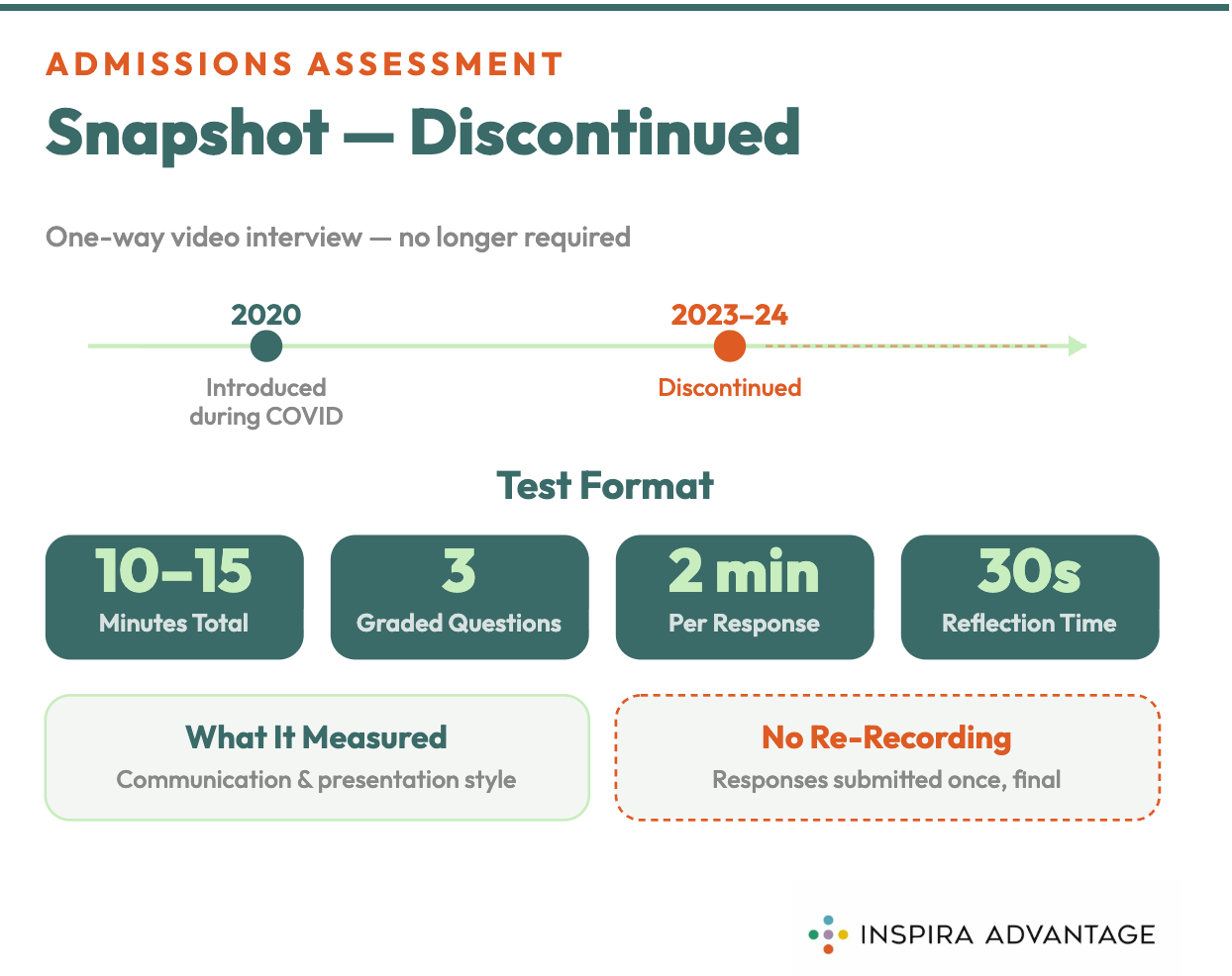
****Please note: Snapshot was discontinued as of the 2023-2024 admissions cycle. No medical schools require Snapshot for the 2026-2027 application cycle.***
Snapshot was first introduced during the COVID-19 pandemic because students couldn’t do in-person interviews. The test was designed to give admissions committees an early view of an applicant's verbal communication style and professional presentation before interview invitations were extended.
Once in-person interviews resumed and virtual interviews became more popular, Snapshot wasn’t needed anymore.
Questions focused more on the applicant’s motivation to pursue medicine and their experiences. Some examples were:
Snapshot was a short, one-way video interview with a standardized question set:
There wasn’t a real score or quartile for this test. Schools just received the actual video responses and were able to review and evaluate them themselves.


.svg)


