Most pre-med students think there’s only one path to medical school: spend four years building the perfect application, study for months to ace the MCAT, apply to 15-25 schools, and hope at least one acceptance comes through at the end of the cycle.
But another path exists: Early Assurance Programs (EAPs). These programs allow students to secure a conditional acceptance to medical school as early as their sophomore or junior year, often without ever taking the MCAT.
But that doesn't mean EAPs are easy to get into. In fact, when I spoke with several of our admissions counselors while putting together this guide, many pointed out that EAP admissions committees are often making an even bigger bet than traditional admissions committees.
They're evaluating students years before a typical medical school application would be complete and looking for evidence that those students will continue to excel long after they're admitted.
Before deciding whether an Early Assurance Program is right for you, you need to understand how these programs work, what medical schools look for in applicants, and the tradeoffs that come with securing a seat so early.
Let’s walk through the best Early Assurance Programs, their requirements, and the pros and cons of pursuing this alternative path to medical school.
Privacy guaranteed. No spam, ever.
What Is an Early Assurance Medical Program?
An Early Assurance Program gives undergraduate students a conditional acceptance to medical school as early as their sophomore year, bypassing the traditional application cycle entirely.
Instead of waiting until junior or senior year to apply through the American Medical College Application Service (AMCAS), EAP students secure a guaranteed seat years in advance.
EAPs aren’t available everywhere. Only a small number of U.S. allopathic medical schools offer them. And most restrict eligibility to students at specific partner institutions. A few programs, like Mount Sinai's FlexMed, accept applicants from any U.S. college, but those are the exception.
Privacy guaranteed. No spam, ever.
List of Early Assurance Programs for Medical School
Below, I’ve created a list of the top 10 Early Assurance Programs (EAP), ranked by the strength of their value to applicants, and included their MCAT requirements, application timing, and notable features for each program.
Not required (accepted students are prohibited from taking the MCAT)
Sophomore year
Only EAP open to students at any U.S. college Accepted students can major in anything and are freed from the traditional pre-med track, with only one year of biology or chemistry required by application
Earliest application window among institution-restricted EAPs Accepted students earn the Joseph Sweeney, S.J. Scholar designation, a credential that signals distinction within the Georgetown medical community Located in Washington, D.C., with direct access to NIH, FDA, and federal health policy institutions
Small class size at Geisel (roughly 92 students) means high faculty-to-student ratio and tight-knit clinical training environment Rural medicine focus with strong primary care match outcomes
Not currently required (starting in 2027, accepted students must take the MCAT)
Sophomore year
One of the few EAPs with a parallel geographic track: the Maine Track EAP places students at Maine Medical Center for a rural, longitudinal clinical experience Boston location provides access to a dense medical ecosystem
University of Rochester School of Medicine and Dentistry
Not required
Sophomore year
Partners with 12 elite liberal arts colleges (Amherst, Bowdoin, Carleton, Colgate, Hamilton, Haverford, Hunter College-CUNY, Middlebury, Spelman, Swarthmore, Williams, Xavier University of Louisiana) for extensive network
University of Toledo College of Medicine and Life Sciences
Not required for application (MCAT waived for MedStart admits)
Junior year
Open to juniors at any accredited U.S. college or university Includes a mandatory summer immersion on the Health Science Campus that gives accepted students a head start on the medical school environment, faculty relationships, and peer cohort before their first year
Founded to train physicians for underserved North Carolina communities, and EAP students feed directly into that pipeline Expanding partner network now includes UNC Pembroke and N.C. A&T, broadening access for HBCU students Low in-state tuition
Michigan State University College of Human Medicine
Required (also requires Casper or AAMC PREview)
Junior year
Largest partner school network of any EAP (15+ Michigan institutions, including community colleges like Oakland Community College) Community-based clinical model places students in one of eight Michigan communities for clerkships, building deep ties to future practice locations
Only EAP specifically designed for students underrepresented in medicine Includes built-in research mentorship with Jacobs faculty, peer mentoring from current medical students, and structured MCAT preparation support
Not required for application (must take MCAT in junior year before matriculation)
Sophomore year (fourth semester)
Linked to the Schreyer Honors College, one of the most selective honors programs in the country Penn State Hershey's clinical network provides strong rural and community medicine training across central Pennsylvania
Privacy guaranteed. No spam, ever.
Methodology I Used to Find the Best Early Assurance Medical Programs
I looked through every active Early Assurance Program offered by U.S. allopathic medical schools and ranked them based on three criteria:
Institutional strength: The medical school you attend shapes your residency competitiveness, research access, and clinical training quality for the next four years. A conditional seat at a top-20 research institution with a major academic medical center is a fundamentally different opportunity than a seat at a lower-ranked regional program.
Programmatic benefits: I looked at what accepted students actually receive beyond the conditional seat itself. Some EAPs invest in your development with built-in research mentorship, MCAT prep support, summer immersion experiences, or longitudinal clinical tracks. Programs that actively bridge the gap between acceptance and matriculation ranked higher than those offering admission alone.
Eligibility breadth: Programs restricted to a single university's honors college or a small set of partner schools scored lower on this criterion because fewer students can benefit from them, regardless of how strong the program is.
Privacy guaranteed. No spam, ever.
What Medical Schools Look for in Early Assurance Applicants
One thing that surprised me when speaking with our admissions counselors was how differently EAP committees evaluate applicants compared to traditional medical school admissions committees. Because you're applying so early, they aren't looking for a finished applicant.
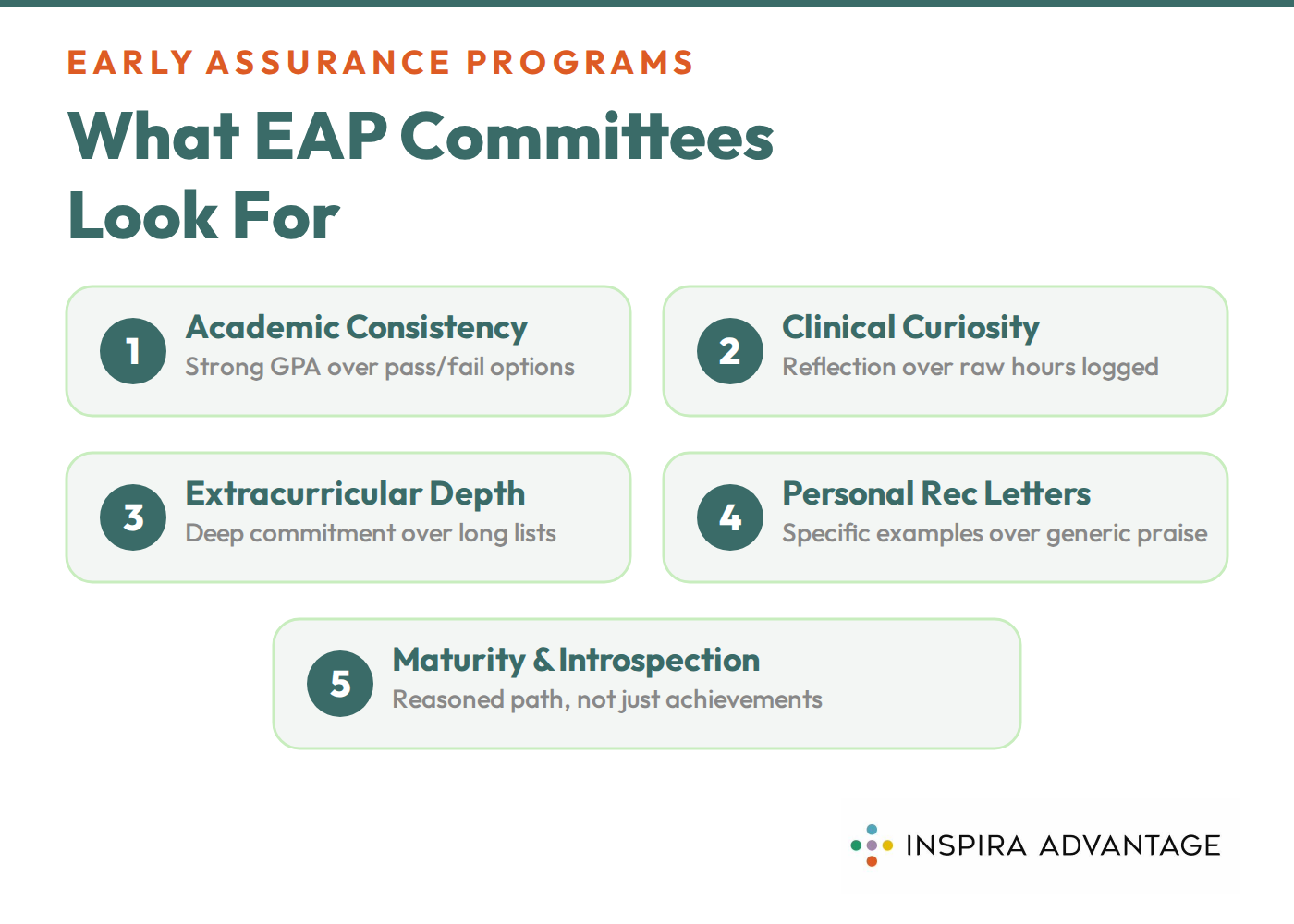
Admissions committees are looking for evidence of potential, maturity, and a genuine commitment to medicine. Here are the qualities the experts I spoke to told me matter most:
Academic Consistency
Many EAPs place extra weight on graded coursework specifically because the MCAT is waived. Tufts' EAP admissions page even states this directly: Coursework and grades carry greater emphasis in determining fit and readiness for medical school. Take pass/fail options sparingly if you are planning to apply and try to maintain a steady, strong GPA throughout university.
Clinical Curiosity Over a Set Number of Clinical Hours
You won’t have 500+ clinical volunteering hours as a sophomore, and admissions committees know that. Shadowing a physician for 20 hours and writing a thoughtful reflection carries more weight than 100 hours of passive observation you can’t describe in detail.
Extracurricular Depth Over Breadth
Leading one organization or committing deeply to one research project stands out over listing 12 activities with surface-level involvement. EAP committees are reading for a specific signal: "Will this student stay committed to medicine for the next six to eight years, or will they drift once the pressure is off?"
A sustained, meaningful commitment to one activity answers that question far better than a scattered resume.
Letters of Recommendation from People Who Actually Know and Can Vouch for You
Most EAP applicants have similar GPAs and course loads. A major differentiator is often a professor who can speak to your character and curiosity with specific examples. A detailed letter from your organic chemistry professor who watched you work through problem sets beats a generic one from a department chair who can’t pick you out of a lecture hall.
Maturity Demonstrated Through Introspection, Not Just Achievements
Admissions committees will be more skeptical of a sophomore committing to a medical career than a senior. Your application needs to prove that skepticism wrong by showing a well-reasoned path to medicine, not just a list of accomplishments.
Reflect on what specific experiences taught you, how your thinking about healthcare evolved, and why you’re confident enough to commit now rather than waiting two more years.
Privacy guaranteed. No spam, ever.
Early Assurance Medical Program Requirements
Requirements vary by school, but most EAPs share a common set of application components:
Enrollment at an eligible undergraduate institution (Some EAPs are restricted to specific partner schools; others accept applicants from any accredited U.S. college.)
Completion of prerequisite courses before or shortly after application (Requirements range from one year of biology or chemistry at FlexMed to four or more science sequences at programs like TUSM.)
A minimum GPA (Typically between 3.0 and 3.7, depending on the program.)
ACT or SAT scores (Many EAPs use these in place of the MCAT, which several programs waive entirely.)
Letters of recommendation (Typically two to three, with at least one from a science faculty member.)
An interview, often in MMI or traditional format
Situational judgment testing at select programs (Casper or AAMC PREview)
Privacy guaranteed. No spam, ever.
Early Assurance vs. Traditional Medical School Admissions
Early Assurance Programs differ from traditional medical school admissions in almost every way: when you apply, what you submit, how much it costs, and how much flexibility you retain. The table below compares the two pathways across the factors that matter most.
Factor
Early Assurance Programs
Traditional Admissions
When you apply
Sophomore or junior year of undergrad
Junior or senior year of undergrad (or later)
MCAT requirement
Waived at many programs
Required at majority of U.S. allopathic medical schools
Number of schools you apply to
One program, binding commitment
Most applicants apply to 15-25+ schools
Application cost
Minimal (single application, no AMCAS fees at most programs)
$5,000-$10,000+ in AMCAS fees, secondaries, and interview travel
Application components
Personal statement, SAT/ACT scores, letters of recommendation, interview
Often restricted to students at partner institutions
Open to graduates of any accredited U.S. college
Undergraduate flexibility
More freedom to explore non-science coursework, study abroad, and personal interests
Pre-med track dominates course selection, extracurriculars, and summers
Risk
Lose your seat if GPA drops below threshold, with no backup applications in progress
Can hold multiple acceptances and waitlist positions simultaneously
Best for
Students certain about medicine early, attending an eligible institution, who want to bypass the traditional pre-med grind
Students who want maximum school choice and need more time to explore their career options
Pros and Cons of Early Assurance Programs
EAPs offer real advantages, but they come with tradeoffs as well. Weigh both sides carefully before committing.
Pros
Some of the biggest benefits of Early Assurance Programs include eliminating the MCAT, reducing application costs, and freeing up your undergraduate years for experiences that actually interest you. Here’s a closer look at these pros:
Skip the MCAT and traditional application cycle. Many EAPs waive the MCAT entirely, saving you months of prep time, $300+ in test fees, and thousands in prep courses. You also avoid the AMCAS process, which means no writing 20+ secondary essays, no flying to a dozen interviews, and no $5,000-$10,000 in application costs.
Free up your undergraduate years for deeper exploration. Without the pressure of building a medical school application, you can study abroad, double major, pursue research that interests you rather than research that "looks good," or take humanities courses you would’ve skipped on a traditional pre-med track.
Lock in a seat at a specific medical school years in advance. An EAP removes the uncertainty of getting accepted or having to reapply entirely, as long as you maintain the required GPA and coursework.
Access built-in mentorship and programming. Several EAPs include structured research mentorship, MCAT prep support, clinical immersion, or peer mentoring that traditional applicants don’t receive.
Cons
The tradeoffs are just as significant as the pros for pursuing an EAP. Binding commitments, limited school choice, and the risk of committing to medicine before you have full information are the biggest downsides.
Here’s a more in-depth breakdown of these cons:
Most EAPs are binding. Once you accept, you agree not to apply to other medical schools. If you later decide you want a higher-ranked program, a different geographic region, or a school with a specific research focus, you can’t pursue those options without withdrawing from the EAP and starting the traditional application process from scratch.
A guaranteed seat can erode your motivation. Without the external pressure of an upcoming application cycle, some EAP students coast through junior and senior year. Admissions committees know this risk, which is why most programs set minimum GPA thresholds that will revoke your seat if you fall below them.
You’re committing to medicine before you have full information. A sophomore has two years of college experience, but interests evolve. Students who felt certain about medicine at 19 sometimes discover a passion for law, policy, engineering, or research by their senior year. An EAP makes pivoting significantly harder.
You’re limited to one medical school. Traditional applicants can choose among multiple acceptances. EAP students attend the school they committed to, regardless of how their priorities shift over the next two to three years.
Falling short of conditions means losing your seat with no backup plan. If your GPA drops below the threshold or you fail to complete required coursework on time, you lose the EAP acceptance and enter the traditional cycle without the advantages other applicants spent years building toward.
FAQs
Are Early Assurance Programs Hard to Get Into?
Yes, EAPs are a selective pathway to medical school. Many of these programs only accept 15-50 students a year but receive hundreds of applications. EAPs also require a GPA of 3.5 or higher, strong SAT/ACT scores, completed prerequisite coursework, and clinical or research experience, all evaluated at the sophomore or junior level when most students have had limited time to build their profiles.
Is an Early Assurance Program the Same as a BS/MD Program?
No, BS/MD programs accept students directly from high school and combine undergraduate and medical education into a single accelerated track, typically six to eight years.
EAPs accept students who are already enrolled in college, usually during their sophomore or junior year, and don’t shorten the overall timeline. You still complete a full four-year undergraduate degree and a full four-year MD. The advantage of an EAP is flexibility during your remaining undergraduate years, not an accelerated path to your degree.
Can You Apply to Multiple Early Assurance Programs at the Same Time?
Some EAPs allow you to apply to more than one, but most are binding once you accept an offer. FlexMed at Mount Sinai, for example, will retract your acceptance if you apply to another medical school or take the MCAT.
Toledo MedStart treats submission of an AMCAS application to another school as a withdrawal. Check each program's commitment policy before applying. Accepting one offer typically means closing the door on every other medical school.
Do You Need to Take the MCAT to Get Into an Early Assurance Program (EAP)?
No, you usually don’t have to take the MCAT to get into EAPs. Many EAPs either waive the MCAT entirely or do not require it as part of the application process. These programs allow students to secure conditional admission to medical school before completing the traditional medical school application cycle.
Examples of EAPs that waive or do not require the MCAT include:
Icahn School of Medicine at Mount Sinai's FlexMed Program
Georgetown University School of Medicine's Early Assurance Program
Dartmouth Geisel School of Medicine's Geisel Early Assurance Program
Tufts University School of Medicine's Early Assurance Program (MCAT waived through the 2026–2027 cycle; a minimum MCAT score of 510 will be required beginning in 2027–2028)
University of Toledo College of Medicine and Life Sciences' MedStart Program
University of Rochester School of Medicine and Dentistry's Early Assurance Program
Albany Medical College's Early Assurance Program
SUNY Upstate Medical University's Early Assurance Pathway (via the University at Albany)
Some EAPs do not require an MCAT score to apply but still require students to take the exam before matriculation. For example, Penn State College of Medicine's Early Assurance Program does not require the MCAT during the application process, but accepted students must take the exam during their junior year.
Arush Chandna is the Co-Founder of Inspira Advantage and a nationally recognized expert on graduate school admissions. Arush has used his 12+ years of experience in higher education to help 10,000+ applicants get into their dream graduate programs.







.svg)


