Get in touch: +1 888 453 5021





Every cycle, I watch pre-med students stress over their MCAT scores and clinical hours, then treat the hobbies section of their AMCAS as an afterthought. They type "reading" or "hiking" into a Work and Activities slot with only a two-sentence description and move on. That’s not a good activity description.
I've met with our former admissions officers at top medical programs, and I learned that some use hobbies to differentiate candidates, especially since they see the same clinical and research descriptions by the 50th application. Your hobby entries are where they get to know you as a person, not just as a candidate. But it only works if you write each description intentionally.
A vague line about enjoying cooking tells a reviewer nothing. A description of how you taught yourself to cook Thai cuisine over two years and what that process shows about how you learn tells them exactly the kind of student you'll be in medical school. It also sets you apart from thousands of other candidates. The list below covers the 15 hobbies that give you the strongest material to work with and how to write about each one.
Here are the best hobbies to include in your medical school application, in addition to which Association of American Medical Colleges (AAMC) pre-med competencies each hobby relates to:
I selected these 15 hobbies based on the following criteria:
Admissions committees care less about your specific hobby and more about what it says about you.
In our webinar on the perfect primary application, Nate Overholtzer, an Inspira Advantage counselor who served for four years on the Keck/Caltech Evaluations and Selections Committee, shares his insights on hobbies.
"If you're a marathon runner, tell me about it!” he says. “I want to know about those things outside of medicine that just make you a human being and not just a pre-med robot ... it helps to remind us that you're a person with other interests outside of just medicine"
Strong MCAT scores and a competitive GPA get your application read, but hobbies tell the committee who you are. The AMCAS application gives you up to 15 slots in the Work and Activities section to list your most meaningful experiences, and hobbies belong here alongside research, clinical work, and volunteering.
For tips on how to fill out the Work and Activities section, check out the video below:
Admissions committees are looking for evidence that you've developed skills and qualities that’ll make you a good physician. A hobby only strengthens your application when you can describe:

Find out more about how a former medical admissions officer at Inspira Advantage can help you get into a medical school. Our experts have years of experience transforming good hobbies into standout qualities on your AMCAS application.
Three things make a hobby entry stand out on an AMCAS application:
In our webinar on mastering the medical admissions process, Dr. Bima Hasjim, an Inspira Advantage advisor and former UC Irvine School of Medicine admissions officer, explains why strong hobby entries are so important.
"Don't ever neglect the things that make you a human being ... maybe you like underwater basket weaving ... don't be afraid to put that in your applications, because those little things are really what’s going to be fodder for your interviews. It’s ultimately going to determine whether or not someone envisions how you’re going to interact with your future patients"
Choose three hobbies maximum to include in the Work and Activities section, and save the remaining slots for clinical experiences, research, and healthcare service activities. Quality always beats quantity here.
Arush’s Pro Tip: Don’t include a hobby just because you think it looks good. You might get an admissions reviewer who’s really passionate about that hobby, and if you don’t have anything concrete to say about it, that could be a really awkward situation for both of you. Choose hobbies you’re genuinely passionate about.
Knowing you should include hobbies is the easy part. Writing about them in a way that actually strengthens your application takes more thought than most applicants expect.
After speaking with several of the former admissions officers on my team, I know the biggest mistake pre-med students make with hobbies is treating them as filler activities. They pick a slot, type a generic description, and move on to the entries they think matter more. Admissions committees can spot a low-effort hobby entry immediately, and a weak one does more harm than leaving the slot empty.
Take a look at our guide to filling out the Work and Activities section, with examples of how to include your experiences. Every entry in your Work and Activities section should be something you can talk about in your interviews.
Approach your hobby descriptions with the same intentionality you bring to your personal statement. Before you write a single word, ask yourself three questions:
If you can answer all three, you have a strong entry. If you can't get past the first question, that hobby probably doesn't deserve a spot on the list.
Hobbies go in the Work and Activities section of your AMCAS application under the "Hobbies" activity type.

You get 700 characters to describe each entry, which is roughly 100 words. That's not a lot of space, so every sentence needs to count.
You can also designate up to three experiences as "Most Meaningful," which gives you 1,325 characters. But save those Most Meaningful tags for clinical, research, or service experiences unless a hobby played a truly transformative role in your path to medicine.
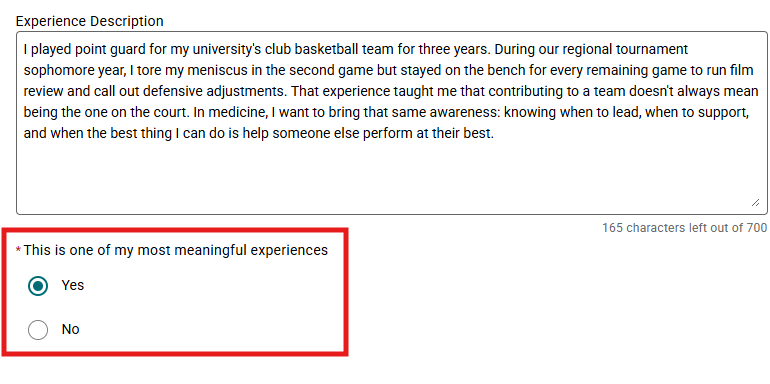
If a hobby fundamentally shaped your decision to become a physician or developed a core skill you'll carry into practice, it can earn that designation. Just make sure you can speak to that choice if an interviewer asks about it.
Your personal statement offers another opportunity to discuss a hobby in greater depth. If a hobby is central to your identity or your motivation for medicine, the personal statement gives you the space to tell that story fully rather than reducing it to 700 characters.
The difference between a forgettable hobby entry and a compelling one comes down to specificity. Specific descriptions grounded in real moments and clear self-awareness stick with readers.
Below are three examples that show how to turn a common hobby into a meaningful AMCAS entry.
"I played point guard for my university's club basketball team for three years. During our regional tournament sophomore year, I tore my meniscus in the second game but stayed on the bench for every remaining game to run film review and call out defensive adjustments. That experience taught me that contributing to a team doesn't always mean being the one on the court. In medicine, I want to bring that same awareness: knowing when to lead, when to support, and when the best thing I can do is help someone else perform at their best."

"I started running half marathons junior year after struggling with anxiety during organic chemistry. Training gave me a structured outlet: four runs a week, progressive mileage increases, and a long run every Sunday regardless of how the week went. Over two years and six races, I learned that the ability to stay disciplined when motivation disappears is more valuable than motivation itself. Medical school will demand that same consistency, and running proved to me that I can sustain effort through discomfort without burning out."

"I've played classical violin since age 8 and performed with my university orchestra for four years. Preparing for a concerto performance my senior year required me to isolate the same 16-bar passage for weeks until my intonation and bowing were automatic under pressure. That process mirrors how I approach learning complex material: break it into components, drill each one past the point of comfort, then perform under real conditions. I'll carry that practice framework into clinical skills training."

No, you don’t have to include hobbies in your medical school application. Hobbies are optional entries in the AMCAS Work and Activities section, and you can fill all 15 slots with clinical experiences, research, volunteering, and employment if those better represent your candidacy. Include hobbies only when you can write about them with the same depth and intentionality as your strongest entries.
You should include one to three hobbies at most. The Work and Activities section gives you 15 slots, and clinical experience, research, and service activities should always take priority. Every hobby you add takes a slot away from an entry type that admissions committees weigh more heavily, so only include hobbies that genuinely strengthen your application.
Yes, you should add a cliché hobby if you can write about it in a way that's specific to your experience. Running, playing guitar, and cooking are common hobbies on AMCAS applications, but the description is what makes an entry memorable or forgettable. Focus on a particular moment, what it taught you, and how it connects to your readiness for medicine, rather than on the activity itself.
Medical schools care about hobbies when they demonstrate something meaningful about who you are outside of academics. Admissions committees aren't evaluating the hobby itself. They're evaluating your self-awareness, your ability to sustain commitment to something you care about, and whether you've developed skills that translate to clinical training.
No, impressive hobbies can’t make up for a lower GPA or MCAT score. Academic metrics are the baseline filter that determines whether your application gets a full review. No hobby can substitute for meeting a school's academic thresholds.
Dr. Akhil Katakam was the original author of this article. Snippets of his work may remain.


.svg)


