In this guide, we’ll go over how to get into Harvard Medical School (HMS), its acceptance rate, key admissions requirements and deadlines, and tips on how to stand out.
If you’re just here for the requirements, click here.
Privacy guaranteed. No spam, ever.
Harvard Medical School Acceptance Rate: 1.99%
Harvard Medical School’s acceptance rate is 1.99%. According to the Medical School Admission Requirements (MSAR) database, HMS received 8,275 verified applications in the 2025-2026 admissions cycle. Of these applicants, only 165 students matriculated.
Take a look at the interactive infographic below to see how HMS’s acceptance rate has changed over the last few admissions cycles:
0.00%
Acceptance Rate for Harvard Medical School (2025–2026 Cycle)
0
Applications Received
0
Matriculated Students
0:1
Applicant-to-Seat Ratio
Out of 100 applicants, roughly 2 matriculated:
1.99
Matriculated
Not Matriculated
Acceptance rate by cycle
Harvard Medical School received 8,275 applications in the 2025–2026 cycle for 165 matriculated students, giving it an estimated acceptance rate of 1.99%.
Over the past five admissions cycles, the HMS has remained highly competitive, with an average acceptance rate of 2.00%. On average, about 8,208 students applied each year for roughly 164 seats. These averages show students that HMS’s selectivity is long-standing, so success depends on building a strong, well-rounded application every year.
How Hard Is It to Get Into Harvard Medical School?
It is extremely difficult to get into Harvard Medical School. In the 2025-2026 admissions cycle, HMS had an acceptance rate of just 1.99%. HMS could have filled its entire incoming class more than 50 times over with highly qualified applicants.
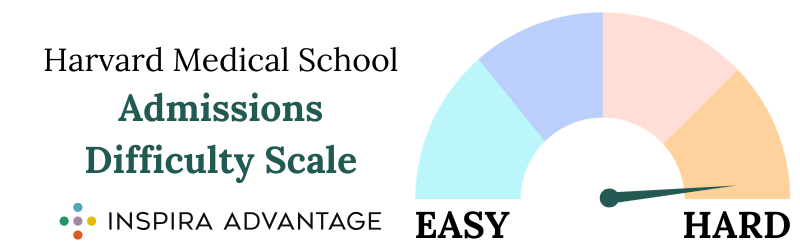
Our Harvard Medical School Admissions Difficulty Scale was created by comparing acceptance rates and overall selectivity across all accredited US medical schools.
What Is HMS’ Acceptance Rate for In-State Applicants?
Harvard Medical School’s acceptance rate for in-state applicants is 3.64%. The MSAR reports that 659 in-state applicants applied during the 2025-2026 admissions cycle, and only 24 in-state applicants matriculated.
Massachusetts residents account for 7.96% of HMS’ total applicant pool, yet take about 14.55% of the incoming class seats. At 3.64%, the in-state acceptance rate is about twice that of the out-of-state acceptance rate. HMS still denied 635 of 659 Massachusetts applicants in the 2025-2026 admissions cycle. State residency doesn’t give you enough of an advantage, so your MCAT, GPA, and research depth need to be as competitive as every other admitted student.
What Is HMS’ Acceptance Rate for Out-of-State Applicants?
Harvard Medical School’s acceptance rate for out-of-state applicants is 1.84%. According to MSAR, 7,057 out-of-state applicants applied in the 2025-2026 admissions cycle, and only 130 students matriculated.
Out-of-state candidates comprise the majority of HMS’s applicant pool, submitting 85.28% of applications and filling 78.79% of incoming class seats. At 1.84%, fewer than 19 of every 1,000 out-of-state applicants receive an offer. Out-of-state applicants need to articulate a specific reason why HMS’s research infrastructure and affiliated teaching hospitals match their trajectory better than any peer institution.
What Is HMS’ Acceptance Rate for International Students?
Harvard Medical School’s acceptance rate for international students is 1.97%. The MSAR reports that 559 international students applied in the 2025-2026 admissions cycle, of which only 11 matriculated.
International students make up about 6.75% of HMS’s applicant pool and fill 6.67% of seats in the incoming class. At 1.97%, the international acceptance rate actually edges slightly above the out-of-state rate at HMS. The international students HMS admits each year typically arrive with exceptional research output, advanced degrees, or clinical training that rivals that of the top domestic candidates. International candidates need to demonstrate why their background contributes something HMS couldn't obtain from a U.S.-trained applicant, whether that's a specific research methodology, global health exposure, or clinical training in a system U.S. medical schools can't replicate.
How Many People Apply to HMS Every Year?
HMS receives approximately 8,208 applications per year, the average across the past five admissions cycles. The average acceptance rate over that same period is 2.00%.
Privacy guaranteed. No spam, ever.
HMS Admissions Statistics
HMS Median MCAT Score: 521
The median MCAT score of HMS accepted applicants in the 2025-2026 admissions cycle was 521. HMS does not require a minimum MCAT score for admission.
Here’s an interactive infographic comparing MCAT scores of accepted applicants in the 2025-2026 admissions cycle.
521
Median MCAT Score of Accepted Applicants
Harvard Medical School
517
10th Percentile
518
25th Percentile
521
Median Score
524
75th Percentile
526
90th Percentile
Enter your MCAT score
521
472490500510520528
Harvard Medical School does not publish a minimum MCAT requirement. The MCAT is one factor in a holistic review that also considers GPA, research, clinical experience, service, leadership, and personal qualities.
Refer to the table below for a comprehensive view of the MCAT score percentiles for matriculants and accepted students in the 2025-2026 admissions cycle.
MCAT Score Percentiles
MCAT Score of Accepted Applicants at HMS
MCAT Score of Matriculants at HMS
10th Percentile
517
517
25th Percentile
518
518
50th Percentile (median)
521
520
75th Percentile
524
523
90th Percentile
526
525
The table below shows section-specific MCAT scores of HMS matriculants and accepted students.
MCAT Section
Median MCAT Score of Accepted Applicants at Harvard Med
Median MCAT Score of All Matriculants at Harvard Med
Chemical and Physical Foundations of Biological Systems
131
131
Critical Analysis and Reasoning Skills (CARS)
129
129
Biological and Biochemical Foundations of Living Systems
131
131
Psychological, Social, and Biological Foundations of Behavior
In the 2025-2026 admissions cycle, the national average MCAT score for medical school matriculants was 512.1. HMS’s average MCAT score for all accepted applicants was 520.9 in the same admissions cycle, nearly nine points higher than the national average.
What MCAT Score Makes You Competitive at HMS?
An MCAT score of 524 or above makes you competitive at Harvard Medical School. This puts you in the top quarter of accepted applicants in the 2025-2026 admissions cycle.
What this means for competitiveness:
⚈ You can still be competitive with a 521 MCAT score (median) if you submit a 4.00 overall GPA, 75th percentile science GPA, and a standout personal statement.
⚈ You’ll be very competitive with a 526 MCAT score. This puts you in the top 10% of accepted applicants in the 2025-2026 admissions cycle.
⚈ HMS will not consider MCAT scores of 518 or below as competitive, so consider retaking the MCAT before applying.
HMS Median Overall GPA: 3.98
The median overall GPA of accepted applicants at HMS was 3.98 in the 2025-2026 admissions cycle. HMS does not require a minimum overall GPA for admission.
Refer to the visual below to see how your overall GPA compares to HMS accepted applicants in the 2025-2026 admissions cycle. This is a great way to estimate your competitiveness.
3.98
Median Overall GPA of Accepted Applicants
Harvard Medical School
3.89
10th Percentile
3.94
25th Percentile
3.98
Median GPA
4.00
75th Percentile
4.00
90th Percentile
Enter your overall GPA
3.98
2.002.503.003.504.00
Harvard Medical School does not publish a minimum GPA requirement. Overall GPA is one factor in a holistic review that also considers MCAT scores, research, clinical experience, service, leadership, and personal qualities.
The table below shows the overall GPA percentiles of matriculants and accepted applicants at HMS:
Overall GPA Percentiles
Overall GPA of Accepted Applicants at HMS
Overall GPA of Matriculants at HMS
10th Percentile
3.89
3.87
25th Percentile
3.94
3.93
50th Percentile (median)
3.98
3.97
75th Percentile
4.00
4.00
90th Percentile
4.00
4.00
The national average GPA of all medical school matriculants was 3.81 in the 2025-2026 admissions cycle. In that same cycle, HMS accepted applicants had an overall GPA of 3.96, which is 0.15 points higher than the national average.
What Overall GPA Makes You Competitive at HMS?
An overall GPA of 4.00 makes you competitive at HMS. This puts you in the top 10% of accepted applicants in the 2025-2026 admissions cycle.
What this means for competitiveness:
⚈ You can still be competitive with a 3.98 overall GPA (median) if you supplement it with a 524+ MCAT score, impressive letters of recommendation, and a well-written personal statement.
⚈ HMS does not consider an overall GPA of 3.94 or lower as competitive, so you’ll need to pair this with a 526+ MCAT score to stand out.
HMS Median Science GPA: 3.98
The median science GPA of accepted applicants at HMS was 3.98 in the 2025-2026 admissions cycle. HMS does not require a minimum science GPA for admission.
The table below shows the range of science GPA percentiles of accepted applicants at HMS:
Science GPA Percentiles
Science GPA of Accepted Applicants at HMS
Science GPA of Matriculants at HMS
10th Percentile
3.86
3.85
25th Percentile
3.93
3.93
50th Percentile (median)
3.98
3.98
75th Percentile
4.00
4.00
90th Percentile
4.00
4.00
What Science GPA Makes You Competitive at HMS?
A science GPA of 4.00 makes you competitive at Harvard Medical School. This puts you in the top 10% of accepted applicants in the 2025-2026 admissions cycle. You can still be competitive with a 3.98 science GPA if you supplement it with a 4.00 overall GPA and an MCAT score of 526.
Privacy guaranteed. No spam, ever.
Harvard Medical School Admissions Requirements
Here are all the admissions requirements to get accepted to Harvard Medical School.
Baccalaureate degree completed before matriculation, with at least three years of college work
At least one year of coursework at an accredited US or Canadian institution
One year with lab, covering cellular and molecular aspects
Chemistry
Required
Two years with lab, covering inorganic chemistry, organic chemistry, and biochemistry
Physics
Required
One year; lab preferred for Pathways, calculus-based physics required for HST
Expository Writing
Required
One year of coursework featuring analytical writing (humanities or social sciences courses qualify)
Mathematics
Recommended for Pathways, Required for HST
One semester of calculus plus one semester of statistics (biostatistics preferred); HST applicants need upper-level math such as linear algebra or differential equations
Behavioral Sciences
Recommended
Coursework in psychology, sociology, or related fields
These HMS coursework prerequisites reflect the minimum recommended duration in each subject. To strengthen your application, consider exceeding these minimums by taking additional advanced courses in the core disciplines.
HMS Interview Format
Harvard Medical School uses a traditional interview format. Invited applicants complete two virtual one-on-one interviews with either HMS-affiliated physician faculty, senior medical students serving on the admissions committee, or a combination of both.
Student and faculty evaluations carry equal weight in the final decision. Each interview runs 30-45 minutes and emphasizes open-ended conversation about your motivations, experiences, and alignment with HMS's mission rather than standardized scenarios or rapid-fire questions.
Interviewers have reviewed your full application in advance, so use the time to add depth and context rather than restate what's already written. The interview season for the 2026-2027 cycle runs virtually from mid-September through January, and HMS expects applicants to flag any scheduling restrictions of 3 weeks or longer on the secondary application.
What Is HMS’s Interview Rate?
The interview rate at HMS in the 2025-2026 admissions cycle was 8.65%. HMS interviewed 716 of the 8,275 students who applied.
Of the total 716 students interviewed:
⚈ 79 were in-state students
⚈ 603 were out-of-state students
⚈ 34 were international students
This means only this number of students were interviewed:
⚈ 11.99% of in-state students
⚈ 8.54% of out-of-state students
⚈ 6.08% of international students
Privacy guaranteed. No spam, ever.
Secondary Application
Here are the secondary essay prompts for HMS in the 2025-2026 admissions cycle.
Essay 1: What You’ve Done Since Graduation
“If you have already graduated, briefly summarize your activities since graduation.” (4000 characters maximum)
How to Approach This Prompt
HMS asks this question because the admissions officers need to account for every period of an applicant's timeline. Unexplained gaps raise questions. Well-answered, purposeful gaps can significantly strengthen a candidacy.
Structure the response around two or three primary activities rather than cataloging everything you've done since graduation. If you've been working as a clinical research coordinator at a major academic medical center, lead with that.
Describe the role, what you've learned, and how it has refined your understanding of medicine or research. Then address secondary activities with less detail. The admissions committee values depth of engagement over breadth of activity.
Avoid simply listing activities with dates and titles. The prompt says "summarize," but the admissions officers are reading for narrative coherence, not inventory. Every activity mentioned should connect back to your development as a future physician or scientist. If you spent six months working at a coffee shop to pay off loans before starting a research position, you can mention it briefly for timeline clarity, but don't belabor it unless the experience taught you something directly relevant to medicine.
For applicants with multiple gap years, resist the urge to justify the length of time away from school. HMS regularly admits applicants who are three, five, or even ten years out from undergrad. The admissions committee evaluates what you did with the time, not how much of it passed. Confidence about your timeline signals maturity. Defensiveness about it signals insecurity.
Essay 2: How You Would Contribute to Harvard Medical School
“If there is an important aspect of your personal background or identity not addressed elsewhere in the application that may illuminate how you could contribute to the medical school and that you would like to share with the Committee, we invite you to do so here. Examples might include significant challenges in access to education, unusual socioeconomic factors, diverse ideological perspectives, or other aspects of your personal or family background that help place your prior academic achievements in context or provide further insight into your motivation for a career in medicine or the view points you might bring to the medical school community.” (4000 characters)
How to Approach This Prompt
This prompt asks whether there's something "not addressed elsewhere" that would help the admissions committee understand your contributions, context, or motivation. Applicants who use this space to restate their personal statement theme show that they didn't read the prompt carefully.
The examples provided show the range of what they consider relevant. Notice that the list includes "diverse ideological perspectives," which opens the door for applicants whose distinguishing characteristic isn't demographic but intellectual. A conservative applicant from a politically homogeneous community. A deeply religious applicant entering a secular academic environment. A military family background that shaped a fundamentally different worldview from most medical school peers. HMS values cognitive diversity alongside demographic diversity, and this prompt is one of the few in medical school admissions that explicitly invites it.
If you're writing about socioeconomic disadvantage or educational barriers, be specific about how those factors affected your academic trajectory. Don't just state that your family was low-income. Describe what that meant in practice.
Maybe you attended a high school with no AP science courses and had to teach yourself biology from a library textbook before arriving at college underprepared relative to peers from well-resourced schools. Maybe your family's financial instability meant you worked 30 hours a week during undergrad, which explains a GPA that doesn't fully reflect your intellectual capacity. The admissions committee uses this context when evaluating your academic record, so give them the specific details that make that evaluation fair.
Scheduling Question: Interview Restrictions
“The interview season for the 2026-2027 cycle will be held virtually and is anticipated to run from mid-September through January 2027. Please indicate any significant (three or more weeks) restriction on your availability for interviews during this period. If none, please leave this section blank.” (1000 characters)
How to Approach This Prompt
The admissions committee includes this prompt for practical scheduling purposes. If you have a military deployment, a study-abroad commitment, a medical procedure with extended recovery, or another obligation that makes you completely unreachable for three or more weeks between September and January, state the dates and the reason in one or two sentences.
Do not use this space to show your enthusiasm for an early interview. Do not write "I am available anytime" or "I look forward to interviewing at your earliest convenience." Leaving the field blank already communicates full availability, and filler text in a logistics prompt makes it seem like you don’t follow instructions.
If your restriction is shorter than three weeks, leave the field blank. HMS specified "three or more weeks" as the threshold for a reason. A one-week vacation or a few days of exams doesn't need to be reported. The admissions committee will work around minor scheduling conflicts during the normal coordination process.
Keep any response purely factual. "I will be completing a clinical rotation in rural Guatemala from October 15 through November 10 with limited internet access." The admissions officers don't need context about why you chose that rotation or how meaningful it is. Save the narrative for your other essays.
Essay 3: How Your Application Has Changed Since Your Previous One
“If you are re-applying, briefly summarize your activities since your previous application.” (4000 characters)
How to Approach This Prompt
Reapplicants must prove that the time between applications produced meaningful growth rather than just another year of the same activities. The admissions officers who reviewed the previous application may or may not be on the current review team, but they can see your file. Repeating content from the prior cycle shows that you learned nothing.
Open with the single most impactful development since your last application. Maybe you completed a post-baccalaureate program and raised your science GPA by half a point. Maybe you took on a new research role that deepened your scholarly interests. Maybe you gained clinical experience in a setting that addresses a gap the admissions committee may have identified in your previous application. Whatever it is, name it in the first sentence and spend the first third of the essay explaining its significance.
Then address secondary developments with less detail. New volunteer commitments, additional shadowing, coursework, and leadership roles. The admissions committee needs to see a full picture of how you spent the intervening time, but the emphasis should fall on the activities that most strengthen the parts of your application that were previously weakest.
Avoid explicitly stating what you think went wrong with your previous application. "I believe my application was previously weak in clinical experience," reads as speculative and draws attention to a deficit. Instead, let the new activities speak for themselves. If you've added 500 hours of clinical experience, the admissions officers will connect the dots without you highlighting the previous gap.
Essay 4 (HST Applicants): How You’ve Prepared for the HST Program
“The HST MD program draws on the combined resources of Harvard and MIT to provide a distinct preclinical education tailored to preparing students for careers as transformative physicians who will shape the future practice of medicine. Our students come from the full spectrum of disciplines including biological, physical, engineering and social sciences. HST classes are small, commonly include graduate students and have an emphasis on quantitative and analytic approaches. The unique HST pre-clinical curriculum prepares students well for the HMS clinical education while also emphasizing disease mechanisms and preparing students to solve critical unmet needs in medicine and healthcare (ranging from novel diagnostics and therapeutics to applications of ‘big data’ and systems engineering). Please focus on how your interests, experiences and aspirations have prepared you for HST (rather than identifying specific HST faculty or research opportunities). (For HST applicants only)
How to Approach This Prompt
The admissions officers screening HST applicants are looking for someone who approaches medical problems with quantitative rigor, interdisciplinary thinking, and a drive to develop novel solutions rather than apply existing ones. If your primary motivation for medicine is patient care without a strong scholarly or innovation component, HST is not the right track, and forcing a fit in this essay will be obvious.
The prompt explicitly instructs applicants to focus on "interests, experiences and aspirations" rather than naming specific faculty or research opportunities. The admissions committee doesn't want a list of HST labs you'd like to join. They want to understand the intellectual trajectory that makes HST a natural fit for how you already think and work.
Structure the essay around the convergence of your disciplines. If you majored in biomedical engineering and conducted research on medical device design, describe how that experience shaped the way you approach clinical problems. If you studied computer science and worked on machine learning applications in radiology, explain what that work revealed about unmet needs in diagnostic medicine. The strongest HST essays show that the applicant has already been operating at the intersection of medicine and another discipline before arriving at HMS.
Avoid writing a standard "Why Medicine" essay with a paragraph about HST appended at the end. The admissions committee wants the entire essay to reflect HST-caliber thinking. Every experience discussed should demonstrate the quantitative, analytic, or engineering mindset that distinguishes HST students from their Pathways peers.
Privacy guaranteed. No spam, ever.
How to Improve Your Chances of Getting Into Harvard Medical School
Demonstrate What Harvard Medical School’s Admissions Committee Is Looking For Throughout Your Application
To craft a strong application, you must understand what Harvard Medical School is looking for in competitive applicants. HMS says its most successful applicants:
“Reflect an extraordinary diversity of accomplishments, talents, interests, and backgrounds.”
That means you need to be well-rounded to be a competitive applicant. The table below shows how you can prove your interdisciplinary nature.
Category
What It Means
How to Show It In Your Application
Diversity of Accomplishments
Meaningful achievements, not limited to academics.
Use your personal statement and activities list to highlight leadership roles, community projects, research output, creative work, or public service.
Diversity of Interests
Intellectual curiosity that spans disciplines, especially in the humanities or social sciences.
Reference relevant coursework, reading, or projects.
Diversity of Backgrounds
Life experiences that shape your perspective.
Use your personal statement or secondary essays to reflect on cultural, geographic, or socioeconomic influences.
Purpose
A clear and compelling reason for pursuing medicine.
Share a defining moment or experience in your path to med school. Explain why medicine, not just health care.
Intrinsic Motivation
Long-term commitment in your education.
Highlight experience such as tutoring, sustained lab research, or long-term involvement in a clinic or community organization.
Commitment to Service
A genuine desire to help others, especially in underserved settings.
Describe what you did and how it made a difference. Reflect on what you learned and how it shaped your desire to study medicine.
Reference Your Interdisciplinary Education, Not Just Science Courses You Completed
Many applicants believe that excelling in biology, chemistry, and physics is enough to gain admission to top medical schools. While these are essential, Harvard Medical School wants students with a broader academic foundation.
The HMS Committee on Admissions emphasizes that while students must demonstrate strong aptitude in the biological and physical sciences, the ideal candidates also possess:
“A well-balanced academic background that includes the humanities and social sciences.”
Many pre-med students assume that excelling in chemistry or biology is enough, but at HMS, your intellectual range matters. Majoring in the humanities or taking courses in philosophy, literature, ethics, and sociology helps develop the kind of nuanced thinking, empathy, and communication skills that world-class physicians need. A strong GPA in these areas signals that you’re a holistic thinker who is capable of understanding patients as whole people.
If you’ve engaged deeply with the humanities in college, be sure to make that clear in your application. Use your personal statement and secondary essays to reflect on how your academic diversity has shaped your approach to medicine.
HMS is not only looking for students who can master science. HMS is looking for thinkers who can connect knowledge across disciplines to care for people in all their complexity.
Highlight Community Service & Leadership in Your Application
Leadership at HMS is about substance, not status. What matters most is the initiative you took, the responsibility you carried, and the difference you made.
HMS’s Dean, Bernard Chang, underscores the importance of purpose-driven leadership in an admissions blog.
“We are looking for students who have the potential to be the future ‘physician leaders’ in society … the emphasis is on ‘physician’ above all else. Having the impact on human health that we hope for begins with our students learning to be the most outstanding doctors they can possibly be for their patients.”
This statement reflects HMS’s belief that leadership is about serving others through clinical excellence, innovation, and community engagement.
To stand out, applicants should share examples of leadership driven by purpose, like organizing health initiatives in underserved areas or mentoring at-risk youth. The strongest applicants show that their leadership is rooted in compassion, action, and a clear commitment to advancing human health.
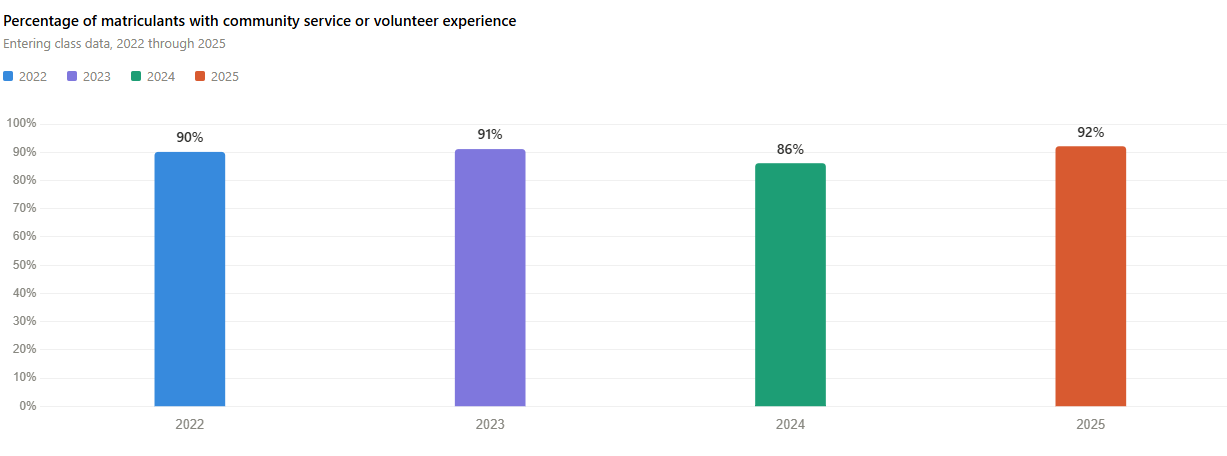
These values are reflected in the extracurricular profiles of matriculants: 92% engaged in community service or volunteer work in the 2025-2026 admissions cycle.
With so many matriculants engaged in community service and clinical volunteering, it’s clear that HMS values leadership rooted in real-world impact. Applicants who can link their initiatives to measurable benefits for health and well-being will align closely with the school’s mission.
Prioritize Your Interest in Patient Care, Not the Prestige of HMS
Harvard Medical School carries immense prestige, and many applicants are drawn to it for that reason. But you should avoid referencing the school’s ranking, name recognition, or status in your personal statement, secondary essays, or interview.
HMS’ mission is patient-centered. As Chang puts it:
“For us, the ultimate stakeholder in our medical education program is not the student but the patient, and we emphasize that from day one.”
This means your application should reflect a commitment to care and clinical impact, not a desire for status. Admissions officers are looking for students who are driven by responsibility, not recognition, and they admit those who demonstrate this clearly.
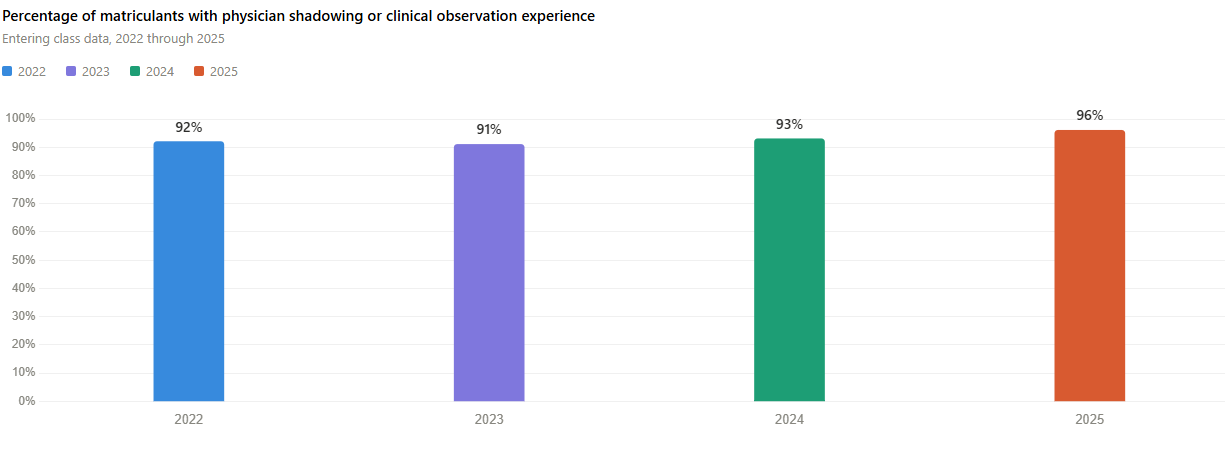
In fact, 96% of matriculants in the 2025-2026 cycle had experience in physician shadowing or clinical observation.
Successful applicants found out about hands-on opportunities to better understand patient care and the scientific foundations of medicine. They pursued what they genuinely felt was their calling to study medicine.
Your application should reflect your desire to study medicine, anchored in responsibility and purpose. Rather than focusing solely on your ambitions or personal goals, center your narrative around the people you hope to support. Talk about the real-world problems that drive you, the healthcare issues that move you, and the kind of doctor you want to become for your patients.
Privacy guaranteed. No spam, ever.
MD Programs Offered
HMS offers one MD program with two tracks (Pathways and HST), and all combined degrees except MD/PhD are applied for after MD admission.
Program
Length
Key Information
MD - Pathways Track
4 years
Traditional MD track emphasizing active learning, early clinical exposure, and a faculty-mentored scholarly project
MD - Health Sciences and Technology (HST) Track
4 years
Joint with MIT; built for students pursuing quantitative, engineering, or translational research careers
MD/PhD
7-9 years
Joint Harvard/MIT program funded through NIH MSTP; applied concurrently with the MD application
MD/SM (Master of Science)
5 years
Completed between years three and four; offered in Bioethics, Healthcare Quality and Safety, and Media Medicine and Health
MD/MMSc (Master of Medical Science)
5 years
Completed between years three and four; offered in Clinical Investigation, Global Health Delivery, Immunology, and Medical Education
MD/MBA
5 years
Joint with Harvard Business School; for students targeting health system leadership or healthcare industry roles
MD/MPH
5 years
Joint with Harvard Chan School of Public Health; for students focused on population health or preventive medicine
MD/MPP
5 years
Joint with Harvard Kennedy School, for students targeting health policy or public health program development
Tuition and Scholarships
Harvard Medical School’s tuition for the 2025-2026 year is $76,828. After factoring in additional fees, you can expect to pay $121,950 for the total cost of first-year attendance.
How Much Does HMS Cost for 4 Years?
The total cost of attendance for the four-year MD program at HMS is $496,650. Here’s a breakdown of the total cost of attendance each year.
Year 1: $121,950
Year 2: $125,030
Year 3: $125,418
Year 4: $124,252
Scholarships
Harvard Medical School offers generous need-based scholarships, with 50% of MD students benefiting annually from its Middle Income Initiative, which reduces the expected contribution from middle-income families.
For students with full financial need, HMS scholarships can cover the entire cost of tuition and mandatory fees. Select incoming students may also be nominated for the Dean’s REACH Scholarship, a four-year award recognizing resilience, compassion, and a commitment to underserved communities.
Harvard Medical School Application Timeline
Here is the application timeline for Harvard Medical School’s 2026-2027 admissions cycle.
Date
What Happens
Early May
AMCAS application opens
Late May
AMCAS submission begins; submit as early as possible to start the verification process
Late June
AMCAS sends verified applications to medical schools, and HMS automatically sends a secondary to every verified applicant with no screening
July - August
Complete and submit the HMS secondary application within two weeks of receiving it
Mid-September
HMS virtual interview season begins; invitations are sent on a rolling basis from this point forward
Mid-October
AMCAS application deadline for HMS
Late October
HMS secondary application deadline, including all letters of evaluation and MCAT scores submitted through AMCAS; incomplete applications after this date are reviewed based on whatever materials are on file
Mid-January
Final interview invitations sent; applicants not contacted by this point were not selected for interview
January
HMS virtual interview season closes
Early March
All admissions decisions are released on the same date via email: accepted, declined, or waitlisted
March - April
Waitlist activity begins; applicants may submit up to two updates through the admissions portal
April 30
Admitted students select "Plan to Enroll" on the AAMC Choose Your Medical School tool and withdraw from all other schools holding offers
June 1
Admitted students select "Commit to Enroll" on the Choose Your Medical School tool; final enrollment commitment deadline
August
Matriculation at HMS
FAQs: Gaining Admission to HMS
How Can I Get Into Harvard Medical School With a Scholarship?
To get into HMS with a scholarship, you must first gain admission and then qualify for need-based financial aid, which is the only type of scholarship HMS offers. Once admitted, you submit detailed financial information through the HMS Financial Aid application. HMS uses your family's income and assets to calculate an expected contribution, then covers the gap between that number and tuition plus mandatory fees. For full-need students, HMS scholarship funding covers all costs.
Can International Students Get Scholarships at HMS?
Yes, international students qualify for the same need-based HMS scholarship funding as domestic students. HMS uses identical criteria regardless of citizenship, so an international applicant with demonstrated financial need receives the same institutional scholarship calculation as a US resident with the same family income and assets.
How Many Times Can You Apply to HMS?
You can apply to HMS a maximum of two times. Incomplete application attempts count toward that two-cycle cap, so only submit when your application is fully ready. Reapplicants must complete Prompt G on the secondary, which asks you to summarize what changed since your previous submission. Strong reapplicants demonstrate concrete improvements, such as a higher MCAT score, new research outputs, or deeper clinical experience, rather than a repackaged version of the same file.
Does HMS Accept Transfer Students?
No, HMS does not accept transfer students under any circumstances. Candidates who have previously matriculated at another medical school, including international programs where students enter directly from secondary school, are ineligible to apply. HMS enforces this policy regardless of the reason for leaving the prior program.
Can You Apply to Both the Pathways and HST Tracks?
You can apply to Pathways, HST, or both tracks simultaneously through a single AMCAS application. Applying to both does not hurt your chances at either. HST applicants complete an additional 4,000-character essay and should expect two extra interviews if selected, bringing the total to four. Choose both tracks only if your background includes the quantitative or research depth that HST specifically demands.






.svg)

