Get in touch: +1 888 453 5021





I often see students who want to know the easiest medical schools to get into just so they have plenty of backup options. But using these schools as “backup” is a big mistake, because admissions officers at these programs can often tell when you’re just applying to have something in your back pocket.
I made this guide to help you find some of the most accessible programs with less strict admissions requirements, in case your stats aren’t quite at the Harvard Med or Yale Med level but you still want to attend medical school. At the end of the day, whether you get your degree from a top MD program, a lower-tier MD program, a DO program, or a Caribbean program, you still become a licensed physician who can specialize with further training.
But you also need to know exactly how to find the right schools for you, even if their admissions requirements are more flexible than others. In this guide, I’ll help you learn the most accessible MD, DO, and Caribbean programs and show you how to find other accessible schools to add to your list.
Here is a list of some of the easiest medical schools to get into, along with their acceptance rates and GPA/MCAT medians, as reported in the Medical School Admissions Requirements (MSAR) database:
Note: Keep in mind that the term “easiest” is relative, and your admissions odds ultimately come down to factors like in-state residency, mission fit, and applicant pool competitiveness.
Also, acceptance rates can be misleading because some schools receive fewer than 1,000 applications per cycle and often have higher acceptance rates than schools that receive far more applicants.
Applying to medical schools in the state where you live can drastically change your admissions odds. Some state-funded MD programs reserve most of their seats for in-state residents.
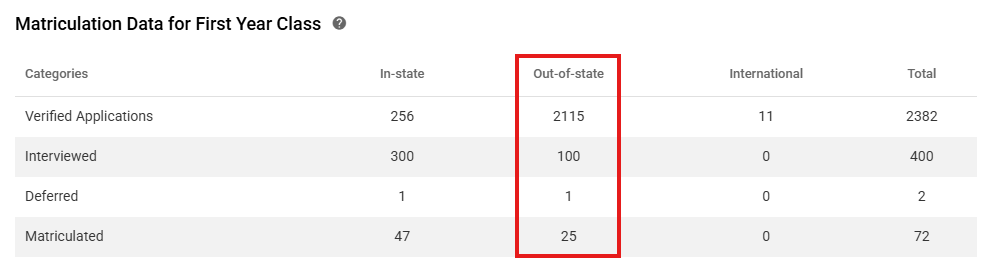
Out-of-state applicants can have a harder time getting into medical school simply due to where they live. Even if a public medical school has a higher acceptance rate, the out-of-state acceptance rate can be much lower because of limited seat availability.
That’s why overall acceptance rates can sometimes be misleading. Some medical schools look easier to get into because they prioritize in-state applicants, which can significantly improve the overall acceptance rate. However, out-of-state applicants are usually at a significant disadvantage.
If you’re looking for the easiest schools to get into as an out-of-state student, use the MSAR’s out-of-state acceptance data for a more accurate figure, shown in the screenshot below.
Safety schools don’t really exist anymore. Medical school applicants compete for a small number of seats against thousands of others each year. Even the easiest schools on this list turn hundreds of applicants away each cycle.
As we transition to new application cycles, the landscape gets more competitive. That’s why you can no longer rely on a handful of schools to automatically accept you. If you have excellent stats, a strong personal statement, effective letters of recommendation, and impressive secondary essays, you increase your chances of standing out. But that applies across the board, not to one school.
These are the least competitive DO schools to get into:
Similar to MD programs, the term “least competitive” here depends on several factors. Just because a school offers more acceptances or has lower requirements for admission doesn’t mean you’re guaranteed a seat.
DO programs typically have lower requirements than MD programs, but you should never let admissions committees know that you’re using these programs as a backup option. Osteopathic programs focus on whole-person care, which can differ significantly from allopathic programs. Apply to these schools because you genuinely want to attend, not because you think they’re easier to get into.
No single statistic actually determines how “easy” a school is to get into, but looking at benchmarks from previous matriculants is one of the best ways to estimate how competitive a school is.
Many applicants look at acceptance rates first, but these figures can be misleading. Most medical schools don’t publish the total number of admissions offers they make.
Instead, publicly available figures often compare the number of applicants with the number of students who ultimately matriculate, which doesn’t account for applicants who were accepted but chose to attend another school.
Acceptance rates also need context. A school that receives fewer applications may have a higher applicant-to-matriculant ratio than a school receiving thousands more, but that doesn’t necessarily mean admission is easy.
Residency preferences, mission fit, applicant volume, and the strength of the applicant pool can all affect how competitive a program is.
The experts I spoke to when creating this guide emphasized that these school-specific factors matter when evaluating how competitive a program really is. That is why you should treat acceptance rates as one indicator of accessibility rather than a complete measure of your chances.
Another useful way to assess competitiveness is to look at the median MCAT and GPA of previous matriculants. These medians show the academic profile of the middle student in the entering class and give you a useful benchmark for comparing your own stats with those of students who successfully enrolled.
You can also look at the 25th-75th percentile GPAs of matriculants as one of the best ways to assess how hard a medical school is to get into. In the 2025-2026 admissions cycle, matriculants nationwide had an average GPA of 3.81. See how that compares to the 25th-75th percentile range of the school you’re applying to, and you’ll learn how difficult it is to stand out in the screening phase. Schools with GPA percentile ranges below 3.81 may be more inclined to accept applicants with lower GPAs.
Let’s look at a real example. Using the Medical School Admission Requirements (MSAR) database, we can see that Charles R. Drew University of Medicine and Science College of Medicine matriculants had GPAs ranging from 3.23 (25th percentile) to 3.63 (75th percentile), meaning that even students near the top of its range fall below the national matriculant average.
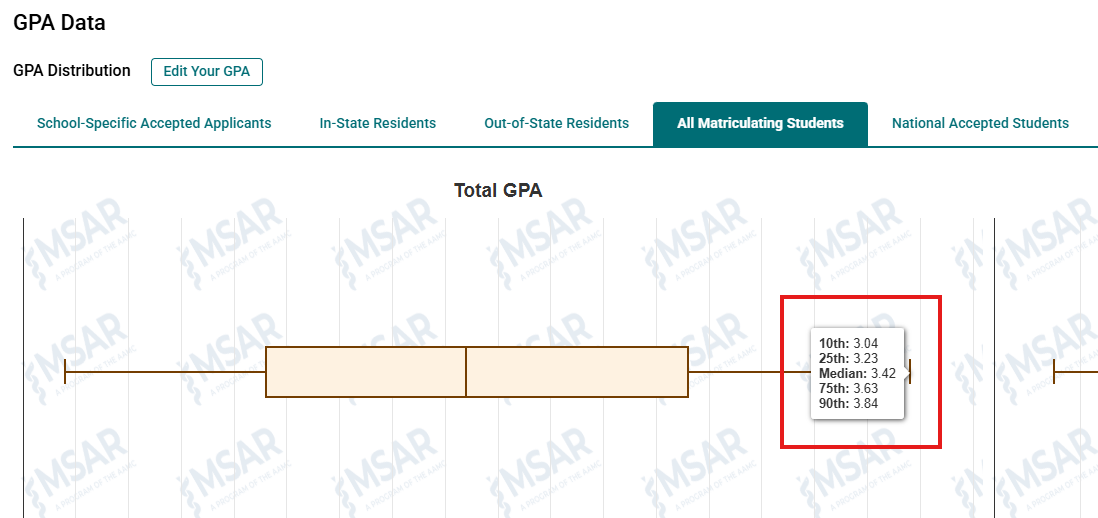
Most elite programs attract high-scoring students, which will contribute to a higher GPA percentile range. Schools with lower ranges are generally considered more accessible for admission.
Very similar to GPA percentiles, using MCAT percentiles of previous matriculants can also give you a better sense of the school’s competitiveness, especially when taking the GPA percentiles into account as well.
According to the AAMC, the average total MCAT score for U.S. medical school matriculants is 512.1. Several schools that we’ve listed above admit students whose 75th-percentile MCAT scores are drastically below this number.
Let’s look at another example. Using the MSAR, we can see that San Juan Bautista School of Medicine’s MCAT matriculant range is 493 (25th percentile) to 501 (75th percentile). Even matriculants at 505 (90th percentile) have MCAT scores that fall drastically below the overall MCAT average reported by the AAMC.
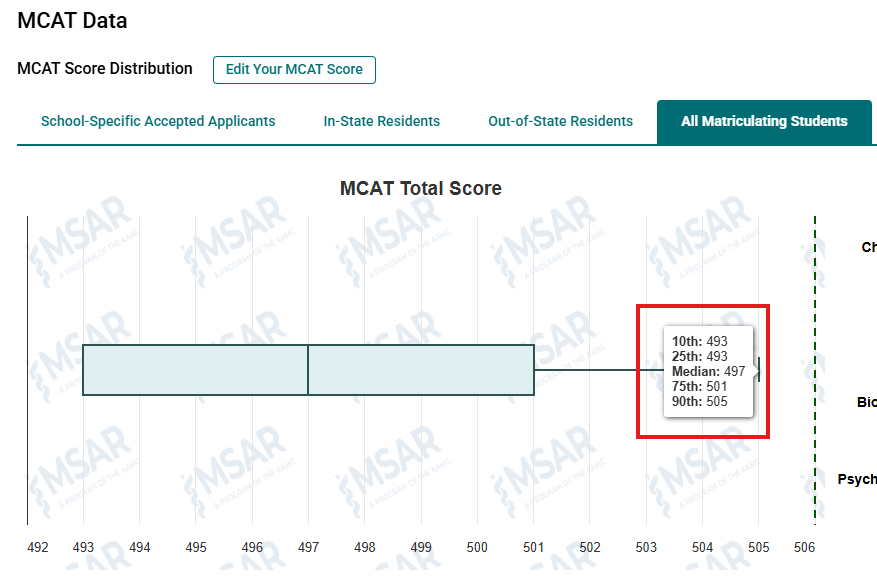
Schools whose MCAT ranges start and extend well above 510 tend to admit higher-scoring applicants, leaving less flexibility for those below national averages. Some programs and pathways don’t require the MCAT at all, which can make them easier to get into for some individuals.
Working with an experienced med school admissions coach can identify weaknesses, refine your strategy, and position your application more competitively. Find out more about how our expert admissions advisors can get you into any medical school.
The University of Mississippi School of Medicine has one of the highest acceptance rates among U.S.-accredited MD programs. In the 2025-2026 admissions cycle, the University of Mississippi School of Medicine had a 52.15% acceptance rate, with 326 verified applicants and 170 matriculants.
The following med schools are among the least competitive in the Caribbean:
Wyoming is the “easiest” state to get into medical school by applicant-to-matriculant odds in 2025-2026. Using the AAMC FACTS 2025-2026 Applicants and Matriculants by Legal Residence data, the highest matriculants-per-applicant ratios were: Wyoming (~68%), West Virginia (~59%), Alaska (~58%), Vermont (~58%), and Mississippi (~56%).
The lowest GPA medical schools typically accept is 3.00, but some schools accept students with lower GPAs. AAMC’s MCAT-GPA Acceptance Grid (aggregated 2023-2024 through 2025-2026) shows a small number of acceptees even in the <2.00 GPA range, which means it can happen, but your odds are very low.
The lowest MCAT score for medical school is typically around 495-500. However, the AAMC’s MCAT-GPA Acceptance Grid shows that some students with MCAT scores less than 486 were still accepted to medical school. But acceptance at that level is uncommon and usually requires exceptional context plus standout strengths elsewhere in the application.
Yes, DO can be “easier” to enter than MD on average, and no, it doesn’t automatically hurt your residency outcomes. DO seniors matched at a record-high 93.20% in the 2026 NRMP Match, just a fraction behind the MD match rate of 93.50%, which shows strong overall residency access.


.svg)


