Get in touch: +1 888 453 5021





In this guide, we’ll break down how to get into NYU Grossman School of Medicine (NYU Grossman), including its acceptance rate, admissions statistics, GPA and MCAT benchmarks, and what NYU Grossman is really looking for in an applicant.
If you’re looking for just the requirements, click here.
NYU Grossman School of Medicine has an acceptance rate of 1.18% for the 2025-2026 admissions cycle. According to verified application data from the AAMC’s Medical School Admission Requirements (MSAR) database, there were 8,385 verified applications and 99 matriculants.
Here’s a closer look at NYU Grossman’s acceptance rate and admissions data over the past six years:
NYU Grossman School of Medicine's average acceptance rate over the last six years is 1.19%. During this period, the school received an average of 8,654 applications per year for an average of 103 seats, meaning that for every student admitted, more than 84 were turned away.
The 2025-2026 cycle marks the most selective class in six years, with only 99 matriculants and a 1.18% acceptance rate.
It is extremely difficult to gain admission to NYU Grossman, with an acceptance rate of 1.18%. For the 2025-2026 cycle, NYU Grossman received 8,385 applications for just 99 seats. The school could have filled its entire incoming class more than 84 times over with the number of students who applied.
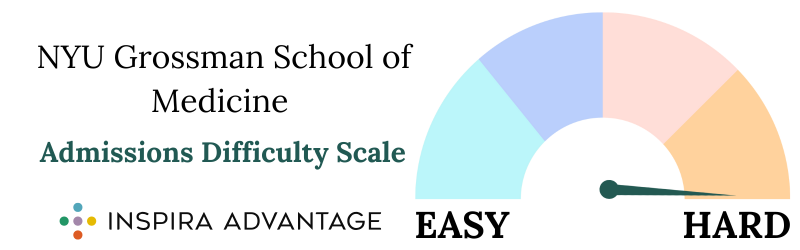
The NYU Grossman School of Medicine’s Admissions Difficulty Scale was created by comparing acceptance rates and overall selectivity across all accredited US medical schools.
If you'd like help developing your application strategy, our NYU Grossman Medical School admissions counselors offer personalized med school advising focused on maximizing your strengths and aligning your profile with NYU’s mission and values.
The median MCAT score among accepted applicants and matriculants at NYU Grossman School of Medicine is 523.
Here is how accepted applicants scored across each MCAT section:
Here is the full percentile distribution for accepted applicants and matriculants:
A 523 MCAT score sits at the 99th percentile nationally. Even the 10th percentile of NYU Grossman accepted applicants, at 519, outperforms roughly 96% of all test takers.
For further context, the national average MCAT score for applicants is 506.3, according to the AAMC. NYU Grossman's accepted applicants had an average MCAT score of 522.6, which sits more than 16 points above the average applicant.
Accepted applicants to the NYU Grossman School of Medicine had a median total GPA of 3.99. Matriculants had a median total GPA of 3.98.
NYU Grossman does not publish a minimum GPA requirement.
Here is the full percentile breakdown for accepted applicants and matriculants:
The AAMC reports a national average GPA of 3.67 for all medical school applicants. NYU Grossman's accepted applicant average of 3.96 sits 0.29 points above that figure. The 75th and 90th percentiles both reach 4.00, meaning at least one in four accepted applicants earned a perfect total GPA.
NYU Grossman School of Medicine’s 2025-2026 accepted applicants had a median science GPA of 4.00. Matriculants matched that figure as well.
The compression at the top of this distribution gives you insight into how NYU Grossman's pool actually looks. From the 25th percentile upward, three-quarters of accepted applicants earned a science GPA between 3.95 and 4.00.
Science GPA functions less as a differentiator here and more as a baseline requirement: you need near-perfect marks in the sciences in order to clear NYU Grossman’s academic expectations.
NYU Grossman Medical School’s admissions requirements include:
NYU Grossman does not have course prerequisites. However, they strongly recommend students take the following premedical courses:
These recommended NYU Grossman prerequisites can provide a strong basis for your medical education. To impress the admissions committee, ensure you take several advanced courses within these subjects.
NYU Grossman School of Medicine uses a virtual multiple mini interview (MMI) format. Applicants rotate through eight stations, each involving a short, timed conversation with a different interviewer from the faculty, staff, or student body. Most stations are seven minutes long and present an open-ended prompt designed to assess qualities like empathy, communication, and ethical reasoning.
One station follows a more traditional one-on-one interview format and lasts 14 minutes, while two are designated rest stations. This structure allows the admissions team to evaluate candidates more holistically, minimizing bias and emphasizing interpersonal skills and professionalism.
NYU Grossman School of Medicine's overall interview rate is 8.92%. According to MSAR data, NYU Grossman interviewed 748 of the 8,385 students who submitted verified applications during the most recent admissions cycle.
Of the 748 students interviewed, 81 were in-state applicants, 655 were out-of-state applicants, and 12 were international applicants.
Here is how interview rates break down by residency status:
NYU Grossman School of Medicine’s secondary application includes a set of short-answer and essay-style questions designed to assess applicants beyond their academic metrics.
Here are NYU Grossman’s 2025-2026 secondary essay prompts:
"If applicable, please comment on significant fluctuations in your academic record."
"If you have taken any time off from your studies, before, during, or after college, please describe what you did during that time and your reasons for doing so."
"The Admissions Committee holistically evaluates a range of student qualities and life experiences that complement demonstrated academic excellence. What unique qualities do you possess that make you uniquely suited to become a physician or physician-scientist? How have your individual lived experiences shaped your core values and desire to be a future leader in our profession?"
"The most meaningful achievements are often non-academic in nature. Describe the personal accomplishment that makes you most proud. Why is this important to you?"
"Conflicts arise daily from differences in perspectives, priorities, worldviews, and traditions. How do you define respect? Describe a situation where you found it challenging to remain respectful while facing differences."
"Describe a situation in which working with a colleague, family member, or friend has been challenging. How did you approach the situation, and what did you gain from the experience that will benefit you as a future healthcare provider?"
Below are tips to get into NYU Grossman School of Medicine, drawn from NYU’s admissions values, MSAR data on recent admits, and admissions experts’ insights.
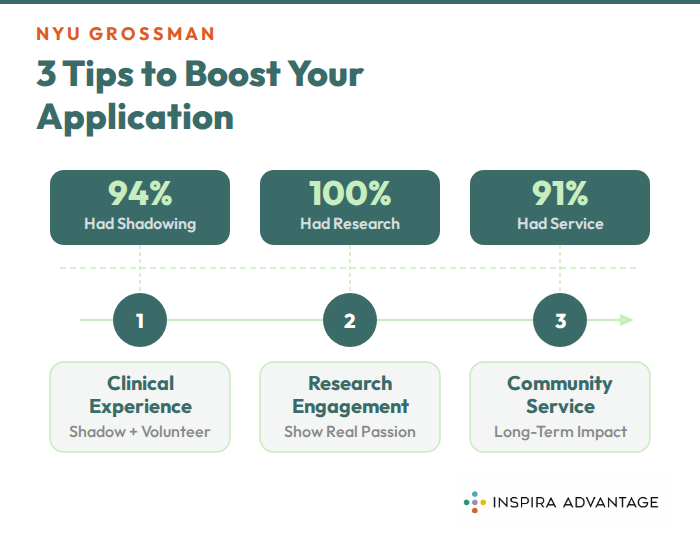
Clinical exposure is expected of all serious applicants, but at NYU Grossman, it’s nearly universal: 94% of admits had physician shadowing experience, and 93% had clinical volunteering. These numbers make it clear that clinical experience is non-negotiable, and variety, depth, and reflection matter.
Consider the inverse: only 6% of matriculants lacked physician shadowing, and 7% lacked clinical volunteering. In such a competitive pool, being part of those small percentages risks weakening your application. To stand out, aim for both clinical observation and hands-on service, then articulate how those experiences shaped your vision of the physician you hope to become.
Spending time in hospitals, clinics, or patient-facing roles helps you internalize what patient care looks like beyond the textbook. It also shows you understand the emotional and ethical complexities of medicine, which the NYU Grossman School of Medicine assesses closely through interviews and essays.
Clinical work also demonstrates readiness for the fast-paced, urban medical environment Grossman is known for. Ideally, your experience will include both observation (shadowing) and direct patient interaction (volunteering or working), allowing you to reflect on what kind of physician you hope to become.
Research experience is essential to get into NYU Grossman, as it’s a core part of their training philosophy. As reported in the MSAR, 100% of accepted students had research or lab experience, proving that meaningful engagement with research is expected. What truly matters is why you did it, what you learned, and how it connects to your future goals in medicine.
As Costner McKenzie, a dermatology resident at NYU and Inspira Advantage admissions consultant, shared in a webinar about med school application mistakes to avoid:
“Admissions committees are looking for passionate people... they want people that find things that drive them, that motivate them. That’s what will carry over into your interviews and distinguish you from other applicants.”
To demonstrate your passion, you should choose a research project that genuinely excites you. Whether it involves basic science, clinical trials, or public health, use it to show a deeper passion for a specific area in medicine, such as health equity, patient care innovation, or biomedical discovery.
You can also demonstrate that your research is not just a short-term activity but something you hope to continue at NYU Grossman School of Medicine and into your career by mentioning similar initiatives the school is involved in. Showing this kind of sustained interest signals long-term motivation and purpose, which is exactly what NYU Grossman is looking for in future physician-leaders.
As McKenzie emphasizes:
“If someone asks you, hey I see that your sophomore year you engaged in the volunteer experience at your local hospital, tell me more about that — you should be ready to launch into an explanation of what that experience was like and why it’s meaningful for you. You need to be the expert on your application. Your application is going to highlight all of the activities that you've engaged in… and you should be ready to talk about them in detail during interviews.”
This insight captures what NYU Grossman looks for: applicants who not only participate in service but also can articulate its impact and meaning. According to MSAR, 91% of recently admitted Grossman students reported community service or volunteer experience. That overwhelming statistic underscores how central service is to NYU’s admissions philosophy.
To stand out, your service should reflect personal investment and consistency. Whether it's working with youth, organizing mutual aid efforts, or advocating for public health, your commitment should demonstrate genuine care and leadership.
These experiences allow NYU Grossman’s admissions committee to evaluate not just your values but also your interpersonal skills and cultural humility. Interpersonal skills and cultural humility are key traits that physicians practicing in diverse communities like New York City should have. Highlighting these qualities in your activities and personal statements will help align your application with what NYU Grossman Medical School looks for in applicants.
NYU Grossman School of Medicine offers seven MD programs:
NYU Grossman School of Medicine awards a full-tuition scholarship to every enrolled MD student, automatically, regardless of financial need or residency status.
For the 2026-27 academic year, the scholarship covers $63,552 in tuition per student. NYU Grossman also fully subsidizes the required student health insurance plan, worth $7,026 annually, at no cost to students.
Students remain responsible for fees and living expenses, but the total out-of-pocket cost sits well below what most US medical schools require.
Here is a breakdown of the estimated 2026-27 annual costs for first-year students:
The estimated out-of-pocket cost of attending NYU Grossman over the first three years, after the full-tuition scholarship and health insurance subsidy are applied, totals approximately $94,876.
That figure breaks down to $32,396 in year one, $32,050 in year two, and $30,430 in year three. Fourth-year costs vary based on individual circumstances and are not included in the published breakdown.
With the full-tuition scholarship eliminating $63,552 per year in tuition and the health insurance subsidy removing another $7,026 annually, NYU Grossman remains one of the most affordable options among top-ranked medical schools in the country.
NYU Grossman School of Medicine provides every MD student with a full-tuition scholarship. Additionally, the school offers a need-based Debt-Free Scholarship to cover the remaining cost of attendance, such as living expenses and fees, for those who qualify. These scholarships ensure that eligible students can graduate without incurring any medical school debt.
Here are the important dates and deadlines to keep in mind when applying to NYU Grossman:
Yes, NYU Grossman School of Medicine is free. NYU Grossman offers a full-tuition scholarship to every student in its MD program. Students are responsible for living expenses and other fees, but the cost of tuition is $0.
No, you don’t need to be a New York resident to get the full-tuition scholarship. The program is open to all admitted MD students, regardless of their state or country of residence, and eligibility is based solely on admission to NYU Grossman School of Medicine.
Yes, it’s possible to get into NYU Grossman with a 3.50 GPA, but it will be challenging. NYU Grossman’s recent median GPA for admitted students was 3.99, which means a 3.50 is well below the typical range.
To be competitive, you’ll need to offset your GPA with an exceptional MCAT score. The median MCAT for admitted students is 523, so aiming for a 525 or higher would strengthen your application and show you’ve excelled academically despite a lower GPA.


Get 25+ free medical school personal statements written by our succcessful applicants free of charge. No strings attached.


.svg)

