Get in touch: +1 888 453 5021





PA school is expensive, but one thing I've noticed over the years is that most students dramatically underestimate how many scholarships are actually available to them. They assume funding is limited to a few well-known awards and stop looking after a quick Google search.
When I spoke with our PA admissions counselors, they all pointed to the same problem: students often don't know where to find scholarships or which opportunities they're actually competitive for. As a result, many leave thousands of dollars in potential funding on the table.
Below, you'll find some of the best full-ride and merit-based scholarships for PA students, along with strategies to help you find additional opportunities and improve your chances of winning them.
Here is our list of the top PA scholarships you can apply for.
Disclaimer: Official 2027 dates have not yet been released. The deadlines shown reflect 2026 dates and will be updated once the 2027 schedule is confirmed.
Find the perfect scholarship for you with guidance from our PA admissions counselors. As industry experts, they know how to secure the right scholarships.
Every cycle, I watch PA students apply to two or three big-name scholarships, write a generic essay about wanting to help people, and hope for the best. Then they're surprised when nothing comes back.
Our most successful students approach scholarships the way they approached getting into PA school. They connect their background and future goals to every scholarship that aligns with their story. With that strategy, they're no longer competing alongside thousands of other qualified applicants. They're competing for awards where their specific experience makes them one of a handful of strong fits.
Here are the best ways to increase your chances of securing scholarships for PA school.
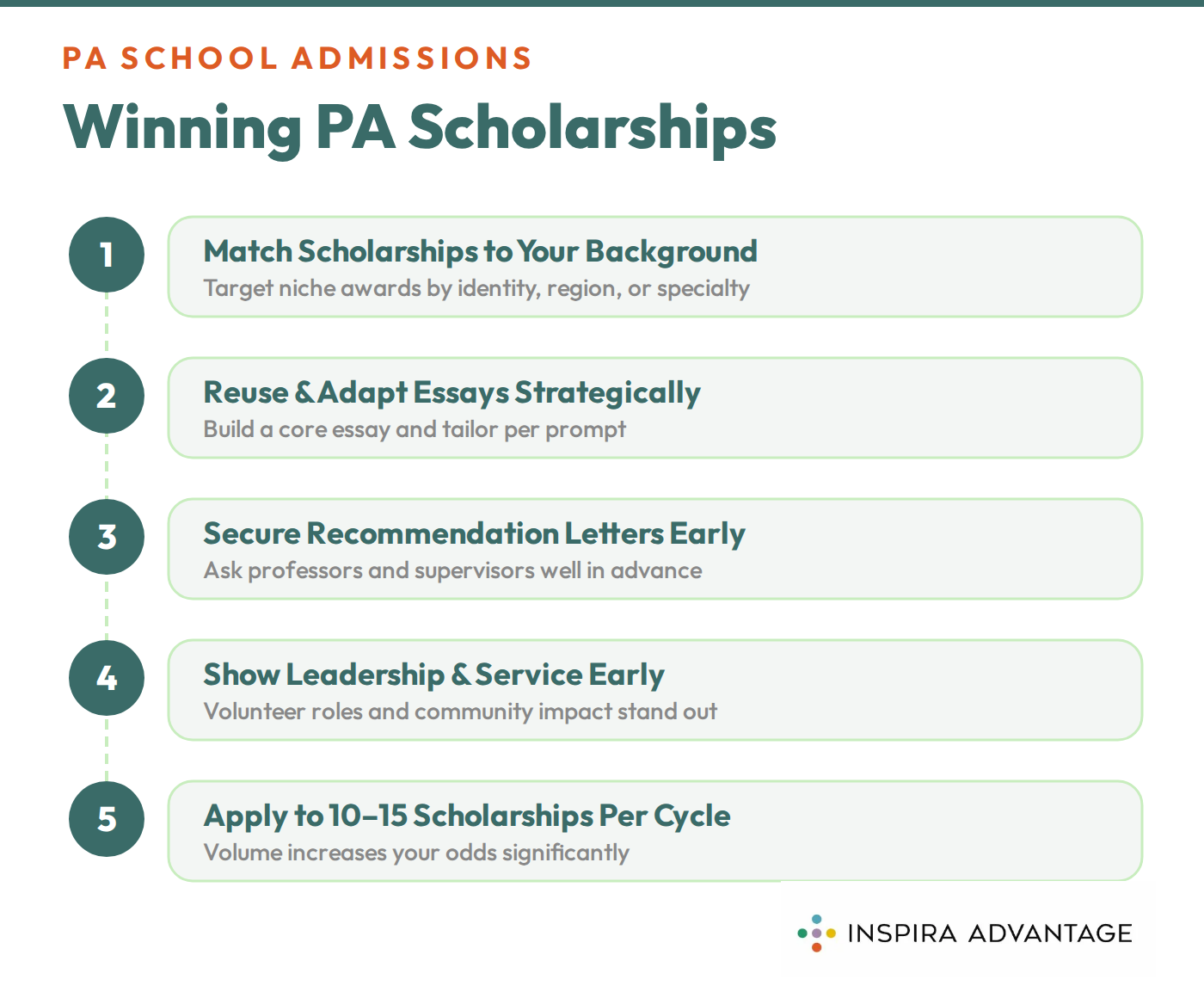
Broad national scholarships attract thousands of applicants. Niche awards attract dozens. Your odds increase dramatically when you apply to scholarships designed for people exactly like you.
For example, a veteran applying through the AAPA Veterans Caucus competes against a much smaller pool than someone applying for a general PA Foundation award. A student from a rural community targeting the AAPA Rural Health Caucus Scholarship faces fewer applicants than those chasing the $2,500 Marquardt Community Health Access Scholarship.
Students who identify as members of a historically marginalized group should consider the NCCPA Endowed Scholarship, particularly the Ruth Ballweg Memorial Scholarship.
Reflect on your own background for every possible angle, such as:
Each one provides you with different scholarship opportunities to become a PA.
Writing a new essay from scratch for every application is a waste of time. Most PA scholarship essays ask some version of the same three questions:
Write one strong "anchor essay" for each of those themes. Then customize 20-30% of the content for each scholarship.
Swap in details about the organization's mission. Reference their stated values. Mention the specific population or cause the scholarship supports.
A reviewer for a rural health scholarship needs to see your connection to rural medicine in the first paragraph. A reviewer evaluating leadership awards needs to see a concrete example of you leading something within the first few sentences.
Save every completed essay in a dedicated folder so you can swap out the words quickly when the next application opens.
Most competitive PA scholarships require at least one letter of recommendation. Some require two or three. Scrambling to find a recommender the week before a deadline results in weak, generic letters.
Find three to four people who can speak to your different strengths, such as:
Ask each person for a letter at least four weeks before the scholarship deadline. Give them a one-page summary of the scholarship along with your resume and a few bullet points about what you'd like them to highlight.
Strong recommenders need specifics from you to write specific letters. Generic asks produce generic letters that selection committees see right through.
Scholarship selection committees evaluate applicants on three criteria:
Join your state PA chapter as a student member. Volunteer at a free clinic. Organize a health screening event at your program. Serve on a committee within your PA cohort. These activities strengthen your application and give you concrete material for your essays.
Applying to at least 10 scholarships increases your odds of getting one. Smaller scholarships in the $500-$1,000 range attract fewer applicants and fill up quickly. Five awards at $1,000 each put the same amount in your pocket as one $5,000 scholarship you competed against 500 other people for.
Yes, it’s possible to get a full ride to PA school through service-commitment programs such as the National Health Service Corps Scholarship and military health professions scholarships. The NHSC covers tuition, fees, books, and a monthly living stipend in exchange for at least two years of full-time service at an approved site in a Health Professional Shortage Area. The Department of Veterans Affairs offers a similar structure that pairs full tuition with book and living stipends for students who commit to working at an underserved VA location. Navy and Air Force Health Professions Scholarship Programs also cover the full cost of tuition, fees, books, and supplies.
You should apply for PA school scholarships six to 12 months before your program starts and continue applying throughout your enrollment. Many of the largest awards require you to already hold acceptance into an accredited PA program before you can submit an application, such as the Navy Health Professions Scholarship Program and Air Force Health Professions Scholarship Program. Set calendar reminders for recurring deadlines and check your state PA academy's website quarterly for new awards.
You can receive multiple PA school scholarships at the same time as long as each award's terms allow stacking with other funding. Most PA-specific scholarships do not explicitly prohibit holding other awards, but always check individual terms before assuming you can combine them. Applying to 10 or more scholarships per cycle increases your chances of winning several smaller awards that add up to significant tuition relief.
You need a competitive GPA for most PA school scholarships, but there is no universal minimum GPA across all awards. Programs evaluate applicants on academic achievement, financial need, and leadership or service involvement, which means a lower GPA paired with strong community impact can still win over a higher GPA with a thin application. Several scholarships prioritize identity, background, or intended practice setting over grades entirely. Focus on building a well-rounded application rather than assuming your GPA alone determines your eligibility.


.svg)


