Get in touch: +1 888 453 5021




Here are the 10 cheapest PA schools in the U.S.:
We used the Centralized Application Service for Physician Assistants (CASPA) Program Directory to source the data in the table above. Tuition numbers for 2026 reflect the most recent figures published in the directory at the time of writing and are subject to change.
To create our rankings, we used the figures programs report directly to the Physician Assistant Education Association (PAEA). Here's what we factored into the ranking:
Taken together, these steps allowed us to identify the 10 lowest-cost PA programs while being transparent about how reported figures shape the rankings.
Work with an Inspira Advantage counselor to get into PA school. Our counselors help apply for the right scholarships, build a competitive PA school application, and secure admission to a top program.
PA students can expect to pay for their education in three different application periods:
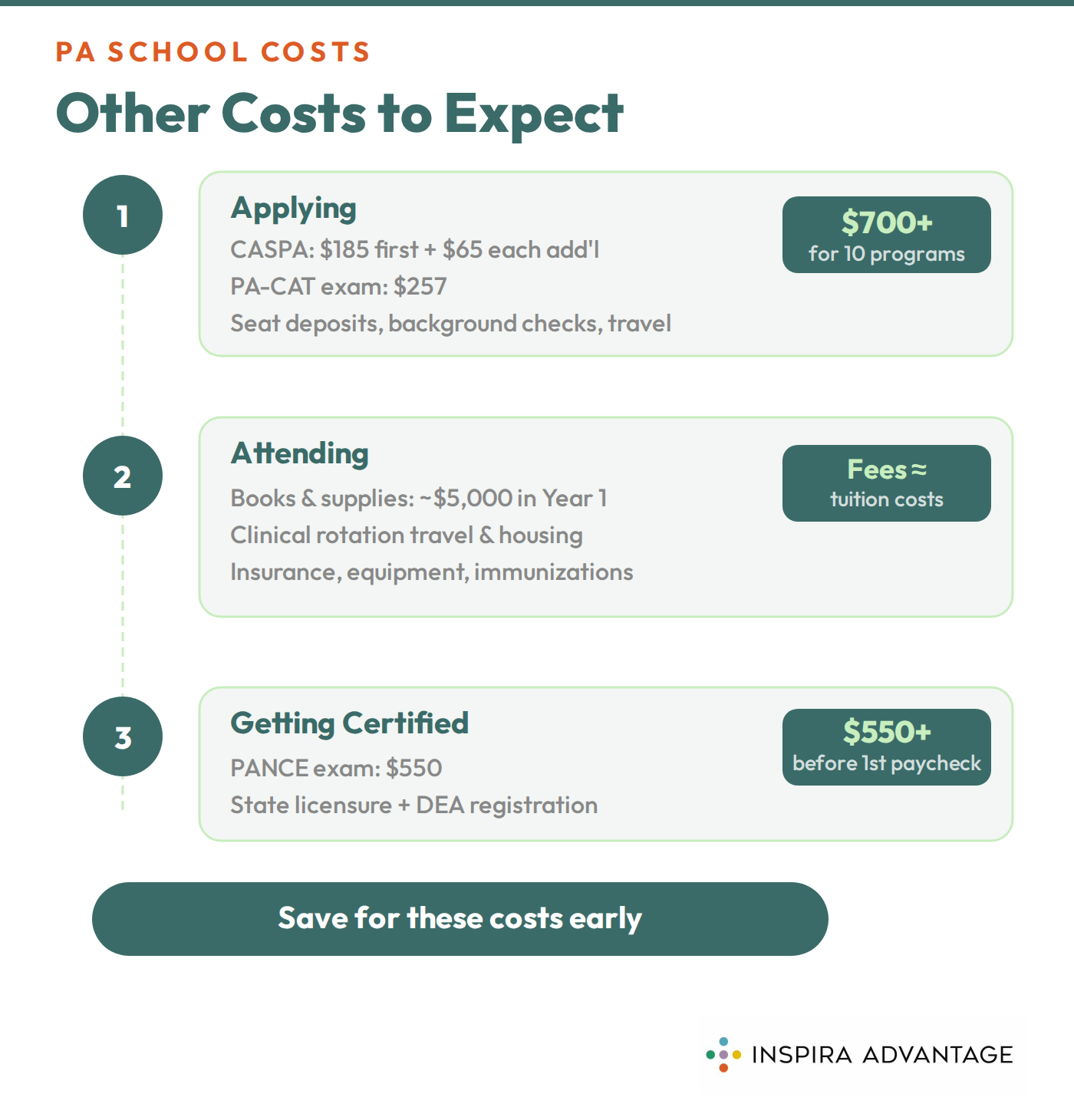
Applying alone runs from several hundred to a few thousand dollars. CASPA charges $185 for your first program and $65 for each additional one, so a 10-program list exceeds $700 before supplemental fees, the $257 PA-CAT, background checks, and a non-refundable seat deposit if you get in. Interview travel adds more unless programs interview virtually.
During the program, fees alone can amount to the same as tuition. The University of New Mexico estimates that books and supplies alone cost roughly $5,000 in your first year and holds you responsible for all expenses associated with its mandatory off-site clinical rotations.
Budget separately for health insurance, medical equipment, immunizations, and the travel or second housing those rotations far from campus demand.
After graduation, the Physician Assistant National Certifying Examination (PANCE) costs $550, and state licensure plus DEA registration add a few hundred more before your first paycheck. Save for these as early as possible so you don’t have as much debt.
Take a look at the video below for expert tips on the PA school application process:
Yes, you can attend PA school for free through PA scholarships, but every option trades tuition for a commitment of your time. Each free-tuition scholarship requires you to serve a population or an employer in return.
Out-of-state students can qualify for lower tuition rates at some programs, but not all. Regional exchange agreements, such as the Midwest Student Exchange Program, allow residents of member states to pay a discounted rate that falls between resident and full-nonresident rates. Confirm the options for each program, since some allow you to establish residency after your first year, while others charge every student the same flat rate regardless of where you live.
Public universities are usually cheaper than private PA schools, but mainly for in-state residents. State subsidies allow public programs to charge residents far less, while private schools set a flat tuition that applies to everyone. For out-of-state students, the gap narrows, and a private school's rate can sometimes beat a public school's nonresident price.
Affordable PA schools offer the same degree as expensive programs, as long as both hold ARC-PA accreditation. Every accredited program awards a master's degree and qualifies you for the same national certifying exam, the PANCE, which leads to the identical PA-C credential that all 50 states, D.C., and the U.S. territories rely on for licensure. Price reflects location, funding, and campus resources, not the value of the license you earn. So verify a program's accreditation rather than assuming cost signals quality.
Orthopaedic Surgery Resident Physician
Lewis Katz School of Medicine at Temple University


.svg)


