Key Concepts & Formulas to Memorize for the MCAT Chem/Phys Section
The Chemical and Physical Foundations of Biological Systems (Chem/Phys) section of the MCAT relies heavily on knowing equations and physical relationships. While some formulas can be derived, memorizing common high-yield concepts and equations allows you to solve passage questions quickly.
Intermolecular forces occur between molecules (London dispersion, dipole–dipole, hydrogen bonding). Intramolecular forces are bonds within a molecule (covalent, ionic, metallic) that hold atoms together.
Students should also memorize kinematics equations, which frequently appear in passage-based physics questions:
v = v₀ + at
v² = v₀² + 2aΔx
x = x₀ + v₀t
x = x₀ + v₀t + ½at²
Privacy guaranteed. No spam, ever.
Key Concepts & Skills to Master for the MCAT CARS
Unlike other MCAT sections, the Critical Analysis and Reasoning Section (CARS) does not rely on studying or memorizing scientific facts or equations. Instead, your success depends on reading comprehension, argument analysis, and identifying author perspectives.
However, you should still memorize common rhetorical and argument structures that frequently appear in passages:
Concept
What to Remember
Author’s Main Idea
Central argument or thesis of the passage
Tone Indicators
Critical, neutral, supportive, skeptical
Argument Components
Claim, evidence, counterargument
Passage Structure
Introduction → argument → examples → conclusion
Common Question Types
Main idea, inference, and function of the paragraph
Logical Fallacies and Reasoning Patterns to Understand
You should also recognize logical fallacies and reasoning patterns, such as:
Logical Reasoning Pattern Often Tested in MCAT CARS
What It Means
MCAT-Style Example
Cause vs. Correlation
An argument assumes one event caused another simply because they occur together. The relationship may exist, but the cause has not been proven.
A passage notes that the rise of social media occurred during the same period that political polarization increased. An author argues that social media, therefore, caused polarization. A CARS question may ask whether the evidence truly supports causation or merely shows a correlation.
Overgeneralization
Drawing a broad conclusion about a group or system based on limited examples.
An author describes several experimental museums that prioritize interactive exhibits and concludes that traditional museums no longer serve a meaningful educational purpose.
False Dichotomy
Presenting only two choices when other possibilities exist.
A passage argues that either universities focus exclusively on vocational training or they remain irrelevant to modern society. Another part of the passage may discuss hybrid educational models that challenge this assumption.
Appeal to Authority
Claiming an idea is valid because an expert or respected figure supports it rather than providing reasoning or evidence.
An author defending a literary theory argues that it must be correct because a famous critic from the 20th century supported the interpretation, without explaining why the theory is convincing.
Memorizing these frameworks helps you quickly identify the author’s reasoning and answer questions efficiently.
Privacy guaranteed. No spam, ever.
Key Concepts to Memorize for the MCAT Bio/Biochem Section
The Biological and Biochemical Foundations of Living Systems (Bio/Biochem) section includes many factual relationships and biological pathways that you should memorize:
Types of protein structure (primary, secondary, tertiary, quaternary)
You can also review many of these formulas and concepts through short explanations. The MCAT Bites: Breaking Down Essential MCAT Concepts playlist includes 193 short videos covering many of the high-yield topics tested on the MCAT. These bite-sized lessons make it easier to revisit concepts quickly while studying or before practice questions.
Privacy guaranteed. No spam, ever.
Key Concepts, Theories, & Definitions to Master for the MCAT Psych/Soc Section
The Psychological, Social, and Biological Foundations of Behavior (Psych/Soc) section requires the most direct memorization of terms and theories compared to other MCAT sections.
Pavlov’s dog: food (US) naturally causes salivation (UR); after pairing a bell with food, the bell becomes a conditioned stimulus (CS) that triggers salivation (CR).
Remembering a phone number briefly before dialing uses working memory, while remembering how to ride a bike relies on procedural memory.
Demographic Transition Model
Four stages of population growth: preindustrial, transitional, industrial, postindustrial
Countries moving from Stage 2 to Stage 3 often experience declining birth rates due to improved healthcare and education.
Social Stratification
Components of socioeconomic status: class, status, power; social mobility (horizontal vs vertical)
A person moving from a low-income job to a higher-paying profession demonstrates vertical social mobility.
Health Disparities
Social determinants of health: income, education, neighborhood environment, access to healthcare
Lower-income communities may have higher rates of chronic disease due to limited healthcare access and environmental factors.
Psychological Theories to Memorize
Students should also memorize major psychological theories, such as:
Psychological Theory
What It Explains
Key Levels or Stages
Simple Example
Maslow’s Hierarchy of Needs
People prioritize basic survival needs before pursuing higher psychological goals.
Physiological needs → Safety → Love and belonging → Esteem → Self-actualization
A person who lacks stable housing may focus on finding shelter and food before pursuing career goals or personal fulfillment.
Erikson’s Stages of Psychosocial Development
Social relationships and life challenges shape personality across eight stages of life. Each stage involves a key psychological conflict that must be resolved.
Examples include: Trust vs. Mistrust (infancy), Identity vs. Role Confusion (adolescence), Generativity vs. Stagnation (adulthood)
An adolescent exploring different interests and career paths while trying to figure out who they are is experiencing identity vs. role confusion.
Piaget’s Stages of Cognitive Development
Children’s thinking and reasoning abilities develop as they grow. Cognitive abilities become more complex at each stage.
A teenager who can reason about hypothetical scenarios and abstract ideas is demonstrating the formal operational stage of cognitive development.
These frameworks frequently appear in both standalone questions and passage-based scenarios.
For a full breakdown of these key concepts with comprehensive lesson plans, get help from an experienced MCAT tutor.
Privacy guaranteed. No spam, ever.
3 MCAT Memorization Tips That Improve Recall
The most effective MCAT study strategies combine memorization with reasoning. You should understand the logic behind concepts rather than memorizing definitions alone, use active recall systems that repeatedly test your memory, and rely on visual anchors to organize complex biological relationships or formulas.
Here’s a closer look at each of these memorization strategies.
Avoid Memorizing Facts Without Understanding the Logic
One of the biggest MCAT mistakes students make is trying to memorize every detail from review books. The MCAT tests application and reasoning, not just recall.
One of Inspira’s admissions experts, Dr. Jason Gomez, a former Stanford Medical School admissions committee member, explains that many students rely too heavily on memorization. In reality, the exam focuses on how well you interpret data, recognize trends, and analyze experiments rather than simply recalling facts.
“The goal is to think like a lab scientist, not a trivia savant.”
This means you should focus on understanding relationships and reasoning through problems. Instead of only recalling facts, look at how variables relate to each other and what happens when one changes.
For example, memorizing the equation for kinetic energy is useful, but you should also understand how the variables affect the result. The formula is KE = ½mv², which means velocity is squared, but mass is not. So if velocity doubles, energy increases much more than if mass doubles.
When you understand this relationship, you can still reason through the question even if the MCAT presents the concept in a graph, experiment, or unfamiliar scenario.
A useful framework is the Explain-It Rule:
Memorize the formula or definition.
Explain the concept in your own words.
Solve a practice problem using the concept.
Use Active Recall and Spaced Repetition Instead of Passive Memorization
Many students approach MCAT studying by rereading notes or highlighting textbooks. This approach may feel productive, but it rarely builds the recall you need on test day. On test day, you’ll be expected to retrieve and apply information quickly under pressure, not simply recognize it on a page.
Benji Popokh, a medical student at UT Southwestern Medical who advises pre-med students at Inspira Advantage, recommends using active recall combined with spaced repetition.
In our MCAT webinar, he suggested using flashcard software like Anki, which automatically schedules cards based on how well you remember them. Concepts you miss appear more frequently, while material you consistently recall shows up less often.
This system strengthens memory by forcing you to retrieve information repeatedly over time. For example, instead of rereading your notes on amino acids, create flashcards that test structures, properties, and classifications. Review them daily, focusing especially on cards you previously missed.
A well-designed study schedule should include daily flashcard review. A practical way to apply this is to build a flashcard loop. For example:
Review 30–50 flashcards from older material each morning
Add new cards after studying a topic like amino acids or acid-base chemistry
Revisit missed cards later the same day
Flashcards build long-term memory, but you should regularly test that knowledge in realistic conditions. Schedule full-length MCAT practice tests and passage sets throughout your study period to ensure you can retrieve and apply information under timed conditions.
Use Visual Anchors to Remember Complex Biological Systems
Some MCAT topics involve complex pathways that are difficult to memorize through text alone. Visual anchors can help your brain remember a process as a mental image instead of a list of disconnected steps.
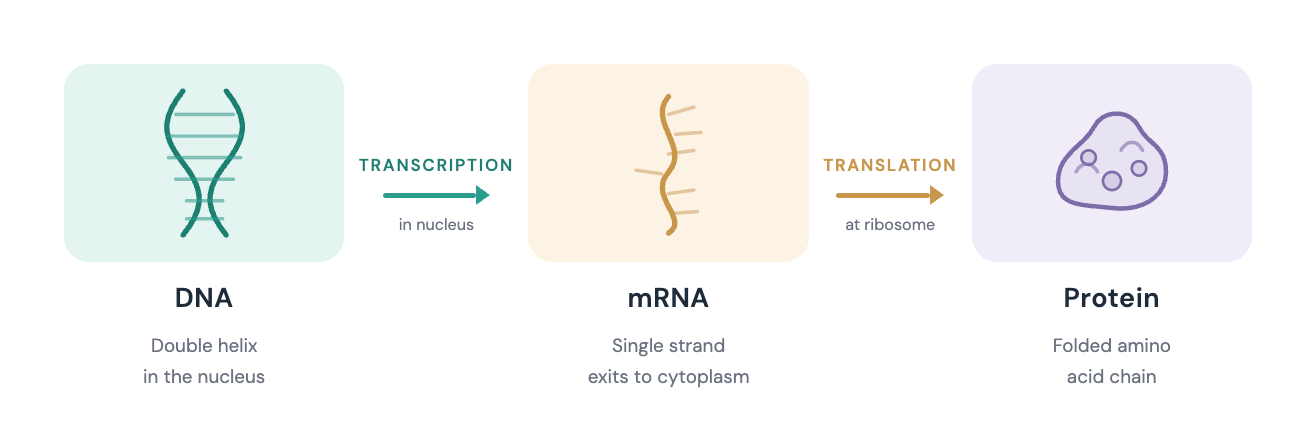
Lois Owolabi, a Harvard Medical School student and admissions counselor at Inspira Advantage, recommends building strong mental pictures for complex pathways like the central dogma.
In one of our MCAT workshops, she explained that she relies on a single diagram she can mentally reconstruct: she keeps a simple visual of DNA → RNA → protein in mind and practices redrawing it quickly when studying.
You can apply this technique with a simple framework:
Find one clear diagram of a pathway such as glycolysis or transcription
Redraw it from memory without looking at the image
Explain the steps out loud as you sketch it
For example, instead of memorizing the central dogma as separate facts, picture the flow of information: DNA is transcribed into RNA, and RNA is translated into protein. If you can redraw the process in under 30 seconds, you likely understand it well enough for MCAT passages.
Visual recall works because the MCAT often asks you to apply concepts to new situations. When you remember the system as a picture, it becomes easier to reason through unfamiliar questions.
Privacy guaranteed. No spam, ever.
FAQs: MCAT Memorization
1. What Are the Most Important Concepts to Memorize for Each MCAT Section?
The most important MCAT concepts to memorize include core formulas, biological processes, and foundational psychology and sociology terms. Focus on high-yield concepts that appear repeatedly in passages and practice questions:
Chemical and Physical Foundations (Chem/Phys): Kinetic energy and work equations, acid–base concepts, circuits, fluids, thermodynamics, and common unit relationships.
Biological and Biochemical Foundations (Bio/Biochem): Amino acids and their properties, enzyme kinetics, metabolism pathways such as glycolysis and the citric acid cycle, DNA replication, transcription, translation, and cell signaling.
Psychological, Social, and Biological Foundations (Psych/Soc): Conditioning models, major psychological theories, social identity concepts, demographic transition models, health behavior frameworks, and common sociological definitions.
Critical Analysis and Reasoning Skills (CARS): Focus on developing reading comprehension, identifying the author’s argument, analyzing evidence, and understanding logical structure.
Prioritize high-yield frameworks and relationships rather than isolated facts so you can apply them in passage-based questions.
2. Are There Areas of the MCAT That Don’t Require Memorization?
Yes, the CARS section requires almost no content memorization. Instead, you’re required to read carefully, identify the author’s argument, recognize assumptions, and evaluate evidence within the passage.
3. What Are Common Mistakes Students Make When Trying to Memorize MCAT Content?
The most common mistake students make when memorizing MCAT content is trying to memorize everything instead of focusing on high-yield concepts and relationships. Students often memorize definitions without understanding how the concept actually works to be able to apply it properly.
Another frequent mistake is relying on passive review, such as rereading textbooks or highlighting notes. These methods feel productive but don’t actually strengthen your recall.






.svg)

